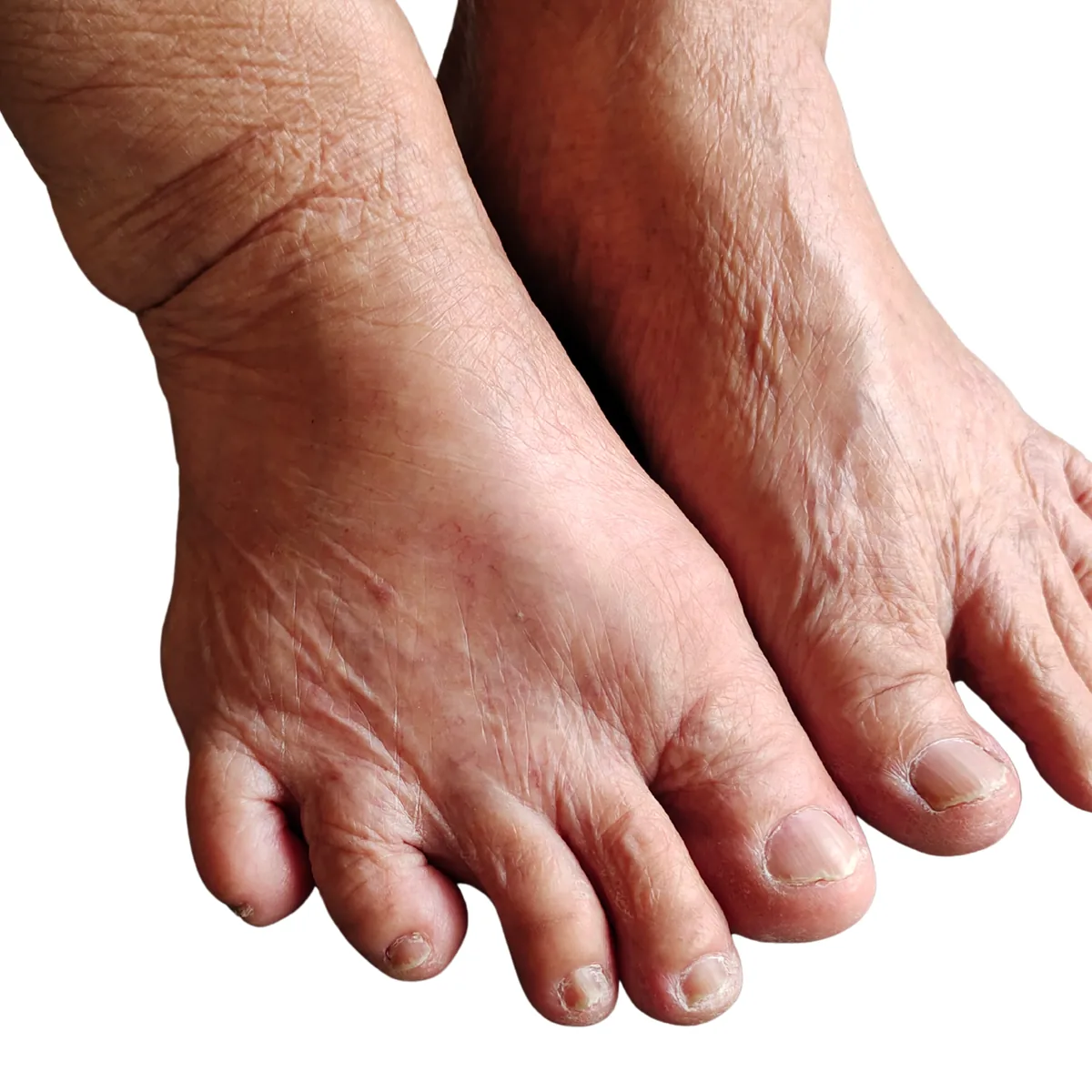
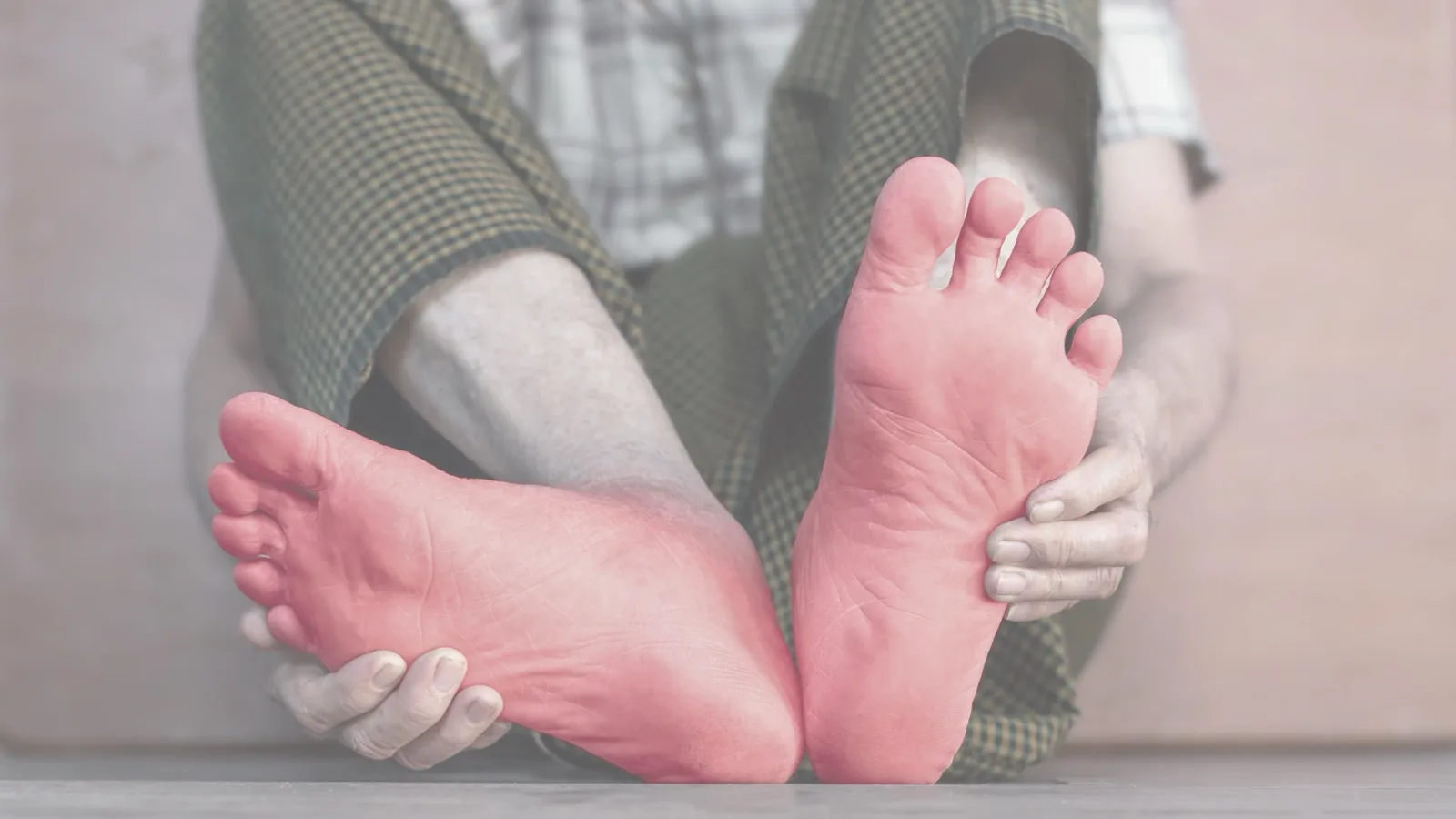
Numb feet from peripheral neuropathy change driving safety, because the pedal feedback loop depends on feeling you may no longer have. The National Institute of Neurological Disorders and Stroke lists two sensory nerve symptoms that matter here. One is not being able to feel vibration and touch, especially in the hands or feet. The other is loss of position sense.1 Both are exactly what you use to find a pedal and judge how hard you are pressing it.
Why do numb feet affect driving?
Driving is a correction loop. You press, you feel the push back, you adjust. When touch and position sense fade, the correction comes late or lands in the wrong place.
NINDS also notes that loss of position sense can leave a person unable to coordinate complex movements or keep their balance with their eyes shut.1 A footwell is a dark place where your eyes cannot help you.
Symptoms can arrive on any timescale
NINDS states that symptoms of peripheral neuropathy may develop over days, weeks or years. That depends on the type of nerve fibers affected and the type and severity of damage.1 That is why a driving call made two years ago is not a call about today.
Check again after any medicine change, any fall, any new numbness, and any near-miss you explained away. You can read how doctors describe the sensory pattern in peripheral neuropathy of the feet symptoms.
Is it dangerous to drive with neuropathy in your feet?
Does neuropathy slow your braking?
A 2017 case-control study in the Journal of Foot and Ankle Surgery measured brake response time on a computer driving simulator. It compared 25 active drivers with type 2 diabetes and lower-leg neuropathy against 25 active drivers with neither condition.2 The neuropathy group had a slower average brake response time. Abnormally delayed responses also happened more often.
Pressing the wrong pedal
A 2026 study in Transportation Research Interdisciplinary Perspectives used a driving simulation. It compared drivers with and without neuropathy affecting foot feeling and ankle position sense.3 Only the drivers with neuropathy made sudden, powerful, unsafe and unintended accelerations when braking was needed. These were cases of pedal confusion and misapplication.
The authors state that diabetic peripheral neuropathy raises the chance of pressing the wrong pedal. That puts those drivers at higher risk of a crash from unintended acceleration.3 They recommend three countermeasures: drive a manual gearbox instead of an automatic, fit an acceleration limiter, and light the footwell and pedals at night.
When should you stop driving with neuropathy?
These are the patterns to act on, not to shrug off:
Numbness that is spreading or deepening over weeks instead of staying stable.
Having to hunt for the pedal, or being unsure how far down you have pushed it.
Any episode of unintended acceleration, pedal confusion, or a near-miss you cannot explain.
New unsteadiness on uneven ground or in the dark.
A new medication that affects alertness, balance or reaction time.
If driving already feels unreliable, pause it while you get checked. Do not test the question on a public road.
What an evaluation at Regenerve looks at
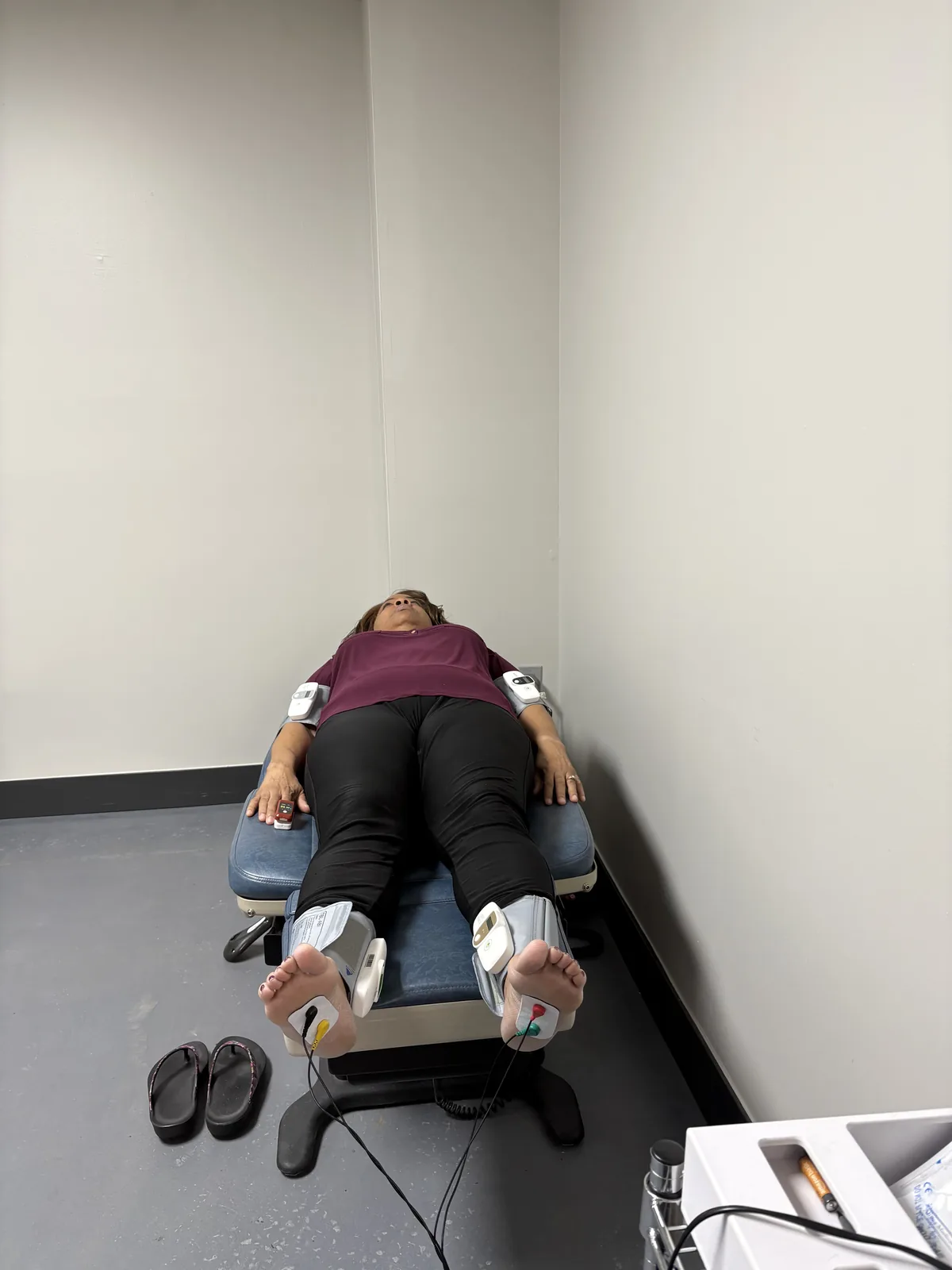
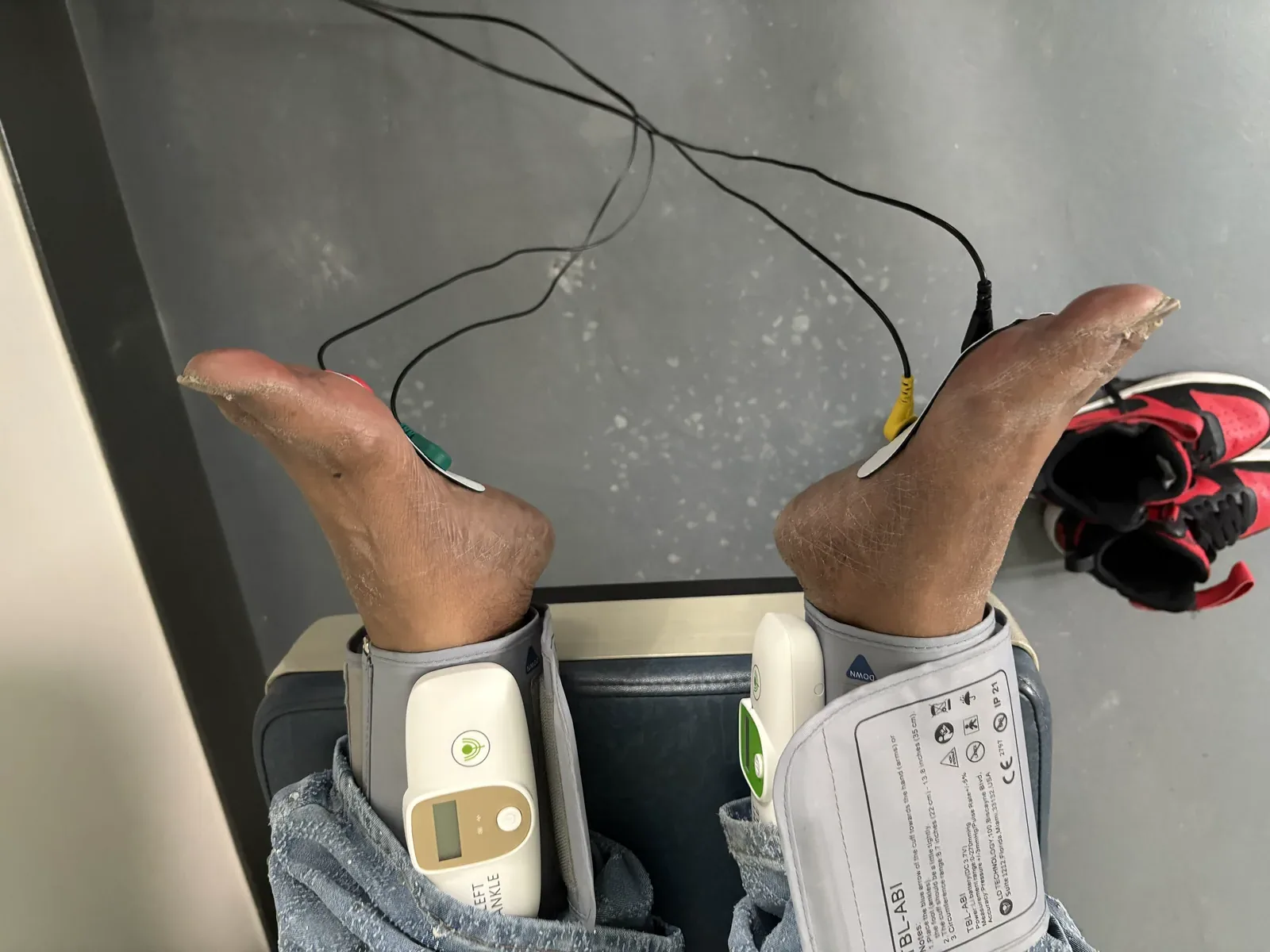
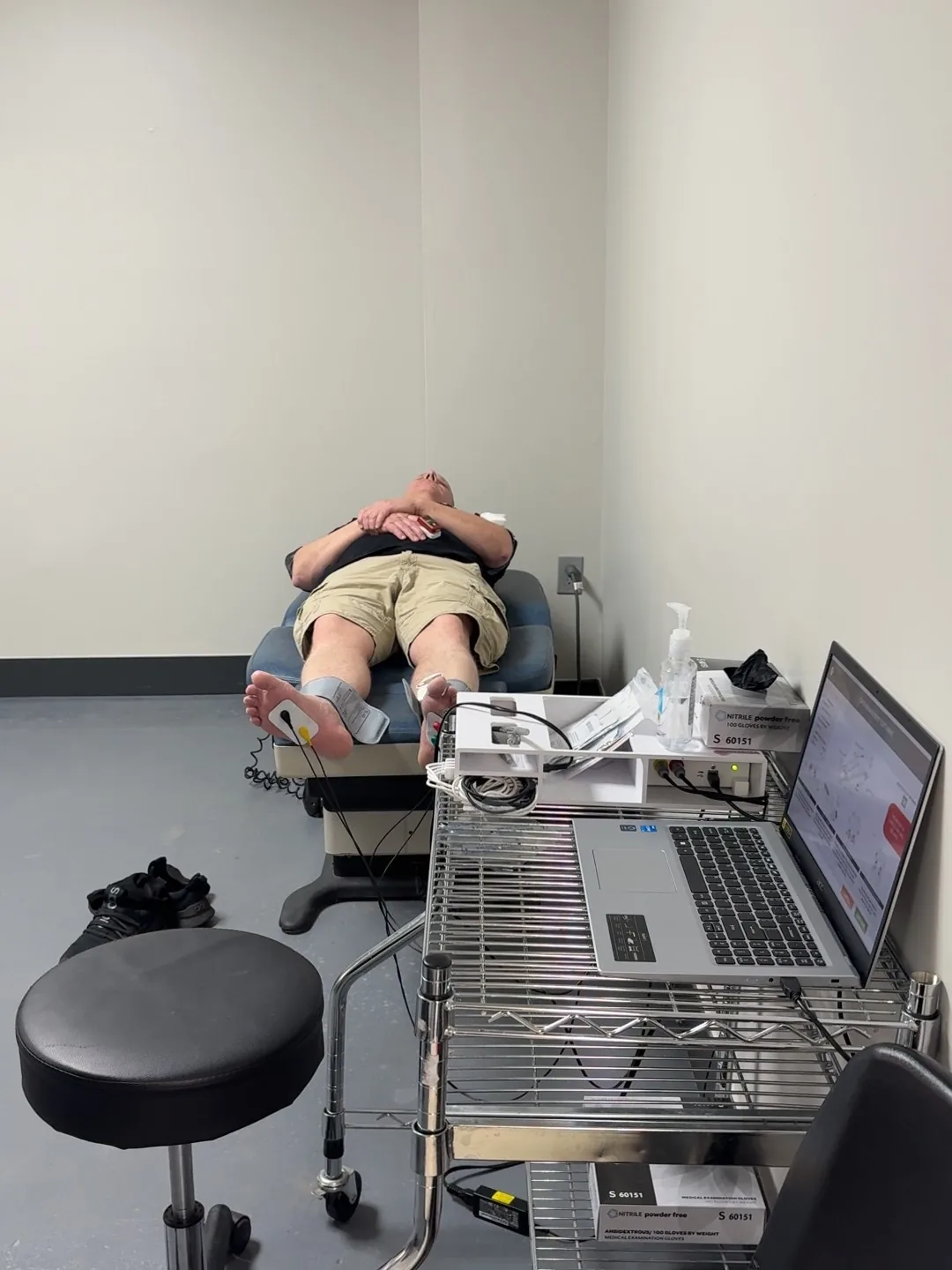
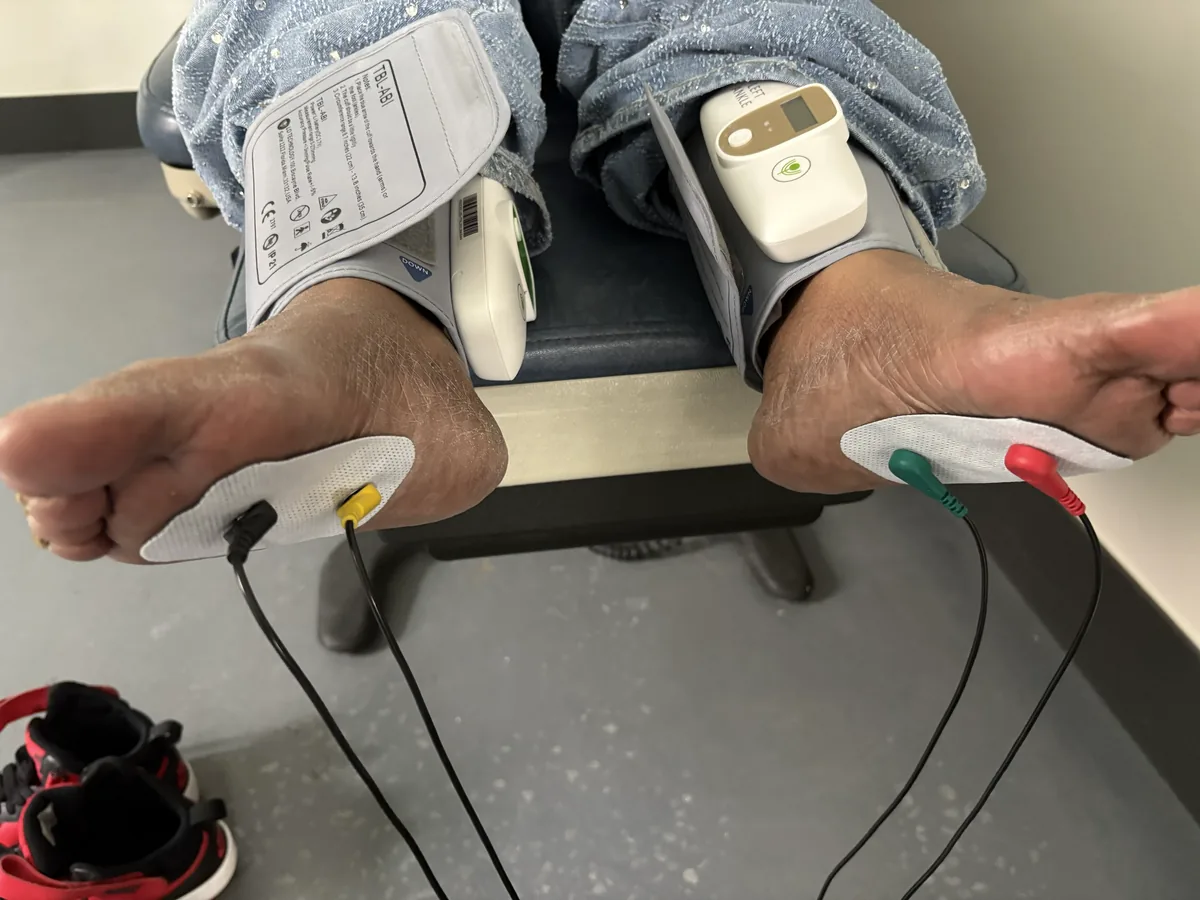
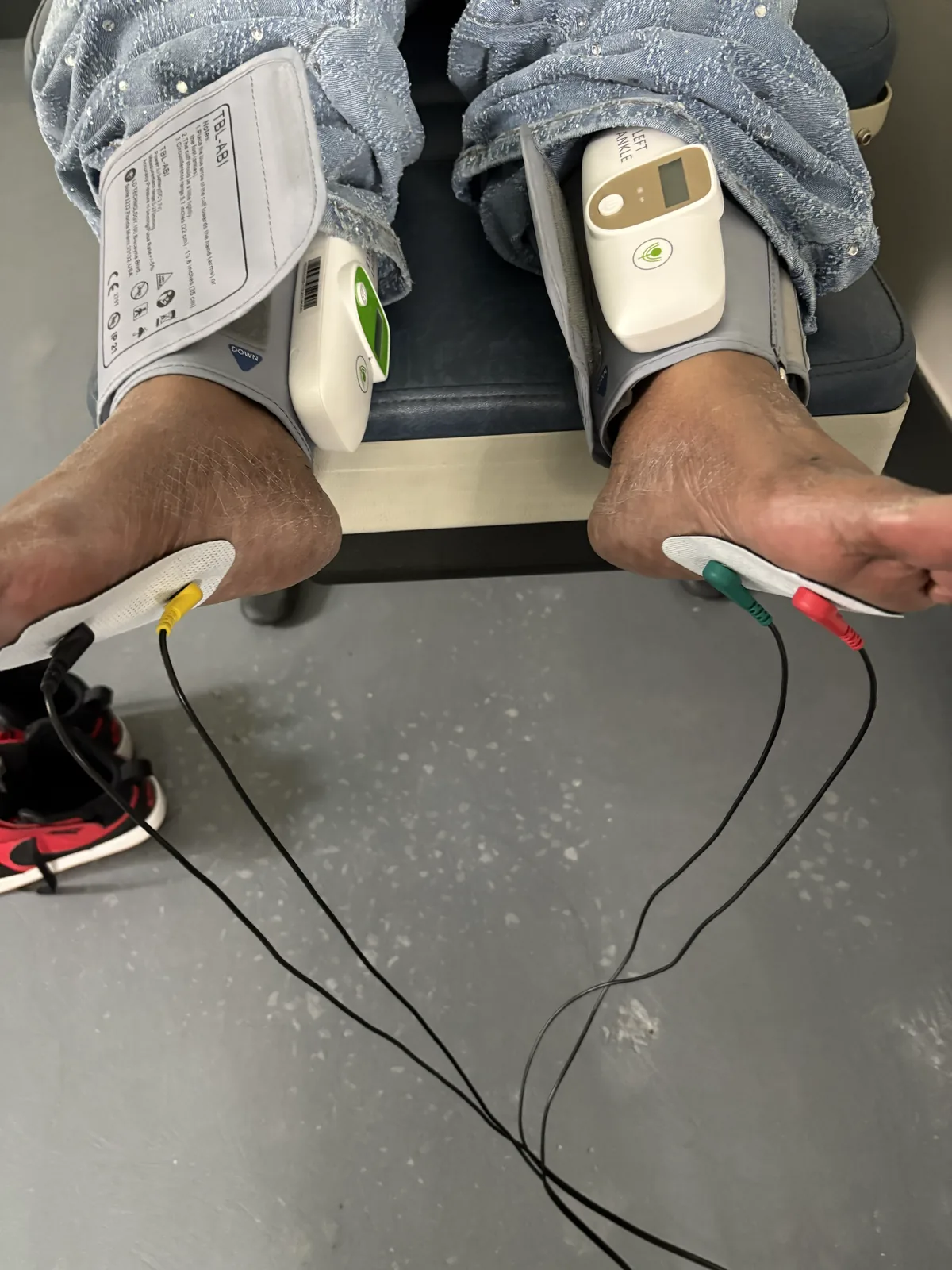
The useful question is not whether you have neuropathy. It is which cause is behind it and which specific functions have been lost. We do electrodiagnostic testing (EMG/NCS) on site. We sort between metabolic, nutritional, autoimmune, toxic and structural causes.
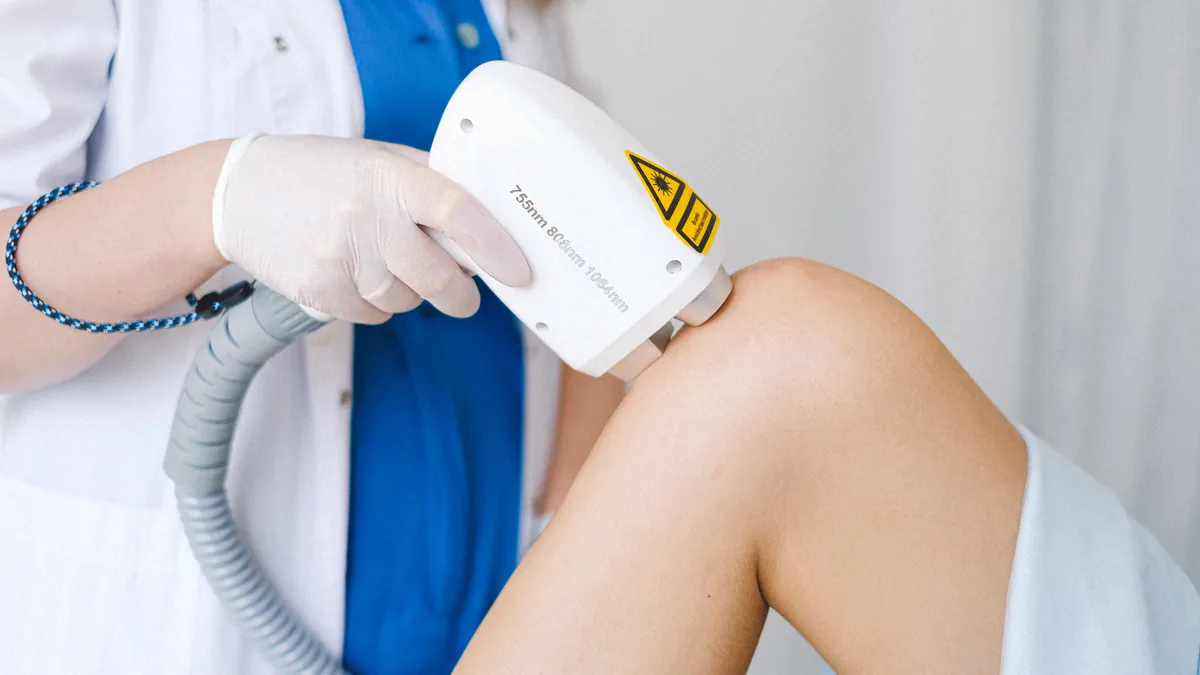
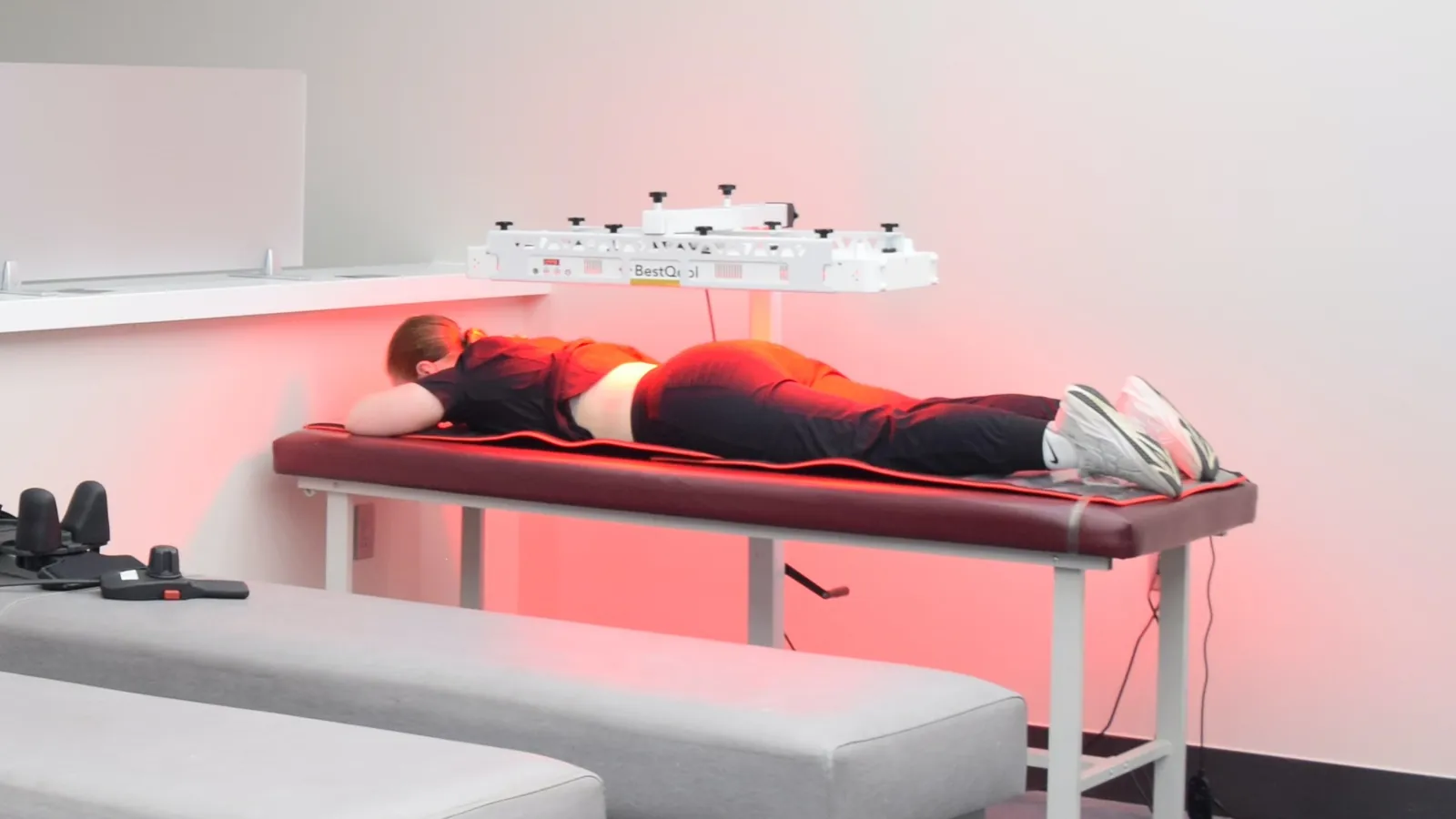
When balance is part of the picture, we use VNG as a test of inner-ear balance. VNG is a test, not a treatment. Our therapy options include class 4 photobiomodulation, class 3B cold laser and whole-body infrared.
Orthobiologic injections such as PRP and BMAC are offered in selected situations. Qutenza (capsaicin 8% patch) is FDA-approved in adults only for neuropathic pain from postherpetic neuralgia and from diabetic peripheral neuropathy of the feet. It is applied in clinic by a clinician and repeated no more often than every three months. We do not promise nerve regeneration, reversal or cure.
We see patients from the St. Louis region, Missouri and Illinois, at 4477 Woodson Rd #104, St. Louis, MO 63134. Details are on our St. Louis neuropathy treatment page.
Start with your Nerve Damage Score
If your feet have gone quiet, find out what is causing it before you decide anything about driving. The Nerve Damage Score is a free five-question screen.
Can I keep driving if my feet are numb from neuropathy?
That depends on how much feeling and position sense you have lost. It is not something to judge from a good day. NINDS lists loss of vibration and touch feeling and loss of position sense among sensory nerve symptoms. Both affect how well you place and press a pedal. See burning feet and nerve pain.
What is pedal confusion, and is neuropathy really linked to it?
Pedal confusion means pressing the gas when you meant to brake. In a 2026 driving-simulation study, only drivers with diabetic peripheral neuropathy made sudden, powerful, unsafe and unintended accelerations when braking was needed. See the hidden drivers of peripheral neuropathy.
What should I ask about before a driving decision?
Ask about your sensory exam, your position sense, your medicines, and whether a formal driver rehab evaluation fits your case. Bring the specific driving moments that feel unreliable, not a general impression. See Regenerve services and testing.
Does treating the pain make driving safer?
Not by itself. Pain relief and accurate feeling are different things. A treatment that cuts burning does not restore the pressure and position feedback a pedal needs. Qutenza, for example, is approved for nerve pain, not for restoring feeling. See Qutenza (capsaicin 8% patch).
How do you drive a car safely with neuropathy?
Start with an honest check of your feeling and position sense, not a guess from a good day. The 2026 pedal-confusion study recommended three countermeasures: drive a manual gearbox instead of an automatic, fit an acceleration limiter, and light the footwell and pedals at night. Then check again after any medicine change, any fall, any new numbness and any near-miss.
What should you not do if you have neuropathy in your feet?
Do not judge your driving from a good day. Do not explain away a near-miss or a moment of pedal confusion. Do not assume that less pain means safer feet, because pain relief does not restore the pressure and position feedback a pedal needs. And if driving already feels unreliable, do not test the question on a public road. Pause it while you get checked.
Is it harder to drive at night with numb feet?
Yes. Loss of position sense can leave a person unable to coordinate complex movements or keep their balance with their eyes shut. A footwell at night is a place where your eyes cannot help. That is why the 2026 driving study recommended lighting the footwell and pedals at night. It is also why new unsteadiness in the dark is a sign to get checked.
Meyr AJ, Spiess KE. “Diabetic Driving Studies—Part 1: Brake Response Time in Diabetic Drivers With Lower Extremity Neuropathy.” Journal of Foot and Ankle Surgery. 2017;56(3):568–572. https://pubmed.ncbi.nlm.nih.gov/28476387/
Perazzolo M, Esselaar M, Marple-Horvat DE. “Sudden, powerful, unsafe and unintended accelerations: Pedal confusion and misapplication in drivers with diabetic peripheral neuropathy.” Transportation Research Interdisciplinary Perspectives. 2026;38:102129. https://doi.org/10.1016/j.trip.2026.102129
When neuropathy has taken your protective feeling, foot ulcer prevention stops being a hygiene habit and becomes a swap. You replace the warning your nerves used to give with a daily visual check and careful control of pressure. Diabetic peripheral neuropathy occurs in up to 50% of patients with diabetes mellitus [1][4]. In that group, an injury can form well before anything hurts.
That is the whole logic of prevention here. Look, because you can no longer feel. And control the pressure and rubbing that cause the injury in the first place.
Why does neuropathy make foot ulcers more likely?
Metabolic neuropathy is length-dependent, so it reaches the longest nerve fibers first. That causes the familiar pattern that starts at the toes and moves upward. It brings burning, tingling or numbness that is often worse at night.
The result is mechanical. Every step still stresses the skin, but the alarm is weaker. So a blister or a crack has time to become a chronic wound before anyone notices. Once skin is open, bacteria have a way in. That is why prevention is really about keeping that door shut and catching any opening early [2].
How do you prevent diabetic foot ulcers every day?
Check your feet every day
Not when there is time. Do it daily, as a fixed routine, because it is doing the job that feeling used to do [3].
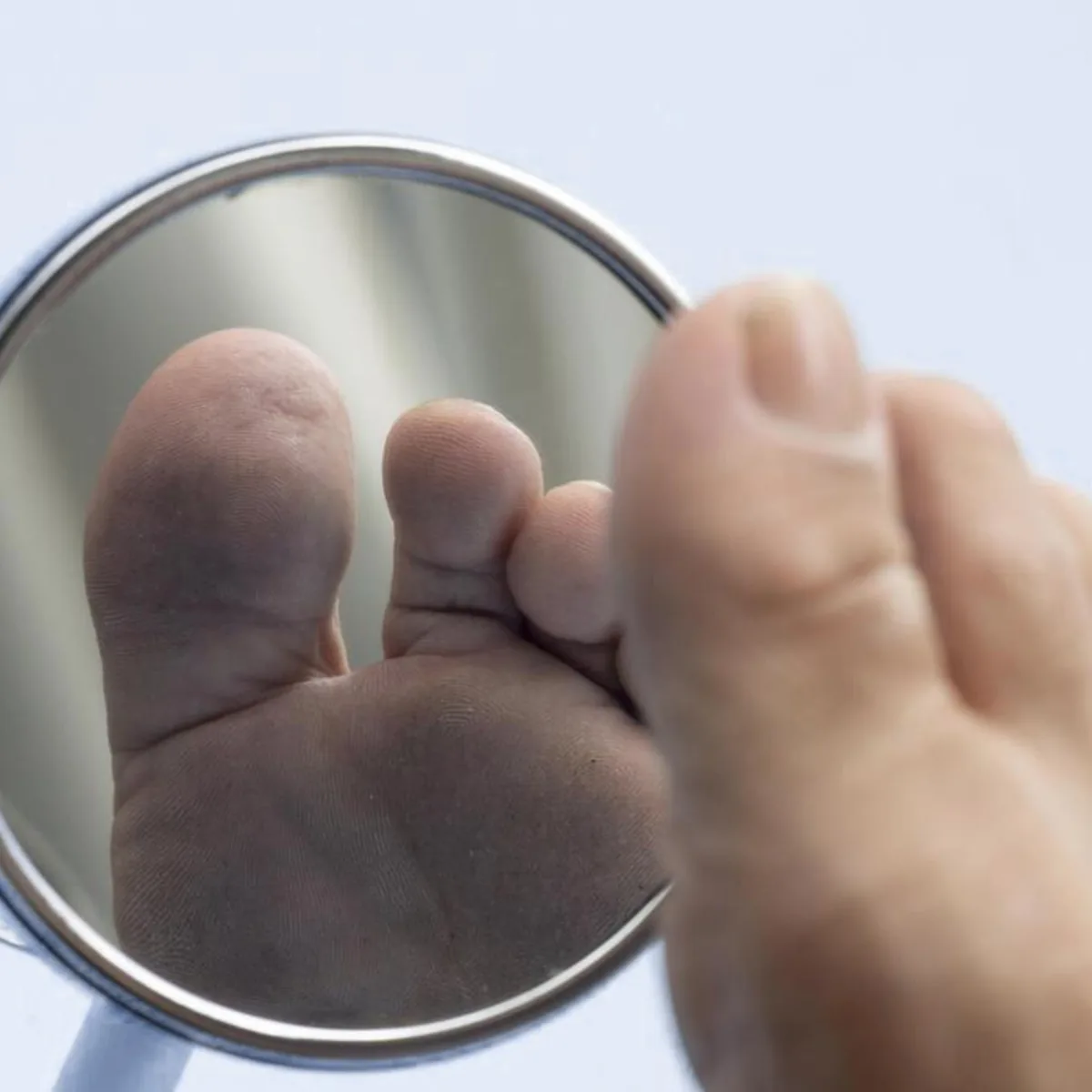
Use bright light and a mirror for the soles and between the toes.
Look for redness that does not fade, new callus, blisters, cracks, drainage or a new odor.
Note changes in writing, and photograph anything you want to compare next week.
Keep pressure and friction under control
Pressure is the part people get backward. Patients with numb feet may choose shoes half a size too small, because they need more pressure before the shoe feels like it fits. That creates the pressure points that turn into skin breakdown [5].
Buy for measured length and width, not for how snug the shoe feels.
Check inside the shoe before putting it on. A seam, a pebble or a shifted insert is enough.
Do not walk barefoot outdoors, and do not stay in wet socks.
Map the driver instead of guessing
Neuropathy is a category, not a diagnosis. Blood sugar is rarely the only thing acting on the nerve. Some causes are metabolic, some nutritional, some toxic, some autoimmune or structural. Each one responds to different levers.
That matters for prevention, because the causes decide how well tissue handles stress and how fast it repairs. If the cause is still active, the skin you are protecting has a thinner safety margin.
Testing that changes the plan
Electrodiagnostic testing, done on site, can map nerve damage when symptoms are unclear or changing. When blood flow is in question, a vascular check looks at whether poor tiny-vessel circulation is part of why healing is slow. Both are worth doing when the answer would change what you do at home.
Does exercise help prevent foot ulcers?
Exercise works on the systems that decide how much stress your feet can take. These are insulin sensitivity and sugar handling, blood fats, blood vessel function, and blood flow to the vasa nervorum, the tiny vessels that feed the nerve itself.
The program at Regenerve combines endurance work, balance and body-awareness training, strength work, and daily foot and ankle mobility. The weekly plan, and how to step it up without setting off flares, is in exercises for peripheral neuropathy in the feet.
What we do in clinic, and what it is not
Medicine that quiets the pain signal does not repair the nerve’s environment. The work in clinic aims at the terrain. That means restoring tiny-vessel blood flow so oxygen reaches the nerve, cutting the metabolic pathways that cause glycation damage, and supplying the raw materials nerves need. All of it happens under a physician’s evaluation.
Light-based therapies
Class 4 photobiomodulation and class 3B cold laser are part of neuropathy care. They go alongside the metabolic work, not in place of it. Whole-body infrared is also offered.
Orthobiologic injections at Regenerve
When orthobiologic injections are considered, the cause-focused plan stays first.
When you find something
This is where prevention is won or lost. Waiting for pain in a foot that cannot feel means waiting for the ulcer to show itself some other way.
Stop walking on it. Keep weight and pressure off the area entirely.
Clean gently. Do not scrub broken skin or apply anything abrasive.
Call your clinician the same day for evaluation, not next week.
Ulcers come back after a first one often enough that prevention has to go on after healing, not stop with it [2]. The routine is for life.
What does a daily foot check for neuropathy actually involve?
Bright light, a mirror for the soles, and a look between every toe. You are watching for redness that does not fade, new callus, blisters, cracks, drainage or a new odor. It replaces the warning that protective feeling no longer gives you. See peripheral neuropathy of the feet symptoms.
Why do people with numb feet often end up in shoes that are too small?
Because pressure is what still registers. Patients with numb feet may pick shoes half a size too small so they can feel that the shoe fits. That creates the pressure points that lead to skin breakdown [5]. Buy for measured length, not for how the shoe feels. See the hidden drivers of peripheral neuropathy.
Do I need nerve testing to prevent a foot ulcer?
No test replaces the daily check. But electrodiagnostic testing can show which fibers are involved when the pattern is unclear or changing. That in turn sharpens what you are preventing. See the neuropathy services offered at Regenerve.
What if the problem is not diabetic neuropathy at all?
It happens. Pinched-nerve problems such as carpal tunnel and sciatica can cause numbness and burning that get filed under diabetic neuropathy. And the prevention plan is different. See carpal tunnel, sciatica and double crush.
What causes diabetic foot ulcers?
Neuropathy takes away the warning. Every step still stresses the skin. But a blister or crack no longer hurts enough to notice, so it has time to become a chronic wound. Pressure makes it worse. People with numb feet often choose shoes half a size too small, because a tight shoe is the only one that feels like it fits. Once the skin opens, bacteria have a way in.
What should you never do to the feet of someone with diabetes?
Never walk barefoot outdoors or stay in wet socks. Never buy shoes by how snug they feel. Buy for measured length and width, and check inside each shoe before putting it on. Never scrub broken skin or put anything rough on it. And never wait for pain before acting on a change you can see, because a foot that cannot feel will not warn you in time.
How can I treat a foot ulcer at home?
Home care is first aid, not treatment. Stop walking on the area and keep weight and pressure off it entirely. Clean it gently without scrubbing. Call your clinician the same day, not next week. After it heals, keep up the daily foot check and pressure control for good, because ulcers often come back after a first one.
Find out what is driving it
Prevention gets easier when you know which cause is doing the damage. The free five-question Nerve Damage Score at regenerve.com/assessment is the starting point. It takes a few minutes.
Bragg S, Tucker Marrison S, Haley S, Diabetic Peripheral Neuropathy: Prevention and Treatment, American Family Physician, 2024;109(3):226–232, https://www.aafp.org/afp/2024/0300/diabetic-peripheral-neuropathy.
Parveen K, Hussain MA, Anwar S, Elagib HM, Kausar MA, Comprehensive review on diabetic foot ulcers and neuropathy: treatment, prevention and management, World Journal of Diabetes, 2025;16(3):100329, https://pmc.ncbi.nlm.nih.gov/articles/PMC11885961/.
Centers for Disease Control and Prevention, Diabetes and Your Feet, https://www.cdc.gov/diabetes/diabetes-complications/diabetes-and-your-feet.html.
University of Michigan Medical School, The Burden of Diabetic Peripheral Neuropathy, https://medresearch.umich.edu/research-news/burden-diabetic-peripheral-neuropathy.
Kowalick C, Advances in preventing and treating diabetic neuropathy, Magazines of the Schools at UT Health San Antonio, December 1, 2025, https://magazines.uthscsa.edu/schools/2025/12/01/advances-in-preventing-and-treating-diabetic-neuropathy/.
Class 3B cold laser therapy, meaning low-level laser devices in that power range, has been tested against sham treatment in peripheral neuropathy. The results are mixed, not missing. A 50-patient trial in Toronto found a trend toward pain relief that did not reach statistical significance. A 60-patient trial in Iran and a 200-patient trial in India each reported significant improvement in pain and neuropathy scores.1,2,3 No single trial has been large enough, long enough, or similar enough to the others to settle the question.
The second thing worth knowing is who was in those trials. Every one of them enrolled a narrower group of people than the patients who actually walk into a neuropathy clinic. That is the part most articles skip. And it is the part that decides whether a published number applies to you.
This page walks through each trial. It covers the device, the people studied, the exclusion rules as the papers and trial registries state them, and what the design could not measure.
What does “class 3B” mean for a cold laser?
The class is a safety label, not a dose
Laser class is a hazard rating. The federal performance standard at 21 CFR 1040.10 sets the classes. A Class IIIb laser product is one that lets people reach laser radiation, while it runs, above the accessible emission limits of table III-A but not above those of table III-B. A Class IV product goes above table III-B.4 The class describes how dangerous the beam is to an eye or to skin. It says nothing about whether the light helps a nerve.
Two devices in the same class can differ in wavelength and in whether the beam is steady or pulsed. They can differ in how large an area is treated and in how much energy actually reaches tissue. Two devices in different classes can deliver similar energy to similar depth if treatment time and area differ. Class 3B and class 4 are not two schools of therapy. They are two rungs on a safety ladder.
The numbers that matter are often missing from the papers
This is where pooling the research breaks down. A 2016 analysis in Lasers in Medical Science reviewed 74 low-level light therapy and photobiomodulation articles indexed between March 2014 and March 2015. Many left out key settings. Wavelength was missing in 3% of papers, power in 41%, beam area in 40%, irradiance in 43%, pulse frequency in 52%, and radiant energy in 74%.5 Most papers, 73%, gave no information about how light was measured and relied on the maker’s stated values. Only 5% reported a complete set of the settings assessed.
That is not a theory-only complaint. The Toronto trial reports a wavelength of 905 nm and an average power of 0 to 60 mW. But it never states a dose in joules per square centimeter.1 The Iranian trial reports an energy density of 2.5 J/cm². As printed, it also reports a wavelength of 78 nm. That figure is in the extreme ultraviolet range, which no therapeutic laser produces, and the published paper repeats it without correction.2 Neither paper states a laser class at all.
So when someone asks what the trials show for “class 3B,” the honest first answer is this. The trials mostly did not describe themselves in those terms. What they reported was wavelength and, sometimes, power and dose. Reading them means working from those numbers, not from a class label.
The sham-controlled trials that used low-level devices
Toronto, 2004: 50 patients, 905 nm, up to 60 mW
This trial was run at the Diabetic Neuropathy Research Clinic of the Toronto University Health Network between October 2000 and February 2001.1 Fifty patients with painful diabetic sensorimotor polyneuropathy took part: 34 men and 16 women, 88% of them with type 2 diabetes. All received sham therapy for a two-week run-in. They were then randomized to low-intensity laser or continued sham, twice weekly for four weeks. That is eight active sessions in total. The device was a Theralase TLC 5000 at 905 nm with an average power of 0 to 60 mW. It was applied for five minutes to two painful spots on each foot, through a five-prong head covering a 6 cm wide circle of skin.
Who was screened out. Eligible patients were adults aged 18 or older. They had polyneuropathy for at least three months, pain in both feet, and a pain score of at least 4 on the visual analog scale of the Short-Form McGill Pain Questionnaire. Pain medicines and add-on pain medicines were allowed if the regimen was unchanged. The trial excluded patients with unstable medical conditions, naming cancer and active or untreated thyroid disease as examples. It also excluded patients with other nerve diseases that would muddy the neuropathy assessment. Pregnancy, metal implants, alcohol or illicit drug use, and other severe pain that might muddy self-ratings of nerve pain were also exclusions.
What it found. Both groups improved during the sham run-in. The authors put that placebo response at roughly 20% pain reduction. After the four-week treatment, the laser group had an extra drop in weekly mean pain of 1.0 ± 0.4 points, compared with 0.0 ± 0.4 in the sham group. That did not reach statistical significance (P = 0.07). There was no effect on the Toronto Clinical Neuropathy Score, nerve conduction studies, sympathetic skin response, or quantitative sensory testing. The authors concluded that an encouraging trend was seen, but the results did not give enough evidence to recommend the treatment.
What the design could not capture. The authors said this themselves. The study ran over a short period with a fairly small number of patients. Any benefit of low-intensity laser may be limited to small nerve fibers, which are hard to assess accurately. And clearer results might have come from a larger sample and more frequent or longer treatment. They also recorded that no significant side effects occurred. There was no concern about interactions in patients on several medicines. So the treatment could be offered safely to patients with a wide range of other diseases.
Kermanshah, 2013: 60 patients, twice weekly for a month
Sixty patients with diabetic sensorimotor polyneuropathy took part at a diabetes research center in Kermanshah, Iran.2 They were matched on sex, age, body mass index, type and length of diabetes, and length of pain. Then a coin toss randomized them to laser or sham. Participants were 77.7% female, with a mean age of 56.1 years. Diabetes duration ranged from 24 to 360 months, and neuropathy duration from 4 to 96 months. Treatment was twice weekly for five minutes over one month, about eight sessions.
Who was screened out. Eligible patients were older than 18 and diagnosed with polyneuropathy for more than three months. They had pain in both feet and a visual analog score of at least 4. Patients on medicine could join if the regimen had not changed in the four weeks before the study. The trial excluded patients with cancer, patients with thyroid disease who were not taking medicine for it, and patients with nerve disorders that could get in the way of evaluation. Pregnant women, patients with metal objects in the body, and patients using alcohol or psychotropic drugs were also removed.
What it found. In the laser group, visual analog and Toronto Clinical Neuropathy scores improved significantly from baseline at both two and four weeks (P < 0.0001). The difference against sham was also significant (P < 0.0001). The sham group showed no significant change on either measure. Within the laser group, neuropathy scores at four weeks were not significantly better than at two weeks. So most of the change appeared to come early and then level off.
What the design could not capture. Follow-up ended four weeks after a one-month course. So nothing in this trial speaks to how long the effect lasts. The report gives an energy density but no power output, no treatment area, and no laser class. That makes the protocol hard to repeat or to pool with other studies.
Manipal, 2025: 200 patients, helium-neon at 632.8 nm
This is the largest of the low-level laser trials in this condition. Two hundred people with type 2 diabetes and peripheral neuropathy were randomized, 100 per arm, at a center in Manipal, India.3 The treatment arm received photobiomodulation for ten days. It used a low-level helium-neon laser at 632.8 nm and 3.1 J/cm² for nine minutes across the top and sole of the foot. The control arm received sham laser. Patients were assessed on day 0 and four weeks after treatment. The registered protocol also lists a second low-level device. It was a Thor laser at 660 and 850 nm with a power density of 50 to 150 mW/cm², applied behind the knee (popliteal fossa) and over the neck of the fibula. The published report describes the helium-neon part.6
Who was screened out. The trial registration lists inclusion as people aged 30 to 70 with type 2 diabetes and peripheral nerve pain who were willing to consent.6 It excluded patients with any other nerve disorder or other illnesses (morbid conditions). It excluded patients with another metabolic neuropathy, giving thyroid disorders as the example. It excluded pregnant women and patients having chemotherapy or radiation. And it excluded patients with diabetic peripheral neuropathy who had a foot ulcer.
What it found. Four weeks after treatment, the treatment group showed significant change in several measures, all at P < 0.001. These were serum neuron specific enolase and calcitonin gene-related peptide, the Michigan Neuropathy Screening Instrument score, vibration perception threshold, numeric pain rating, and the Norfolk quality-of-life score. Nerve growth factor did not change (P = 0.937). The authors concluded that serum neuron specific enolase and calcitonin gene-related peptide may be good markers of how well photobiomodulation reduces nerve pain and other symptoms.
What the design could not capture. Only the participants were blinded, not the assessors. That is weaker than the double-masked design used in Toronto. The exclusion list removes the two groups a neuropathy clinic sees all the time. These are people whose nerve injury has more than one cause, and people whose feet have already broken down. And ten days of treatment with a four-week check cannot say anything about a year from now.
What happens when these studies are pooled
A 2019 systematic review searched PubMed, Web of Science, CINAHL and Cochrane. It screened 627 records and included six studies, randomized and non-randomized. Its outcomes were pain score, nerve conduction velocity and quality-of-life measures.7 It concluded that the evidence obtained shows low level laser therapy has a positive effect in controlling diabetic nerve pain. Six studies of mixed design is a small and uneven base, and the review says so by reporting its own numbers.
A 2025 review in Lasers in Medical Science looked at 23 clinical and preclinical studies published between 2015 and 2025. It focused on dose.8 It reported the most consistent treatment effects at wavelengths of 630 to 670 nm and 808 to 904 nm. Those effects also came with fluences of 3 to 10 J/cm², output power between 45 and 100 mW, and protocols of at least 12 sessions. It described photobiomodulation as a promising, safe and effective add-on therapy for diabetic neuropathy. And it concluded that the lack of standard dosing across studies remains a major challenge.
Two details in that set of settings are worth pausing on. An output power of 45 to 100 mW sits inside the class 3B range, not the class 4 range. And the session count matters. The Toronto and Kermanshah trials each gave about eight sessions, and the Manipal trial ten. That is fewer than the twelve-session floor later tied to more consistent effect.
The class 4 trials, and why they are a separate question
Older adults with type 2 diabetes
The trial most often quoted in cold laser marketing used a class IV device, not a class 3B one. It was a pilot randomized, double-masked, sham-controlled study of 40 adults aged 60 and above. They had type 2 diabetes and painful diabetic peripheral neuropathy confirmed by nerve conduction velocity. They were recruited from the Department of Geriatric Medicine at AIIMS in New Delhi between April 2016 and September 2017.9 Participants were randomized 1:1 to deep tissue laser therapy or sham. Sessions were twice weekly for four weeks and then weekly for eight weeks, sixteen sessions in total. Both arms continued standard care. So the trial tested laser as an add-on to usual care, not as a replacement for it.
The device was a Class IV medical laser. It delivered a blend of 980 nm and 810 nm light in an 80:20 optical power ratio, at 2 W continuous wave, with a starting combined irradiance of 0.8 W/cm². It covered a sole area of about 120 to 200 cm². Class 3B units run at much lower output. So this trial does not tell you what a class 3B device would do.
Who was screened out. The paper excluded patients with type 1 diabetes and open wounds on the legs or feet. It excluded psychotic, mood or nerve disorders that could get in the way of the assessments. It also excluded patients with a life expectancy of less than three years and any cancer treated with chemotherapy or radiotherapy in the previous two years. Patients were recruited no matter how long they had had neuropathy, so both new and long-standing cases were included.
What it found. Pain fell in both arms, and significantly more in the active arm. On the Pain Disability Questionnaire, the active group fell 60% (P < 0.001), against 28% in sham (P < 0.01). Quality of life improved significantly in the active group (P < 0.001) but not in sham (P = 0.194). Timed Up and Go times improved in both groups, and the improvement was 16% greater in the active group. But the authors reported that the ANOVA interaction for that difference was not statistically significant (P > 0.05). That correction matters. The function result was not a positive finding, and it should not be quoted as one.
What the design could not capture. The authors listed their own limits. There was no data on how long patients had had neuropathy, and disease duration varied among participants. Some comparisons lacked statistical power. And as a pilot, it needs to be confirmed in a multicenter trial with a larger group and longer follow-up.
Chemotherapy-induced neuropathy
Two class IV trials tested a different cause. One was a randomized, double-blind, sham-controlled cross-over trial at the University of Minnesota.10 In it, 70 patients with chemotherapy-induced peripheral neuropathy got 30-minute sessions three times weekly for six weeks. They received either a class IV laser at 800 to 970 nm, 6.75 to 12 W per treatment zone, or a sham ceramic heat probe. Eligibility here was unusually broad. Any adult with self-reported peripheral neuropathy and past chemotherapy could enroll. That included patients diagnosed with neuropathy before chemotherapy and patients already on drug treatment for it, as long as they did not change therapy during the study. The single stated exclusion was active cytotoxic cancer treatment within 30 days of enrollment.
Treated patients had a mean drop in modified total neuropathy score of 6.8 points, 52.6%, at eight weeks (P < 0.001). Sham patients changed by +0.2 points, 1.5% (P = 0.44). Adding physiotherapy to the laser did not improve the result over laser alone (difference 0.1 points, P = 0.85). But the group was entirely female and 98% non-Hispanic white, because it was drawn from a gynecologic oncology clinic. Broad on other diseases, narrow on who the patients were.
The NEUROLASER pilot in Belgium took the opposite approach. It tested prevention, not treatment.11 Thirty-two breast cancer patients getting taxane chemotherapy were analyzed, after 54 were randomized. It used a class IV device at 905 and 808 nm, 0.168 W/cm² and 4 J/cm², twice weekly. The exclusions were long. They included prior neuropathy from another condition and being on a stable dose of neuropathy medicine such as duloxetine or pregabalin. They also included cancer that had spread, pausing chemotherapy for more than two cycles, missing more than two laser sessions in a row, and any cut in chemotherapy dose. Neuropathy scores rose significantly over time in both arms (P < 0.001), and the difference between arms was not significant. Still, quality of life, the six-minute walk at follow-up (P = 0.035) and pain at follow-up (P = 0.058) favored the treated group. The authors named the small sample as their main limit.
Who did the cold laser studies leave out?
Line the exclusion lists up and a pattern appears. Across these six trials, the following people were kept out of at least one, and usually several. Patients with type 1 diabetes. Patients with an open foot wound or ulcer. Patients with any other nerve disease. Patients with a second metabolic cause such as thyroid disease. Patients with cancer, or on chemotherapy or radiation, or with a life expectancy under three years. Patients with other severe pain that would muddy a pain questionnaire. Patients whose medicine regimen had changed recently. And, in the largest trial, patients over 70 or under 30, and anyone with unnamed “other morbid conditions.”
These are reasonable scientific choices. Removing competing explanations is how a trial isolates one variable. But the result is that the published numbers describe a cleaner patient than the one in the exam room. Picture a person with type 2 diabetes, insulin resistance, a thyroid disorder, a healed ulcer, a recent change in gabapentin and eight years of symptoms. That person would have been ruled out of most of this research.
The conclusion cuts both ways, and it should. A trend that missed statistical significance in 50 carefully chosen patients does not prove that low-level laser fails in patients who were screened out. And a significant result in 200 carefully chosen patients does not prove that it will help someone the trial would have excluded. What the exclusions show is that the question has not been asked in the complex patient at all.
What can the cold laser trials not tell you?
Four gaps run across the whole set.
Duration. Active treatment ran four weeks in Toronto, one month in Kermanshah, ten days in Manipal, twelve weeks in New Delhi and six weeks in Minnesota. The longest follow-up in any of them was 16 weeks. Nothing here measures how long the effect lasts at a year.
Combination and sequence. Only the New Delhi trial clearly gave laser on top of ongoing standard care. Only the Minnesota trial tested adding a second treatment, physiotherapy, and that did not improve the result over laser alone. None of them tested light inside a step-by-step program that first finds and corrects the metabolic, nutritional, autoimmune or toxic cause. A single-treatment trial cannot answer a combination question.
Outcome measures. Standard nerve conduction studies mainly test large, coated (myelinated) fibers. The Toronto authors expected no change in those tests and got none. They raised the chance that any benefit lies in small fibers that these tests do not measure well. So a trial can report a null objective result while missing the fibers that carry burning and temperature feeling.
Dose. Settings were reported unevenly, and in two of these papers incompletely or implausibly. So the trials cannot be added together into one answer about one treatment. They are several different treatments sharing a label.
Does Medicare cover laser treatment for neuropathy?
Medicare maintains national coverage determination 270.6, Infrared Therapy Devices, effective for services on and after October 24, 2006.12 It states that the use of infrared or near-infrared light or heat, including monochromatic infrared energy, is non-covered for the treatment of diabetic or non-diabetic peripheral sensory neuropathy and of wounds or ulcers of the skin or subcutaneous tissues, including pain arising from those conditions. The determination it followed was proposed in the CAG-00291N decision memorandum dated July 26, 2006.13
Two things are worth reading carefully. First, the NCD’s own description of the device category is an array of juxtaposed infrared diodes affixed to a flexible pad held in skin contact — a diode pad, not a laser. Second, a coverage determination is a payment decision made under the reasonable-and-necessary standard of the Social Security Act. It is not a clinical finding, and it does not report a trial result. Patients sign an Advance Beneficiary Notice for services a payer does not cover. Whether something is covered and whether something helps are two different questions, and a page that treats them as one is misleading its reader.
Why the driver matters more than the device
A laser cannot correct a nutrient shortage, an autoimmune process or a toxic exposure. Before adding a light-based therapy to a plan, the more useful question is which cause is damaging the nerve right now.
That is why our workup starts with finding the cause, whether metabolic, nutritional, autoimmune, toxic or structural, instead of treating “neuropathy” as one condition. You can read how we sort those apart in the hidden drivers of peripheral neuropathy.
A 2025 review of laser therapy for nerve pain searched four databases for English-language studies published between January 2000 and June 2025. It covered both low-level and high-intensity laser therapy, across conditions including postherpetic neuralgia and diabetic neuropathy.14 The breadth of that research is exactly why a single device label such as “3B” does not predict a result.
How we use class 3B cold laser at Regenerve
Regenerve offers class 3B cold laser alongside class 4 photobiomodulation and whole-body infrared. We use them as parts of a physician-directed plan. That comes after on-site electrodiagnostic testing and a metabolic workup have found what is driving the nerve injury. And it goes alongside the metabolic and nutrition work that treats that cause. We do not use light as a stand-alone treatment for nerve damage.
We do not promise nerve regeneration, reversal or cure. We do not publish a success rate for our protocol. Our full list of testing and therapy options is on the Regenerve services page.
What we tell patients before starting
The talk covers four things. First, what the published trials for your cause actually showed, including where they were negative. Second, whether you would have qualified for those trials, and if not, what that does and does not mean. Third, the safety record, which across these studies was benign. The Toronto trial reported no significant side effects and no concern about interactions in patients on several medicines. The Minnesota trial reported no complications among treated patients. And fourth, a set point at which we stop and reassess instead of going on forever.
“My ethos is to treat all of my patients as I would my own family, with the goal of giving them back their quality of life.” — Dr. Gurpreet Singh Padda, MD, MBA, MHP
We see patients from the St. Louis region, Missouri and Illinois, at 4477 Woodson Rd #104, St. Louis, MO 63134, minutes from St. Louis Lambert International Airport. Call (314) 886-5739 or text (314) 886-5902.
Start with your Nerve Damage Score
If you are weighing cold laser or any other therapy, start by finding out which cause is doing the most damage. The Nerve Damage Score is a free five-question screen that helps focus the first visit.
Does class 3B cold laser therapy work for neuropathy?
The sham-controlled evidence for low-level devices in this power range is mixed. A 50-patient trial in Toronto found a trend that missed statistical significance at P = 0.07. A 60-patient trial in Iran and a 200-patient trial in India each reported significant improvement in pain and neuropathy scores. All three enrolled selected groups. So the results describe those groups, not every patient. See peripheral neuropathy treatments for the feet.
Is cold laser the same thing as infrared therapy for neuropathy?
No. Medicare’s national coverage determination 270.6 describes infrared therapy devices as an array of infrared diodes on a flexible pad held against the skin. That device category is not covered for diabetic and non-diabetic peripheral sensory neuropathy. A laser differs in wavelength, coherence, power and delivery. And a coverage decision is a payment judgment, not a trial result. See alternative medicine approaches to peripheral neuropathy.
Should I have nerve testing before trying laser therapy?
Testing first tells you which fibers are involved. It shows whether the pattern starts in the longest nerves, sits in one spot, or involves small fibers. That changes what is worth trying. Nerve conduction studies mainly test large, coated fibers. So they can read normal when small fibers are the problem. That is also why a trial using them as an endpoint can miss an effect. See small fiber neuropathy symptoms and testing.
Does laser therapy help if my neuropathy is not diabetic?
Most of the low-level laser evidence was gathered in diabetic polyneuropathy. Two class 4 trials studied chemotherapy-induced neuropathy. One reported a large drop in neuropathy scores. The other found no significant difference from sham on its main endpoint. Autoimmune, nutritional and toxic causes have not been tested this way, and the plan should still target the cause doing the damage. See diabetic peripheral neuropathy treatment in St. Louis.
What are the drawbacks of laser therapy for neuropathy?
The main drawbacks are gaps in the evidence, not harm. The longest follow-up in these trials was 16 weeks, so nobody knows how long a benefit lasts. Doses were reported so unevenly that the trials cannot be added together. And most of them screened out complex patients. Light also cannot correct the nutrition, autoimmune or toxic cause that is damaging the nerve.
How many laser sessions does neuropathy treatment take?
The published trials used fewer sessions than you might expect. The Toronto and Kermanshah trials each gave about eight. The Manipal trial treated for ten days, and the New Delhi class 4 trial used sixteen. A 2025 dosing review tied more consistent effects to protocols of at least twelve sessions. At Regenerve we set a point to stop and reassess instead of going on forever.
Is cold laser therapy safe for neuropathy?
Across these studies the safety record was benign. The Toronto trial reported no significant side effects and no concern about interactions in patients taking several medicines. The Minnesota trial reported no complications among treated patients. Laser class is a hazard label for the eyes and skin, not a dose. We use cold laser as one part of a physician-directed plan, never on its own.
Sources
Zinman LH, Ngo M, Ng ET, Nwe KT, Gogov S, Bril V. “Low-intensity laser therapy for painful symptoms of diabetic sensorimotor polyneuropathy: a controlled trial.” Diabetes Care. 2004;27(4):921–924. https://doi.org/10.2337/diacare.27.4.921
Bashiri H. “Evaluation of low level laser therapy in reducing diabetic polyneuropathy related pain and sensorimotor disorders.” Acta Medica Iranica. 2013;51(8):543–547. https://acta.tums.ac.ir/index.php/acta/article/view/4395
Anju M, Ummer Velladath S, Arun Maiya G, Hande M. “A single blinded randomized controlled trial assessing the effect of photobiomodulation therapy on neuron specific biomarkers in type II diabetes mellitus patients with peripheral neuropathy.” Diabetes Research and Clinical Practice. 2025;222:112087. https://doi.org/10.1016/j.diabres.2025.112087
Hadis MA, Zainal SA, Holder MJ, Carroll JD, Cooper PR, Milward MR, Palin WM. “The dark art of light measurement: accurate radiometry for low-level light therapy.” Lasers in Medical Science. 2016;31(4):789–809. https://pmc.ncbi.nlm.nih.gov/articles/PMC4851696/
Clinical Trials Registry – India. “Effect of Low Level Laser Therapy on Neuropathic Pain Specific Markers in Diabetic Peripheral Neuropathy — A Single Blinded Randomised Control Trial.” CTRI/2018/04/013540, registered April 27, 2018. WHO International Clinical Trials Registry Platform record. https://trialsearch.who.int/Trial2.aspx?TrialID=CTRI/2018/04/013540
Anju M, Saleena Ummer V, Arun G Maiya, Manjunath Hande. “Low level laser therapy for the patients with painful diabetic peripheral neuropathy — A systematic review.” Diabetes & Metabolic Syndrome. 2019;13(4):2667–2670. https://doi.org/10.1016/j.dsx.2019.07.035
de Souza V, da Palma Cruz M, Chaves Bittencourt C, et al. “Dosimetric parameters and clinical outcomes of photobiomodulation in diabetic neuropathy: a concise review.” Lasers in Medical Science. 2025;40:436. https://doi.org/10.1007/s10103-025-04701-7
Chatterjee P, Srivastava AK, Kumar DA, Chakrawarty A, Khan MA, Ambashtha AK, Kumar V, De Taboada L, Dey AB. “Effect of deep tissue laser therapy treatment on peripheral neuropathic pain in older adults with type 2 diabetes: a pilot randomized clinical trial.” BMC Geriatrics. 2019;19:218. https://pmc.ncbi.nlm.nih.gov/articles/PMC6689877/
Argenta PA, Ballman KV, Geller MA, Carson LF, Ghebre R, Mullany SA, Teoh DGK, Winterhoff BJN, Rivard CL, Erickson BK. “The effect of photobiomodulation on chemotherapy-induced peripheral neuropathy: A randomized, sham-controlled clinical trial.” Gynecologic Oncology. 2017;144(1):159–166. https://doi.org/10.1016/j.ygyno.2016.11.013
Lodewijckx J, Robijns J, Claes M, et al. “The use of photobiomodulation therapy for the prevention of chemotherapy-induced peripheral neuropathy: a randomized, placebo-controlled pilot trial (NEUROLASER trial).” Supportive Care in Cancer. 2022;30(6):5509–5517. https://pmc.ncbi.nlm.nih.gov/articles/PMC8935622/
Uremic neuropathy is nerve injury that develops with advanced kidney disease. Its most important feature is how often it is there before it is obvious. A Tunisian cohort study looked at 31 children with stage G5 chronic kidney disease. Nerve conduction testing found uremic neuropathy in 45% of them. That included 13% who had silent neuropathy with no symptoms.3 Adults show the same gap. In 200 patients with predialysis CKD studied in India, prevalence was 45% based on symptoms and 90% on electrophysiological testing.1
That gap between what patients feel and what testing finds is the practical case for looking early. Do not wait for symptoms to become convincing.
Key takeaways
Symptoms lag behind nerve dysfunction. Silent neuropathy is well known in advanced CKD.3
Severity tracks with kidney function. In one adult cohort, prevalence rose from 55% in Stage 3 to 84.8% in Stage 5.2
Uremia is a driver, not the only driver. Nutrition, medicine, autoimmune and structural causes can overlap.
Testing separates fiber types. We do electrodiagnostic testing on site. It tells large-fiber patterns apart from what small fibers are doing.
No regeneration or cure is promised. The goals are less ongoing injury, better function and safer walking.
What is uremic neuropathy?
Uremic neuropathy means nerve injury that happens alongside advanced kidney disease. Patients describe burning, numbness, electric-shock feelings or less feeling. It usually starts in the feet and usually on both sides.
Those descriptions alone do not show which nerve fibers are involved or what is causing the injury. In the Tunisian cohort of children, axonal neuropathy (damage to the nerve fiber itself) was the main pattern. No demyelinating cases (damage to the nerve’s coating) were found.3
Small fiber and large fiber involvement look different
Small fiber damage tends to cause burning, hot-coal feelings and pain at night. Large fiber damage tends toward numbness, less vibration sense and weaker protective feeling. That is what affects balance and safe walking.
This matters because it changes what we watch and what counts as a real change over time.
What else can cause neuropathy in kidney disease?
When kidney disease is advanced, it is easy to stop looking there. But a nerve can be under pressure from several sides at once. The causes that can actually be cut back are often not the kidney disease itself.
The overlaps that most often matter
Diabetes. Many patients with CKD also have diabetes. Diabetic nerve injury can worsen or mimic uremic nerve injury.
Nutritional deficiency. Diet limits, poor absorption and medicine effects all raise the risk in this group.
Medications. The medicine list deserves as much attention as the kidney stage.
Toxic and environmental exposures, including alcohol.
Autoimmune processes and structural compression, which can add a second, separate weak point.
Finding which of these is adding to the damage is what turns a diagnosis into a plan. Our overview of the hidden drivers of peripheral neuropathy covers the ones most often left unchecked.
How is uremic neuropathy diagnosed?
The workup answers two separate questions. Which nerves are affected? And what is affecting them? Testing answers the first. History, the exam and a metabolic review answer the second.
What it includes
Electrodiagnostic testing (EMG and nerve conduction studies), performed on site
Metabolic and nutritional review, aimed at causes that can be fixed
VNG balance testing when balance is affected. VNG is a test of inner-ear balance, not a treatment.
What testing does not settle
A nerve conduction study describes the injury. It does not name the cause. And a study that reads close to normal does not rule out small fiber damage. That is why we read the result alongside the rest of the workup, not on its own.
How is uremic neuropathy treated?
Surgery is not part of the treatment plan for uremic neuropathy. Care focuses on the workup, mapping the damage and non-surgical treatment. The aim is to cut ongoing nerve injury and support function.
The therapies used
Class 4 photobiomodulation and class 3B cold laser, chosen when the symptom pattern and workup support them
Whole-body infrared, used as part of the overall plan
Metabolic and nutritional care, when we have found a cause that can be fixed
Kidney disease adds a limit we respect the whole way through. In this group, nutrition and metabolic changes are made together with the kidney team, not on their own.
Orthobiologic injections
Orthobiologic injections (PRP and BMAC) are offered in selected situations.
What we do not promise
We do not promise nerve regeneration, reversal or a cure. Nerve injury may have built up over years of advanced kidney disease. If so, the honest goals are less ongoing injury, better day-to-day function and safer walking.
Qutenza in this setting
Qutenza (capsaicin 8% patch) is indicated in adults for neuropathic pain associated with postherpetic neuralgia and for neuropathic pain associated with diabetic peripheral neuropathy of the feet.4
Where it is used, it is applied in clinic by a clinician, never dispensed for home use, and repeated no more often than every three months. More detail is on our page about the Qutenza capsaicin 8% patch.
Practical steps while you are being evaluated
Check both feet daily if feeling is dulled. Use a mirror for the soles.
Look for skin breakdown, calluses and pressure spots, and act on them early.
Bring a current, complete medicine list to every visit.
Report new weakness, new falls or a fast change right away. Do not wait for the next scheduled visit.
Regenerve in the St. Louis region
Regenerve treats peripheral neuropathy for patients across the St. Louis region, Missouri and Illinois, including Edwardsville, Glen Carbon, Collinsville, Troy and Maryville. The clinic is at 4477 Woodson Rd #104, St. Louis, MO 63134, minutes from St. Louis Lambert International Airport. Call (314) 886-5739 or text (314) 886-5902, or email info@regenerve.com.
Your next step
If you have kidney disease and nerve symptoms, take the free five-question Nerve Damage Score. It shows which group of causes most likely applies to you. Your answers guide what we check first.
How often does neuropathy occur in chronic kidney disease?
It depends a lot on whether you count symptoms or nerve testing. One Indian hospital study looked at 200 adults with predialysis CKD. Prevalence was 45% based on symptoms and 90% on electrophysiological testing.1 Part of that gap is small-fiber injury that routine testing under-counts. See small fiber neuropathy symptoms and testing.
Does it get worse as kidney function declines?
That is the pattern reported. A cross-sectional study looked at 105 adults with CKD in Amritsar. Neuropathy prevalence rose from 55% in Stage 3 to 84.8% in Stage 5.2 Our workup, including on-site electrodiagnostic testing, is on the neuropathy services page.
Why do my feet burn at night if the problem is my kidneys?
Burning at night usually points to small-fiber damage. Small fibers can be affected while routine nerve conduction testing still looks close to normal. See burning feet and nerve pain.
Could something other than my kidney disease be causing this?
Often, yes. A nutrient shortage is one of the most common added causes in this group, and it can be fixed once it is found. See functional B12 deficiency and neuropathy.
What are the symptoms of uremic neuropathy?
People describe burning, numbness, electric-shock feelings or less feeling. It usually starts in the feet and usually on both sides. Burning and pain at night point to small nerve fibers. Numbness, less vibration sense and weaker protective feeling point to large fibers, and that is what affects balance. Many people show nerve changes on testing before they notice any symptoms at all.3
Can kidney disease cause tingling in the feet?
Yes. Nerve injury from advanced kidney disease usually starts in the feet, on both sides. It is also often there before it is felt. One study looked at 200 adults with predialysis CKD. By symptoms, 45% had neuropathy. But 90% showed it on nerve testing.1 Diabetes, low nutrients and medicines often overlap in this group. So tingling deserves a full search for every cause.
Is there a test for uremic neuropathy?
Yes. EMG and nerve conduction studies, done on site, show which nerves are affected. They often find neuropathy before symptoms do. In one cohort of children with stage G5 CKD, testing found neuropathy in 45%, including 13% with no symptoms.3 A near-normal study does not rule out small fiber injury and does not name the cause. So we read results alongside your history, exam and metabolic review.
Can uremic neuropathy be reversed?
We do not promise nerve regeneration, reversal or a cure. When nerve injury has built up over years of advanced kidney disease, the honest goals are less ongoing injury, better day-to-day function and safer walking. That is why the workup hunts for causes that can still be fixed, such as a nutrient shortage. It is also why any nutrition or metabolic change is planned with your kidney team.
Sources
Jasti DB, Mallipeddi S, Apparao A, Vengamma B, Sivakumar V, Kolli S, “A Clinical and Electrophysiological Study of Peripheral Neuropathies in Predialysis Chronic Kidney Disease Patients and Relation of Severity of Peripheral Neuropathy with Degree of Renal Failure,” Journal of Neurosciences in Rural Practice, 2017;8(4):516-524, doi:10.4103/jnrp.jnrp_186_17, https://ruralneuropractice.com/a-clinical-and-electrophysiological-study-of-peripheral-neuropathies-in-predialysis-chronic-kidney-disease-patients-and-relation-of-severity-of-peripheral-neuropathy-with-degree-of-renal-failure/
Singh P, et al., “Electrophysiological Characterization and Stage-Dependent Progression of Uremic Neuropathy in Chronic Kidney Disease,” Annals of Medicine and Medical Sciences, published May 21, 2026, Vol. 05 (2026), pages 707-711, https://ammspub.com/index.php/amms/article/view/579
Yahyaoui A, Gammoudi N, Nouir S, Mabrouk S, Ghali H, Abroug S, Sakly G, “Prevalence of uremic neuropathy and the effect of dialysis in children with end-stage renal disease: A cohort study,” PLOS One, November 25, 2025, doi:10.1371/journal.pone.0337696, https://journals.plos.org/plosone/article?id=10.1371/journal.pone.0337696
U.S. Food and Drug Administration, “QUTENZA (capsaicin) 8% topical system — prescribing information,” label effective July 7, 2026, via DailyMed, https://dailymed.nlm.nih.gov/dailymed/drugInfo.cfm?setid=3ffbbcb0-ad93-4f15-bb38-5da76a71c735
Chemotherapy-induced peripheral neuropathy is nerve injury caused by cancer drugs that harm nerves. It is common. About 30 to 40% of patients treated with nerve-toxic chemotherapy will develop CIPN, and how bad it gets varies a lot from person to person.1 It mostly affects feeling and often comes with pain. It can cause long-term problems.1 That is why care has to look at more than the pain score.
The real question is not whether you have neuropathy. It is which causes are adding to it in your case, and which of them can still be cut back.
Key takeaways
CIPN is usually sensory-predominant. Burning, numbness and electric feelings are more typical than weakness.1
The chemotherapy is rarely the only factor. Nutrition and metabolic weak spots can sit underneath it.
Testing narrows the question. We do electrodiagnostic testing (EMG and nerve conduction studies) on site.
Symptom control is not nerve repair. Medicine that turns down the signal has a role, but it is not the whole plan.
Nothing here is promised as regeneration or cure. The goals are fewer misfires, better function and safer walking.
What causes chemotherapy-induced peripheral neuropathy?
Nerve-toxic chemotherapy drugs can injure nerve fibers directly. The damage usually shows up far from the center of the body and hits feeling first. The feet and hands go first, and feeling goes before strength.1 That is the main cause, and it is the one people already know about.
What gets less attention is the terrain the injury lands on. Nerve fibers depend on working tiny blood vessels and on enough nutrients. When either is weak before treatment starts, the same dose of the same drug lands on a weaker nerve.
Where the overlapping contributors show up
Metabolic stress, such as insulin resistance or diabetes that was never diagnosed
Nutritional deficiency, such as B12 deficiency and functional B12 deficiency
Reduced microvascular perfusion, meaning less blood flow in the small vessels that feed nerve tissue
Pre-existing neuropathy from a cause that was never found
None of these replaces the chemotherapy as the trigger. They change how much injury a given dose causes, and how much room there is to recover afterward. Our overview of the hidden drivers of peripheral neuropathy covers the ones that most often go unchecked.
How is chemo-induced neuropathy diagnosed?
The workup has one job: turn “I have neuropathy” into a clear picture of which fibers are hurt and what else is adding to it. Without that, treatment aims at a category instead of a cause.
What the evaluation includes
Electrodiagnostic testing (EMG and nerve conduction studies), done on site, to map large-fiber damage and where it is
Metabolic and nutritional review, to find problems that can be fixed
VNG balance testing when balance is affected. VNG is a test of inner-ear balance, not a treatment.
Why the exam matters as much as the test
Small nerve fibers carry burning, temperature and pins-and-needles feelings. They can be badly injured while routine nerve conduction testing still reads close to normal. A normal study does not mean nothing is wrong. It means the test looked at the fibers it was built to look at.
How is chemotherapy-induced neuropathy treated?
CIPN care works in layers, because the nerve is under pressure from more than one side at once. Each layer has a clear job. None of them is the whole answer.
Symptom control
Cutting pain matters for sleep, safety and staying active. We treat it as volume control, not repair. And we are clear that a lower pain score is not proof the nerve has healed.
Light-based and energy-based therapy
At Regenerve, class 4 photobiomodulation, class 3B cold laser and whole-body infrared are part of a wider plan aimed at the nerve’s environment. We choose them when your symptoms and workup support them. We do not apply them to everyone the same way.
Metabolic and nutritional care
When we find a nutrition or metabolic problem, fixing it is part of the plan, not an afterthought. This is also the area with the most consumer marketing. That is why we work from your workup, not from a supplement label.
Orthobiologic injections
Orthobiologic injections (PRP and BMAC) are offered in selected situations. We do not present them as a treatment for CIPN.
Safety and function
Dulled protective feeling changes your risk in ways that have nothing to do with pain. Daily foot checks, shoes that fit, and care on stairs and behind the wheel are part of the plan from the first visit.
Where Qutenza fits, and where it does not
Qutenza (capsaicin 8% patch) is indicated in adults for neuropathic pain associated with postherpetic neuralgia and for neuropathic pain associated with diabetic peripheral neuropathy of the feet.2 Chemotherapy-induced neuropathy is not on that list.
Where it is used, it is applied in clinic by a clinician, never dispensed for home use, and repeated no more often than every three months. You can read more on our page about the Qutenza capsaicin 8% patch.
When should you see a doctor for chemo neuropathy?
Numbness that gets worse fast, or new weakness
New falls or a sudden change in balance
A foot wound, skin breakdown, or an injury you did not feel happen
Pain bad enough to stop sleep or basic daily tasks
Regenerve in the St. Louis region
Regenerve treats peripheral neuropathy for patients across the St. Louis region, Missouri and Illinois, including Edwardsville, Glen Carbon, Collinsville, Troy and Maryville. The clinic is at 4477 Woodson Rd #104, St. Louis, MO 63134, minutes from St. Louis Lambert International Airport. Call (314) 886-5739 or text (314) 886-5902, or email info@regenerve.com.
Your next step
Maybe chemotherapy is behind your symptoms, but you suspect something else is adding to it. The free five-question Nerve Damage Score shows which group of causes most likely applies to you. Your answers guide what we check first.
How common is chemotherapy-induced peripheral neuropathy?
About 30 to 40% of patients treated with nerve-toxic chemotherapy will develop CIPN. How bad it gets varies a lot from patient to patient.1 Our workup for nerve symptoms, including on-site electrodiagnostic testing, is on the neuropathy services page.
Why does my burning feel worse than my test results look?
CIPN mostly affects feeling and often comes with pain.1 Routine nerve conduction testing does not pick up damage well in the small nerve fibers that carry burning and temperature. See small fiber neuropathy symptoms and testing.
Can a vitamin deficiency make chemotherapy nerve symptoms worse?
A nutrient shortage can sit underneath a chemotherapy injury and add to it. That is why the workup looks past the obvious trigger. See functional B12 deficiency and neuropathy.
Does Qutenza [Capsaicin 8% Patch] treat CIPN?
Qutenza [Capsaicin 8% Patch] is indicated in adults for neuropathic pain associated with postherpetic neuralgia and for neuropathic pain associated with diabetic peripheral neuropathy of the feet.2 Chemotherapy-induced neuropathy is not one of them. One of the two approved indications is covered in our article on postherpetic neuralgia and shingles nerve pain.
What are the symptoms of chemotherapy-induced neuropathy?
CIPN is usually sensory-predominant, often with pain.1 Burning, numbness and electric feelings are more typical than weakness. They tend to show up far from the center of the body: the feet and hands first, feeling before strength.1 Dulled protective feeling can also affect balance and your ability to notice a foot injury. That is why falls and unfelt wounds matter as much as the pain.
Does neuropathy from chemo ever go away?
It varies. How bad it gets differs a lot from one patient to the next, and CIPN can lead to long-term problems.1 How much room there is to recover depends partly on the terrain the injury landed on. That means blood sugar, nutrition, blood flow to the nerve, and any neuropathy that was already there. We do not promise regeneration or cure. The goals are fewer misfires, better function and safer walking.
What is the best medication for chemo-induced neuropathy?
No single pill is the whole plan. Medicine that turns down the pain signal has a role for sleep, safety and staying active. But we treat it as volume control, not repair. A lower pain score is not proof the nerve has healed. The Qutenza capsaicin 8% patch is labeled for postherpetic neuralgia and diabetic neuropathy of the feet.2
Who is more likely to have severe chemo neuropathy?
The chemotherapy is the trigger. But the terrain it lands on changes how much injury a given dose causes. Several things can mean the same dose hits a weaker nerve. These include undiagnosed insulin resistance or diabetes, and B12 deficiency or functional B12 deficiency. They also include less blood flow in the small vessels that feed nerve tissue, and an earlier neuropathy from a cause nobody found.
Sources
Staff NP, Grisold A, Grisold W, Windebank AJ, “Chemotherapy-induced peripheral neuropathy: A current review,” Annals of Neurology, 2017;81(6):772-781, https://pmc.ncbi.nlm.nih.gov/articles/PMC5656281/
U.S. Food and Drug Administration, “QUTENZA (capsaicin) 8% topical system — prescribing information,” label effective July 7, 2026, via DailyMed, https://dailymed.nlm.nih.gov/dailymed/drugInfo.cfm?setid=3ffbbcb0-ad93-4f15-bb38-5da76a71c735
Rahman N, Sukumar J, Lustberg MB, “Chronic chemotherapy-induced peripheral neuropathy: living with neuropathy during and after cancer treatments,” Annals of Palliative Medicine, 2025, https://apm.amegroups.org/article/view/136218/html
Batash R, Asna N, Ali SH, Charkovsky T, Asali M, Pelles S, Schaffer M, “Management of Chemotherapy-Induced Peripheral Neuropathy (CIPN) in Oncologic Patients — A New Promise? Preliminary Results,” 2025, https://pmc.ncbi.nlm.nih.gov/articles/PMC12562927/
The warning signs of Charcot foot are heat or warmth in one foot, a change in color or redness, swelling, and foot pain. Cleveland Clinic advises seeing a healthcare provider as soon as you notice any change in your feet.1 Charcot foot is rare. It affects less than 1% of all people with diabetes.1 The danger is not how common it is. The danger is the delay. When neuropathy has dulled protective feeling, the foot can be taking damage while reporting very little pain.
Doctors are advised to suspect acute Charcot neuroarthropathy in a certain kind of patient. That patient is 40 years or older, with obesity and peripheral neuropathy. The foot is suddenly swollen after little or no remembered injury. The patient reports little to no pain. This is truest when x-rays and lab tests for infection are normal.2 That description is worth reading twice. It says the lack of pain is part of the picture, not a reason to wait.
Key takeaways
Compare both feet. Warmth on one side is the sign people most often notice first.
Do not wait for pain. Dulled feeling means the usual alarm may never go off.
Redness and swelling are not always infection. They still need a checkup the same week.
Delay has a cost. Delayed treatment leads to rigid deformities of the foot and ankle. That raises the risk of ulcers, infection and major leg amputation.2
The underlying neuropathy still has a cause. Blood sugar is one factor among several.
What is Charcot foot?
Charcot foot is a condition where the bones and joints of the foot weaken and can change shape. It happens with peripheral neuropathy. Dulled feeling lets repeated injury and inflammation go on. The usual response, guarding a sore foot, never kicks in.
Why neuropathy makes the warning signs easy to miss
When feeling is dulled, pressure, rubbing or a small twist can injure the foot without you noticing at the time. You may see the swelling before anything hurts. That reversed order is exactly why this is a looking problem, not a feeling problem.
So the symptoms people usually link to neuropathy are not the ones to track here. Burning at night, numbness, and pins and needles describe the nerve. Warmth, swelling and color change describe the foot. Both matter, and they are checked in different ways. Our overview of peripheral neuropathy of the feet symptoms covers the nerve side.
What are the early symptoms of Charcot foot?
Cleveland Clinic lists these four early symptoms. You can check all four at home with no equipment.1
Heat or warmth, especially one foot noticeably warmer than the other
Discoloration or redness over the foot
Swelling, including a shoe that suddenly fits differently
Foot pain, which may be mild or missing when feeling is dulled
How to check, in a way you will actually repeat
Compare both feet at the same time of day, under the same conditions. Use the back of your hand to feel temperature.
Look at the soles with a mirror or a phone camera if you cannot lift the foot easily.
Note whether a change came after extra walking, a new pair of shoes or a bump you barely noticed.
Write down what you see and the date. A photo on the same day each week makes a slow change easy to see.
Is a red, swollen foot Charcot foot or an infection?
A warm, red, swollen foot can look like cellulitis, a skin infection. It is often treated as that first. But with neuropathy, small repeated injuries can cause a very similar picture with no infection at all. That is one reason the diagnosis gets missed early.
This is not a call to make at home. It is a reason to get checked, not to wait two weeks and see which answer fits.
What happens if Charcot foot goes untreated?
A classic later sign is rocker-bottom foot. It happens when the bones in the middle of the foot collapse and the arch drops.5 Once the foot changes shape, pressure lands in the wrong places. That bad pressure is what carries the risk forward into ulcers.
The neuropathy underneath still needs a driver
Charcot foot happens on top of peripheral neuropathy, and the neuropathy itself deserves the same close look. In many patients diabetes is the main cause. But low nutrients, autoimmune processes, toxic exposures, medicines and pinched nerves can all add to it.
Finding which one does the most damage is the difference between two plans. One cuts ongoing nerve injury. The other only manages symptoms. Our approach when diabetes is the main cause is on the diabetic peripheral neuropathy treatment page.
Where Regenerve’s therapies do and do not fit
At Regenerve, class 4 photobiomodulation, class 3B cold laser, whole-body infrared, and metabolic and nutrition care are part of a longer-term plan for the nerve’s environment. None of them is the answer to a suddenly warm, swollen foot. If Charcot warning signs show up, the right next step is a prompt medical exam, not a therapy visit.
Orthobiologic injections (PRP and BMAC) are offered in selected situations.
Where to get help in the St. Louis region
Regenerve serves patients across the St. Louis region, Missouri and Illinois, including Edwardsville, Glen Carbon, Collinsville, Troy and Maryville. The clinic is at 4477 Woodson Rd #104, St. Louis, MO 63134, minutes from St. Louis Lambert International Airport.
Call (314) 886-5739 or text (314) 886-5902, or email info@regenerve.com. Hours are Monday through Thursday 9 a.m. to 4 p.m. and Friday 9 a.m. to 1:30 p.m. If a foot is acutely warm, red and swollen and you cannot be seen quickly, that is a reason to seek same-day care rather than to wait for a routine appointment.
Your next step
If you want to understand the neuropathy behind the foot risk, take the free five-question Nerve Damage Score. It shows which group of causes most likely applies to you. Your answers guide what we check first.
What are the first Charcot foot warning signs I should check for?
Heat or warmth in one foot, especially when it is clearly warmer than the other. Swelling and a change in color or redness come with it. Foot pain can also show up, but dulled feeling can mute it. Any of these needs a prompt in-person exam. Our guide to choosing a neuropathy specialist covers what to ask for.
I have burning feet at night but no wound. Is that a Charcot warning sign?
Burning at night is a nerve-pain symptom, not a Charcot sign. On its own it does not tell you whether the bones and joints are involved. Warmth on one side, swelling and color change are the findings that call for a prompt exam. See burning feet and nerve pain.
Does testing for neuropathy help with Charcot risk?
Indirectly. Confirming that protective feeling is dulled tells you how much you must rely on looking at your feet instead of feeling a problem. That is the whole point of a daily check. Our on-site electrodiagnostic testing is on the neuropathy services page.
If I have diabetes, is blood sugar the only thing that raises my risk?
No. Nutrition, autoimmune, toxic and structural causes can exist alongside diabetes. They add to the nerve injury that leaves a foot at risk. See the hidden drivers of peripheral neuropathy.
Does Charcot foot hurt?
Often very little, and that is the trap. Neuropathy dulls protective feeling, so the foot can be taking damage while reporting little or no pain.2 Many people notice the swelling before anything hurts. Treat warmth, swelling and color change in one foot as the signal, even when the pain seems too mild to matter.
Who is most at risk for Charcot foot?
It is rare. It affects less than 1% of all people with diabetes.1 Doctors are advised to suspect it in anyone 40 or older with obesity and peripheral neuropathy who has a suddenly swollen foot after little or no remembered injury, and who has little or no pain. This is truest when x-rays and infection tests come back normal.2 Dulled feeling from neuropathy is the common thread.
How do I check my feet for Charcot foot at home?
Compare both feet at the same time of day. Use the back of your hand to feel whether one foot is warmer. Look at the soles with a mirror or a phone camera. Note whether a change came after extra walking, new shoes or a bump you barely noticed. Write down what you see with the date. A photo on the same day each week makes a slow change easy to see.
When should I see a doctor for a warm, swollen foot?
As soon as you notice the change. Cleveland Clinic advises seeing a healthcare provider as soon as you notice any change in your feet.1 Redness and swelling need a checkup the same week, even when infection is not the cause. If the foot is suddenly warm, red and swollen and you cannot be seen quickly, get same-day care. Do not wait for a routine visit.
Sources
Cleveland Clinic, “Charcot Foot,” Cleveland Clinic health library, last updated June 30, 2023, https://my.clevelandclinic.org/health/diseases/15836-charcot-foot
Marmolejo VS, Arnold JF, Ponticello M, Andersen CA, “Charcot Foot: Clinical Clues, Diagnostic Strategies, and Treatment Principles,” American Family Physician, May 1, 2018, https://www.aafp.org/afp/2018/0501/p594
Wukich DK, Schaper NC, Gooday C, et al., on behalf of the International Working Group on the Diabetic Foot, “Guidelines on the diagnosis and treatment of active Charcot neuro-osteoarthropathy in persons with diabetes mellitus,” IWGDF, 2023, https://iwgdfguidelines.org/wp-content/uploads/2023/07/IWGDF-2023-08-Charcot-Guideline.pdf
Rogers LC, Frykberg RG, Armstrong DG, et al., “The Charcot Foot in Diabetes,” Diabetes Care, 2011;34(9):2123–2129, https://diabetesjournals.org/care/article/34/9/2123/38608/The-Charcot-Foot-in-Diabetes
MedlinePlus, “Charcot foot,” MedlinePlus Medical Encyclopedia, U.S. National Library of Medicine, review date November 7, 2024, https://medlineplus.gov/ency/article/007748.htm
American Academy of Orthopaedic Surgeons, “Diabetic (Charcot) Foot,” OrthoInfo, https://www.orthoinfo.org/diseases–conditions/diabetic-charcot-foot/
Collins AC, “Charcot Neuropathic Osteoarthropathy,” StatPearls, Treasure Island (FL): StatPearls Publishing, last updated January 31, 2026, https://www.ncbi.nlm.nih.gov/books/NBK470164/
Yes, peripheral neuropathy can improve. How much depends on which cause is damaging the nerve and how long that cause has been at work. Cleveland Clinic states that some types of neuropathy can be stopped or improved when they are found and treated quickly.1 For damage that has built up over years, real goals shift toward less burning, better protective feeling and safer walking.
Peripheral neuropathy is the term for any nerve damage outside the brain and spinal cord.1 That one definition is why the honest answer varies so much from person to person. The label tells you where the injury is. It does not tell you what is causing it.
Key takeaways
Neuropathy is a category, not a diagnosis. What can improve depends on the driver, not the label.
Most stalled cases are cases where the cause was never found. Treatment aimed at the wrong problem tends to stall.
Testing narrows the question. We do electrodiagnostic testing (EMG and nerve conduction studies) on site. It helps show which nerve fibers are involved.
Timing matters. A cause caught early is a different problem from one that has been at work for a decade.
For long-standing damage, the goals change. The targets are less burning, more reliable feeling and steadier walking, not nerve regrowth.
Why does neuropathy improve for some people and not others?
Two people can describe the same burning feet and the same numbness and have totally different problems underneath. One may have an active metabolic problem. Another may have a nutrient shortage, an autoimmune process, a toxic exposure or a pinched nerve.
That is why the useful question is not “how bad is my neuropathy.” It is “what is still injuring my nerves right now, and can that be reduced.”
The five driver categories we work through
Metabolic drivers, including the nerve injury seen in diabetes
Nutritional drivers, including B12 deficiency
Autoimmune and infectious drivers
Toxic and environmental drivers
Structural and compressive contributors
Medicine that turns down the signal does not repair the wiring. If the cause is still active, symptoms tend to come back whenever the dose is lowered.
What does improvement in neuropathy look like?
Improvement is not one number. It is a set of changes that matter for daily life and for safety.
Goals that are realistic to discuss
Less burning at night and fewer hot-coal sensations
Better protective feeling, so you notice pressure before the skin breaks down
Less numbness and more reliable feedback from the feet, which helps you walk more steadily
Fewer electric, shooting misfires
Holding steady, once exposure to the cause has been cut
What we do not promise
We do not promise nerve regeneration, reversal or a cure. When nerve injury has had years to build up, the honest goal is to heal the nerve’s environment and improve function. It is not a return to how your feet felt before symptoms started.
How is peripheral neuropathy diagnosed?
In diabetic peripheral neuropathy, StatPearls notes that peripheral neuropathy is mainly diagnosed clinically.2 That means your history, your symptom pattern and the exam carry much of the weight. Testing answers specific questions the exam raises.
Mapping before choosing a treatment
On-site electrodiagnostic testing (EMG and nerve conduction studies) to check nerve function
Cause workup across metabolic, nutritional, autoimmune, toxic and structural causes
A plan that follows the finding, not a fixed sequence applied to everyone
Can diabetic neuropathy improve?
Diabetic peripheral neuropathy is a metabolic and small-vessel problem that happens to show up in the feet. How much can improve depends mostly on how much of that metabolic injury is still active. That is why sugar control and blood-vessel support sit inside the treatment plan, not beside it. Our approach for patients in this situation is on the diabetic peripheral neuropathy treatment page.
Why the timeline matters
High blood sugar drives a chemical reaction in the body. It is related to how sugar browns under heat. The longer that process runs unchecked, the more of the nerve’s support system it harms. You can read how that process damages nerve tissue in our article on glycation and nerve damage.
Where light-based and energy-based therapies fit
Class 4 photobiomodulation, class 3B cold laser and whole-body infrared are used at Regenerve as part of a broader plan aimed at the nerve environment. They are not a stand-alone answer, and they are not a substitute for identifying the driver.
When light therapy is added without knowing what is injuring the nerve, the result is a gamble. When it is added to a plan that also cuts the active cause, it has a clear job inside that plan.
When the diagnosis comes back “idiopathic”
Many people arrive with an idiopathic label. That usually means the cause was not found during the last workup. That is a fork in the road, because a cause that has not been found cannot be cut back.
Small fiber damage, nutrient shortage, gluten-related problems, autoimmune processes and toxic exposures are all worth working through before you accept that there is no cause. Some of these turn up on a second look because the first workup was aimed elsewhere.
Regenerve in the St. Louis region
Regenerve treats peripheral neuropathy for patients across the St. Louis region, Missouri and Illinois, including Edwardsville, Glen Carbon, Collinsville, Troy and Maryville. The clinic is at 4477 Woodson Rd #104, St. Louis, MO 63134, minutes from St. Louis Lambert International Airport.
Call (314) 886-5739 or text (314) 886-5902, or email info@regenerve.com. Hours are Monday through Thursday 9 a.m. to 4 p.m. and Friday 9 a.m. to 1:30 p.m.
Your next step
If you want a clear starting point, take the free five-question Nerve Damage Score. It shows which group of causes most likely applies to you. Your answers guide what we check first.
Can peripheral neuropathy improve if both of my feet are affected?
It can. An even, feet-first pattern is common when a metabolic or nutrition cause is at work. Finding that cause is what changes the outlook. The workup, including on-site electrodiagnostic testing, is on our neuropathy services page.
My neuropathy was called idiopathic. Does that mean nothing can be done?
Why do my symptoms feel worse than my test results suggest?
Small nerve fibers carry burning, pins and needles and temperature feeling. They can be injured while routine nerve conduction testing still looks close to normal. See small fiber neuropathy symptoms and testing.
What can I realistically expect for burning feet at night?
Burning at night is one of the symptoms most likely to respond when the cause is treated. The timeline varies, and no one can promise a specific result. See burning feet and nerve pain.
Can peripheral neuropathy ever go away?
For some types, yes. Cleveland Clinic states that some types of neuropathy can be stopped or improved when they are found and treated quickly.1 What decides it is which cause is injuring the nerve and how long it has been at work. When damage has built up over years, the real goals shift to less burning, better protective feeling and safer walking. They are not a return to how your feet felt before.
Can neuropathy be cured?
We do not promise a cure, nerve regeneration or reversal. Neuropathy is a category, not a diagnosis. So what can change depends on the cause underneath it. When a cause is caught early and cut back, holding steady and real symptom relief are fair to discuss. When nerve injury has had years to build, the honest goal is a healthier nerve environment and better daily function.
What makes peripheral neuropathy worse?
A cause that is still active and still injuring the nerve. That can be a metabolic problem such as diabetes, or a nutrient shortage such as low B12. It can be an autoimmune, infectious or toxic process, or a pinched nerve. In diabetes, high blood sugar drives a chemical reaction related to how sugar browns under heat. The longer it runs unchecked, the more of the nerve’s support system it harms.
What are the ways to treat peripheral neuropathy?
Treatment starts with finding what is injuring the nerve. We work through metabolic, nutritional, autoimmune, toxic and structural causes. We run EMG and nerve conduction studies on site. Then we build the plan around what we find. In diabetes, sugar control and blood-vessel support sit inside the plan. Class 4 photobiomodulation, class 3B cold laser and whole-body infrared each have a clear job within that plan. None is a stand-alone answer.
Sources
Cleveland Clinic, “Peripheral Neuropathy,” Cleveland Clinic health library, last updated July 16, 2026, https://my.clevelandclinic.org/health/diseases/14737-peripheral-neuropathy
Bodman MA, Dreyer MA, Varacallo MA, “Diabetic Peripheral Neuropathy,” StatPearls, Treasure Island (FL): StatPearls Publishing, last updated February 25, 2024, https://www.ncbi.nlm.nih.gov/books/NBK442009/
CIDP and length-dependent peripheral neuropathy differ in how they damage the nerve, in where they strike and in how they unfold. CIDP stands for chronic inflammatory demyelinating polyradiculoneuropathy. It is immune-driven inflammation of the nerve roots and the nerves of the limbs. Its symptoms must last at least 8 weeks for the diagnosis [1]. Length-dependent neuropathy follows the length of the nerve fiber instead. So the exam starts at the top of the big toe on both sides and moves upward [3].
That difference is not just for textbooks. It changes which pattern your clinician looks for, which tests are worth running, and in what order.
What is CIDP?
CIDP is immune-mediated. Inflammation hits both the nerve roots and the nerves of the limbs [1]. The damage is segmental demyelination and remyelination: the nerve’s coating is stripped and rebuilt in patches. Repeated rounds of that leave ring-shaped layers of Schwann cells known as onion bulbs [1].
Because nerve roots are involved, the weakness does not stay in the feet. The typical picture is weakness on both sides that keeps getting worse. It hits muscles near the trunk and far out in the limbs, with numbness at the far ends. It builds over at least eight weeks [2].
Course
CIDP can run a single course, relapse, or keep getting worse. About one-third of patients have a relapsing-remitting pattern, and others get steadily worse [1]. A course that flares and settles is one of the features that raises the question.
Which sensations are affected
CIDP hits position and vibration sense more than pain and temperature. That reflects mostly large-fiber damage [1]. Patients often describe unsteadiness and a sense that they cannot tell where their feet are, rather than burning.
What is length-dependent peripheral neuropathy?
Length-dependent neuropathy is the pattern where the longest nerve fibers are hit first. So symptoms begin in the toes and move upward. In diabetes, the American Diabetes Association says the exam follows the typical distal symmetric polyneuropathy pattern. It starts at the top of the big toe on both sides and moves up the leg [3].
Which sensations are affected
The most common early symptoms come from small-fiber damage. They include pain and dysesthesias (unpleasant burning feelings), described as burning, stabbing, tingling or shooting [3]. Large-fiber damage causes numbness, tingling without pain, and loss of protective feeling. That marks more advanced neuropathy and raises the risk of foot ulcers [3].
This is a guide to what to ask and what to test. It is not a self-diagnosis tool. Your clinician makes the diagnosis.
Distribution
Length-dependent neuropathy starts at the far ends and climbs [3]. CIDP involves nerve roots as well as limb nerves. It shows up with weakness near the trunk as well as far out in the limbs [1][2].
Sensory profile
CIDP hits position and vibration sense more than pain and temperature [1]. Length-dependent disease more often starts with small-fiber symptoms, meaning burning and other painful dysesthesias [3].
Timeline
CIDP must last at least eight weeks [1][2]. Length-dependent neuropathy builds more slowly. It tracks the cause behind it, whether metabolic, nutritional, toxic, autoimmune or structural.
How common each is
CIDP is rare. New cases are estimated at 0.15 to 1.6 per 100,000 person-years. Prevalence is estimated at 0.67 to 10.3 per 100,000. It usually starts between 40 and 60 years, and men get it about 2:1 over women [2]. Distal symmetric polyneuropathy in diabetes is far more common. It affects at least 20% of people with type 1 diabetes after 20 years. In type 2 diabetes it ranges from 10% to 15% of newly diagnosed patients to 50% after 10 years [3].
When should CIDP be suspected instead of typical neuropathy?
Certain features should raise the question, not settle it.
Weakness that is not limited to the feet, including weakness near the trunk [1][2]
Symptoms that have lasted and changed beyond eight weeks [1]
Lost feeling that hits vibration and position sense more than pain and temperature [1]
A course with relapses, not steady climbing from the feet [1]
If your symptoms are changing fast, if weakness is severe, or if breathing is affected, that is an emergency. Do not wait for a scheduled visit.
What tests separate CIDP from other neuropathy?
We do electrodiagnostic testing (EMG and nerve conduction studies) on site. We read it alongside where your symptoms are, the exam and the likely causes. CIDP is uncommon and length-dependent causes are not. So the order of the workup follows your pattern and timeline, not a fixed checklist.
When the pattern points to a metabolic, nutritional, toxic or structural cause, testing and diagnosis drive the plan, not the other way around. That sequence is set out in the Regenerve Protocol for peripheral neuropathy.
How we use the diagnosis
We treat the cause behind the label, not the label. We do not promise nerve regeneration or reversal of established nerve damage. If the pattern suggests an immune process such as CIDP, that belongs with the clinicians who manage immune therapy. Our role is to help get the question asked.
Frequently asked questions
How long do symptoms have to last before CIDP is considered?
At least eight weeks. CIDP symptoms must last at least 8 weeks for the diagnosis [1]. The typical picture is weakness on both sides that keeps getting worse, near the trunk and far out in the limbs, with numbness at the far ends, building over that time [2]. Burning that comes and goes over days is a different question. See small fiber neuropathy symptoms and testing.
Does burning in my feet point toward CIDP?
Usually the opposite. CIDP hits position and vibration sense more than pain and temperature [1]. Burning and other painful dysesthesias are the early small-fiber symptoms of distal symmetric polyneuropathy [3]. What follows from that difference is covered in peripheral neuropathy treatments for the feet.
Is CIDP common?
No. New cases are estimated at 0.15 to 1.6 per 100,000 person-years. Prevalence is estimated at 0.67 to 10.3 per 100,000 people. It usually starts between ages 40 and 60, and men get it about twice as often as women [2]. Because it is so rare, the more common causes are usually worked through first. Our sequence is described in our neuropathy services.
Should I bring my medication list to the evaluation?
Yes, and bring the full list, including anything started or stopped in the last few years. Medicine history is one of the groups we review, along with metabolic, nutritional, toxic and autoimmune causes. Our discussion of the medicines patients ask about most is at statins, metformin and nerve health.
What are the first signs of CIDP?
The typical picture is weakness on both sides of the body that keeps getting worse. It hits the muscles near the trunk as well as the hands and feet, with numbness at the far ends of the limbs. It builds over at least eight weeks [2]. Many people notice unsteadiness and trouble sensing where their feet are before they notice pain. That is because position and vibration sense take the biggest hit [1].
Is CIDP a type of peripheral neuropathy?
Yes, but a rare one that works differently. CIDP is immune-driven inflammation of the nerve roots and the limb nerves. It strips and rebuilds the nerve’s insulating coating in repeated cycles [1]. The far more common length-dependent pattern follows the length of the nerve fiber instead. It starts in the toes, climbs, and tracks a metabolic, nutritional, toxic, autoimmune or structural cause [3].
What causes CIDP?
CIDP is immune-mediated. The body’s own inflammation targets the nerve roots and the limb nerves [1]. The damage is repeated loss and repair of the myelin coating. That leaves layered Schwann cells known as onion bulbs [1]. When your pattern points to an immune process like this, it belongs with the clinicians who manage immune therapy. Our job is to make sure the question gets asked.
Can CIDP symptoms come and go?
They can. CIDP can run a single course, relapse, or keep getting worse. About one-third of patients have a relapsing-remitting pattern [1]. A course that flares and then settles is one of the features that should raise the CIDP question. Steady worsening that starts in the toes and climbs fits the length-dependent pattern much better [3].
Start with the Nerve Damage Score
The Nerve Damage Score is a free five-question check. It helps find which cause is most likely behind your symptoms. That way your workup starts with a direction instead of a guess.
Regenerve, 4477 Woodson Rd #104, St. Louis, MO 63134. Serving the St. Louis region, Missouri and Illinois, minutes from St. Louis Lambert International Airport.
Sources
Gogia B, Rocha Cabrero F, Khan Suheb MZ, Lui F, Rai PK. “Chronic Inflammatory Demyelinating Polyradiculoneuropathy.” In: StatPearls [Internet]. Treasure Island (FL): StatPearls Publishing. Last updated 4 March 2024. https://www.ncbi.nlm.nih.gov/books/NBK563249/ — cited for the requirement that symptoms persist at least 8 weeks to establish the diagnosis; inflammation of nerve roots and peripheral nerve; segmental demyelination and remyelination producing onion bulbs; the monophasic, relapsing and progressive courses with about one-third relapsing-remitting; and involvement of position and vibration sense more than pain and temperature.
“Diagnosis of Chronic Inflammatory Demyelinating Polyneuropathy.” Practical Neurology, April 2024 issue. https://practicalneurology.com/diseases-diagnoses/neuromuscular/diagnosis-of-chronic-inflammatory-demyelinating-polyneuropathy/32112/ — cited for the typical presentation of symmetric progressive proximal and distal muscle weakness with distal numbness evolving over at least 8 weeks; the progressive, monophasic and relapsing-remitting courses; incidence of 0.15 to 1.6 cases per 100,000 person-years; prevalence of 0.67 to 10.3 per 100,000; onset around 40 to 60 years; and the approximately 2:1 male-to-female ratio.
Pop-Busui R, Boulton AJM, Feldman EL, Bril V, Freeman R, Malik RA, Sosenko JM, Ziegler D. “Diabetic Neuropathy: A Position Statement by the American Diabetes Association.” Diabetes Care, 2017;40(1):136–154. DOI: 10.2337/dc16-2042. https://pmc.ncbi.nlm.nih.gov/articles/PMC6977405/ — cited for assessment following the typical distal symmetric polyneuropathy pattern starting distally at the dorsal aspect of the great toe on both sides and moving proximally; small-fiber symptoms of pain and burning dysesthesias described as burning, lancinating, tingling or shooting; large-fiber symptoms of numbness, tingling without pain and loss of protective sensation; and prevalence of at least 20% in people with type 1 diabetes after 20 years and 10–15% of newly diagnosed type 2 patients rising to 50% after 10 years.
Burning feet at night are usually a nerve signal, not a foot problem. Burning feet syndrome means feelings of heat or burning that often get worse at night. Peripheral neuropathy, which is damage to the sensory nerves in the arms and legs, is one of its main causes [1]. The useful next step is not a different cream. It is finding which cause is injuring the nerve.
That matters because the list of causes is long, and they do not respond to the same treatment. Cleveland Clinic lists diabetes, alcohol use disorder and hypothyroidism among the causes of the nerve damage behind burning feet [1].
Why do feet burn worse at night?
Burning that gets worse after you lie down is one of the hallmarks of the syndrome [1]. During the day, movement, standing and distraction compete with the signal. At night none of that is going on, so the signal has the stage to itself.
This is also why dulling or numbing the feeling alone tends to let people down. Turning the volume down does not change what is making the sound.
What causes burning feet at night?
Neuropathy is a category, not a diagnosis. Your job is to describe the pattern well. The workup’s job is to find which cause fits it.
Metabolic drivers
Both type 1 and type 2 diabetes can affect the nerves in the arms and legs [1]. Diabetic peripheral neuropathy is one of the most common reasons for burning at night. Sugar is rarely the whole story on its own. The metabolic and small-vessel picture around it usually matters just as much.
Vitamin B levels are part of the standard lab workup for burning feet [1]. When nutrient levels are off, the raw materials for nerve upkeep are not arriving. No amount of symptom control changes that.
Toxic and medication-related drivers
Alcohol use disorder is on the list of conditions that damage the nerves [1]. Chemotherapy drugs and heavy metal exposure belong on the same list. What you have been exposed to is a clue. And no obvious exposure does not mean no cause.
Skin and local drivers that mimic nerve pain
Athlete’s foot causes itching, burning and stinging between the toes and on the soles [1]. That is easy to mistake for neuropathy. Checking the skin costs nothing, and now and then it solves the case on the first visit.
How is the cause of burning feet diagnosed?
The point of testing is not to pile up results. It is to narrow down the cause. Our approach to the causes that most often go unfound is in the hidden drivers of peripheral neuropathy.
Laboratory work
The workup Cleveland Clinic describes includes blood sugar testing and a complete blood count. It also includes blood and urine electrolytes, such as magnesium, sodium, potassium and vitamin B levels [1]. These answer one question. Does the nerve’s environment have what it needs, and is anything injuring it?
Electrodiagnostic testing
Electromyography helps find the cause of the pain. Nerve conduction velocity testing measures how fast electrical signals travel along the nerve [1]. We do electrodiagnostic testing (EMG and nerve conduction studies) on site. So we read the results alongside your history, instead of getting a separate report weeks later.
Can you have neuropathy with a normal nerve conduction study?
A normal nerve conduction study does not rule out neuropathy. Nerve conduction testing checks large fibers. Burning and temperature feeling travel on small fibers. Skin biopsy is the reference method for small fiber neuropathy. Loss of intraepidermal nerve fibers (the tiny nerve endings in the skin) is called the primary morphological indicator. It is the only objective test that confirms a suspicion of small fiber neuropathy [2].
How are burning feet at night treated?
Once the cause is found, the plan follows it. Metabolic and nutrition care treats the terrain. When in-clinic therapy fits, our confirmed options include class 4 photobiomodulation, class 3B cold laser and whole-body infrared. We use them inside a plan matched to your cause, not as a standalone answer.
Qutenza (capsaicin 8% patch)
Qutenza is FDA-approved in adults only for neuropathic pain from postherpetic neuralgia and from diabetic peripheral neuropathy of the feet. It is applied in the clinic by a clinician, is never dispensed for home use, and is repeated no more often than every three months.
Orthobiologic injections
We offer orthobiologic injections (PRP and BMAC), and we do not promise nerve regeneration or reversal of established nerve damage.
What to bring to the visit
Bring the timeline. When did the burning start? Did it begin in the toes? What makes it worse? Your history with diabetes, alcohol, medicines and nutrition also shapes which tests are worth running.
Bring your past results too, including any nerve study that was called normal. A normal large-fiber study is itself a finding when the symptoms point to small fibers.
Frequently asked questions
Why do my feet burn more at night than during the day?
Burning feet syndrome means feelings of heat or burning that often get worse at night [1]. Lying down removes the distractions and the posture changes of the day. Then the nerve signal that was there all along becomes the loudest thing in the room. What the pattern of burning and numbness tells us is covered in peripheral neuropathy of the feet, symptoms and patterns.
My nerve conduction study was normal but my feet still burn. What now?
Nerve conduction studies test large nerve fibers. Burning, heat and temperature feeling travel on small fibers. Small fibers can be injured while a conduction study still looks close to normal. Skin biopsy is the reference method for small fiber neuropathy. Loss of intraepidermal nerve fibers is the objective finding that confirms the suspicion [2]. See small fiber neuropathy symptoms and testing.
Could this be a skin problem rather than a nerve problem?
It can be, and it is worth ruling out early. Athlete’s foot causes itching, burning and stinging between the toes and on the soles [1]. Inflamed skin adds signals that can be mistaken for nerve pain. Treating the feeling without checking the skin is how that gets missed. See peripheral neuropathy treatments for the feet.
Which lab tests are worth running?
The workup Cleveland Clinic describes includes blood sugar, a complete blood count, and blood and urine electrolytes including vitamin B levels. Hypothyroidism is also on the list of causes [1]. Nutrition results most of all deserve a careful read, not a quick normal-or-not glance. See functional B12 deficiency and neuropathy.
What is the most common cause of burning feet?
Peripheral neuropathy, meaning damage to the sensory nerves in the feet, is one of the main causes [1]. Diabetic peripheral neuropathy is one of the most common reasons feet burn at night. Alcohol use disorder, hypothyroidism, low nutrients, chemotherapy, and heavy metal exposure are on the list too. Athlete’s foot can also burn, so we check the skin early.
Can hot feet at night indicate a health problem?
Yes. Burning or hot feet at night are usually a nerve signal, not a foot problem. The nerve damage behind them has causes that need care in their own right, such as diabetes, alcohol use disorder, or an underactive thyroid [1]. Treating the feeling alone leaves that cause in place. That is why the workup looks for what is injuring the nerve.
Which vitamin deficiency can cause burning feet?
The B vitamins are the group to look at. Vitamin B levels are part of the standard lab workup for burning feet [1]. When nutrient levels are off, the raw materials nerves need for upkeep are not arriving. No amount of symptom control fixes that. A result read as normal still deserves a careful look alongside your diet, alcohol, and medicine history.
How do I stop my feet from burning at night?
Numbing the feeling alone tends to let people down. Turning the volume down does not change what is making the signal. The lasting step is finding the cause, whether metabolic, nutritional, toxic, or a skin problem, and matching care to it. In the clinic that can include class 4 photobiomodulation, class 3B cold laser, whole-body infrared, or, for diabetic neuropathy of the feet, the Qutenza patch.
Start with the Nerve Damage Score
The Nerve Damage Score is a free five-question check. It helps find which cause is most likely behind your symptoms. That way your workup starts with a direction instead of a guess.
Regenerve, 4477 Woodson Rd #104, St. Louis, MO 63134. Serving the St. Louis region, Missouri and Illinois, minutes from St. Louis Lambert International Airport.
Sources
Cleveland Clinic. “Burning Feet (Grierson-Gopalan) Syndrome.” Last reviewed 17 July 2023. https://my.clevelandclinic.org/health/symptoms/17773-burning-feet-syndrome — cited for sensations of heat or burning that often worsen at night; peripheral neuropathy as one of the main causes and its definition as damage to the peripheral sensory nerves; type 1 and type 2 diabetes, alcohol use disorder and hypothyroidism among the causes; athlete’s foot causing itching, burning and stinging between the toes and on the soles; and the workup including blood glucose testing, complete blood count, serum and urine electrolytes (magnesium, sodium, potassium, vitamin B levels), electromyography and nerve conduction velocity testing.
Samolis A, Troupis T, Politis C, et al. “Intraepidermal Nerve Fiber Density as an Indicator of Neuropathy Predisposition: A Systematic Review with Meta-Analysis.” Diagnostics, 2025;15(11):1311. DOI: 10.3390/diagnostics15111311. https://pmc.ncbi.nlm.nih.gov/articles/PMC12154223/ — cited for skin biopsy as the reference method for diagnosing small fiber neuropathy and for loss of intraepidermal nerve fibers being the primary morphological indicator and the only objective assessment that confirms a suspicion of small fiber neuropathy.
Autonomic neuropathy is damage to the nerves that run the body’s automatic functions. It goes unnoticed for years because its symptoms show up looking like organ problems. Feeling lightheaded on standing, feeling full after a few bites, a change in sweating, bladder trouble, and pupils slow to adjust between light and dark are all known autonomic symptoms [1]. Each one usually gets sent to a different specialist before anyone asks whether one set of nerves ties them together.
These nerves control heart rate and blood pressure, digestion, bladder and sexual function, sweating and body heat, and the pupils [1]. When those signals fail, the body looks like it has several unrelated problems at once.
Why is autonomic neuropathy so often missed?
Autonomic symptoms are scattered by nature. The autonomic nervous system reaches nearly every organ. So damage to it causes complaints in nearly every clinic, and each complaint makes sense on its own.
That is why diagnosis takes so long. The symptoms are not vague. They are spread out. And spread-out symptoms get split up instead of added together.
Can autonomic neuropathy make you dizzy when you stand up?
Nerve damage can make you feel dizzy or faint when you stand up or exert yourself. It can also cause a fast heart rate or sudden heart-rate changes [1]. In some people it blocks the chest pain that would normally warn of a heart problem [1].
Why it is usually blamed on dehydration
Feeling lightheaded (woozy or faint) on standing can look like low blood volume or a side effect of blood pressure pills, and sometimes it is. When it keeps coming back after fluids and pill changes, it is time to ask whether the reflex itself still works.
What are the digestive symptoms of autonomic neuropathy?
Autonomic damage can cause bloating, fullness and nausea, constipation, vomiting, and diarrhea that is often worse at night [1]. It may also cause gastroparesis, which slows or stops food moving from the stomach into the small intestine [1].
Why the workup usually starts elsewhere
Reflux care, bowel workups and gallbladder scans are fair first steps, and most people get them. They are also why the nerve cause often waits years for its turn. That is truest when the feet were the only thing anyone linked to neuropathy.
Can autonomic neuropathy hide low blood sugar?
Hypoglycemia unawareness means you do not feel the signs of low blood sugar. So a low can turn severe before anyone notices [1]. This is a safety problem, not just a comfort problem.
The shakes and sweats that normally warn of a low are themselves autonomic signals. When that wiring is damaged, the alarm stays quiet even though the emergency is real.
Sweating and temperature control
Autonomic damage can cause heavy sweating at night or while eating. Or the sweat glands may stop working at all, so the body cannot control its temperature well [1].
Patients often describe this as hot flashes, a drug side effect or sensitive skin. What sorts it out is the timing of the sweating, and whether it shows up with the other symptoms on this page.
Pupils that adjust slowly, and trouble driving at night
Nerve damage can make the pupils slow to react to light and dark. That makes it hard to adjust in dark rooms and hard to handle oncoming headlights when driving at night [1].
People nearly always take this to an eye clinic first, and the vision problem is real. But the cause behind it, in this case, is in the nerves.
Bladder and sexual function
Nerve damage can make it hard to tell when the bladder needs emptying and when it is empty. That can lead to holding urine too long and to infections, or to leaking [1]. In men it can block erections and cause ejaculation problems. In women it can reduce lubrication, feeling and the ability to reach orgasm [1].
When should you be screened for autonomic neuropathy?
The American Diabetes Association position statement on diabetic neuropathy gives clear advice. It says all patients should be checked for distal symmetric polyneuropathy starting at diagnosis of type 2 diabetes. For type 1 diabetes, checks start five years after diagnosis. After that, checks should happen at least once a year [2]. It also advises checking for symptoms and signs of autonomic neuropathy in patients who have small-vessel and nerve complications [2].
Say you already have neuropathy in your feet and any of the symptoms above. That guidance puts you squarely in the group your doctor should ask about autonomic function, without waiting for you to bring it up.
What we do with the pattern
Neuropathy is a category, not a diagnosis. We work to find the specific cause: metabolic, nutritional, autoimmune, toxic or structural. The cause decides the plan. Our approach to the causes that most often get missed is in the hidden drivers of peripheral neuropathy.
What testing adds, and what it does not
We do electrodiagnostic testing (EMG and nerve conduction studies) on site. Those studies check nerves in the arms and legs. They do not measure autonomic function. So they narrow the question but do not answer it.
When dizziness needs sorting out, we use VNG (videonystagmography), a test of inner-ear balance. VNG is a test only. It tells us whether the inner ear plays a part in your dizziness. It does not treat anything.
What comes before treatment
The first job is your history and symptom pattern. When do the symptoms happen? What sets them off? What is your history with diabetes, alcohol, medicines and nutrition? Bring that timeline to the visit. It is the most useful thing you can bring, and no test can supply it.
How is autonomic neuropathy different from the neuropathy in my feet?
The neuropathy most people know affects feeling in the feet and hands: burning, numbness, pins and needles. Autonomic neuropathy affects the nerves that run the body on autopilot. These control blood pressure on standing, stomach emptying, bladder emptying, sweating and the pupils [1]. The two often show up together in the same person. See peripheral neuropathy of the feet, symptoms and patterns.
Why do these symptoms get blamed on something else for so long?
Because each one lands with a different specialist. Feeling lightheaded on standing looks like a heart problem. Early fullness and nausea look like a gut problem. Slow pupils look like an eye problem. So the shared nerve cause is rarely the first thing anyone tests for. Small nerve fibers carry much of this traffic. See small fiber neuropathy symptoms and testing.
When should someone with diabetes be screened?
The American Diabetes Association position statement advises checking all patients for distal symmetric polyneuropathy starting at diagnosis of type 2 diabetes. For type 1, it starts five years after diagnosis, and then at least once a year. It also advises checking for symptoms and signs of autonomic neuropathy in patients who have small-vessel and nerve complications [2]. Our workup when diabetes is the cause is on our diabetic peripheral neuropathy treatment page.
What if I do not have diabetes and no one can find a cause?
Autonomic symptoms still have a cause. Idiopathic usually means the cause has not been found yet. Low nutrients are one group worth ruling in or out before the label sticks. See functional B12 deficiency and neuropathy.
What testing does Regenerve perform on site?
We do electrodiagnostic testing (EMG and nerve conduction studies) on site. When dizziness needs sorting out, we use VNG (videonystagmography), a test of inner-ear balance. VNG is a test, not a treatment. The full list is on our neuropathy services page.
What causes autonomic neuropathy?
Autonomic neuropathy has the same kinds of causes as neuropathy in the feet: metabolic, nutritional, autoimmune, toxic, or structural. Diabetes is the best known. That is why the American Diabetes Association advises checking for autonomic symptoms in people with diabetes-related nerve and small-vessel complications [2]. Alcohol, medicines, and nutrition history belong in the workup too, because the cause decides the plan.
How is autonomic neuropathy diagnosed?
It starts with the pattern. Which symptoms on this page do you have? When do they happen, and what sets them off? We weigh that with your history of diabetes, alcohol, medicines, and nutrition. Standard nerve conduction studies test the nerves in the limbs. They do not measure autonomic function, so they narrow the question but do not answer it. Your symptom timeline is the part no test can supply.
Can autonomic neuropathy hide a heart problem?
Yes. Autonomic nerve damage can cause a fast heart rate or sudden heart-rate changes. In some people it blocks the chest pain that would normally warn of a heart problem [1]. That is one reason not to write off lightheadedness on standing, or trouble with exertion, as dehydration when it keeps coming back.
Start with the Nerve Damage Score
The Nerve Damage Score is a free five-question check. It helps find which cause is most likely behind your symptoms. That way your workup starts with a direction instead of a guess.
Regenerve, 4477 Woodson Rd #104, St. Louis, MO 63134. Serving the St. Louis region, Missouri and Illinois, minutes from St. Louis Lambert International Airport.
Sources
National Institute of Diabetes and Digestive and Kidney Diseases (NIDDK), National Institutes of Health. “Autonomic Neuropathy.” Last reviewed February 2018. https://www.niddk.nih.gov/health-information/diabetes/overview/preventing-problems/nerve-damage-diabetic-neuropathies/autonomic-neuropathy — cited for the cardiovascular symptoms (lightheadedness or faintness on standing, rapid or sudden changes in heart rate, absent chest pain), the digestive symptoms and gastroparesis, hypoglycemia unawareness, sweating and temperature-control changes, bladder and sexual dysfunction, and the slow pupil response and night-driving difficulty.
Pop-Busui R, Boulton AJM, Feldman EL, Bril V, Freeman R, Malik RA, Sosenko JM, Ziegler D. “Diabetic Neuropathy: A Position Statement by the American Diabetes Association.” Diabetes Care, 2017;40(1):136–154. DOI: 10.2337/dc16-2042. https://pmc.ncbi.nlm.nih.gov/articles/PMC6977405/ — cited for the recommendation to assess all patients for distal symmetric polyneuropathy starting at diagnosis of type 2 diabetes and five years after diagnosis of type 1 diabetes and at least annually thereafter, and to assess symptoms and signs of autonomic neuropathy in patients with microvascular and neuropathic complications.