
If Your Feet Burn From Diabetes, the Problem Isn’t in Your Feet
Diabetic peripheral neuropathy is nerve damage driven by the metabolic effects of diabetes. It is most often felt first as burning, tingling, or numbness in the feet, especially at night. At Regenerve in St. Louis, we treat it as a metabolic and blood-vessel problem in the tissue around the nerve. It is not just a pain signal to be silenced. The goal is to address why the nerves are failing. That means restoring blood flow, slowing the chemical damage, and supplying what nerves need to repair, all under physician evaluation.
If that describes your feet, the fastest first step is the free, five-question Nerve Damage Score. It tells you which of the three terrain failures is most likely driving your symptoms.
Get My Free Nerve Damage Score → · Call (314) 886-5739 or text (314) 886-5902
What is diabetic peripheral neuropathy?
When blood sugar stays high over time, it damages the smallest nerves in the body. Because the longest nerves reach your feet, that is usually where symptoms begin. Doctors call the most common pattern distal symmetric polyneuropathy. It starts evenly in both feet and can slowly move upward. It is common. Roughly half of people living with diabetes develop some form of nerve damage over their lifetime (American Diabetes Association; NIH/NINDS).
Typical symptoms include:
- Burning or “hot coals” sensations, often worst at night
- Tingling or pins-and-needles
- Numbness, or the feeling of walking on socks or sand that isn’t there
- Sharp, electric, or stabbing pains
- Loss of balance and unsteadiness
Numbness can feel like relief, but it usually is not. It often means signals are failing, not improving. That is why numbness deserves a workup, not reassurance.
Why do feet burn with diabetic neuropathy?
Diabetic nerve pain is rarely one problem. It is three failures in the terrain around the nerve, often at the same time.
1. Starving micro-vessels. Each nerve in your foot is fed by blood vessels thinner than a hair. Diabetes narrows and blocks them. A nerve starved of oxygen fires pain signals as its alarm: burning, fire under the sheets. This is microvascular starvation.
2. Sugar caramelizing your nerves. When blood sugar stays high, sugar sticks to nerve proteins and forms advanced glycation end-products (AGEs). It is the same “browning” chemistry that caramelizes sugar in a pan. It slowly stiffens and short-circuits the wiring. This is active glycation, and it goes on every day sugar stays uncontrolled.
3. Insulation breaking down. Nerves are wrapped in a protective coating called myelin. As it breaks down, signals get garbled and then stop. That causes numbness, wooden or heavy feet, and poor balance. This is structural decay.
Knowing which failure leads is the point of the workup, because the plan changes depending on the answer.
Why don’t gabapentin, pregabalin, and duloxetine fix diabetic neuropathy?
The usual prescriptions are gabapentin, pregabalin, and duloxetine. They do one thing well: they turn down the volume on the alarm. They have a real place in controlling pain. But they do not restore blood flow, slow glycation, or help rebuild myelin. That is why so many patients climb to top doses, foggy, tired and unsteady, and still wake up to burning feet. The alarm keeps ringing because the real emergency is still going on.
Treating diabetic neuropathy well means doing both: controlling symptoms and treating the terrain the nerves live in.
How is diabetic neuropathy treated at Regenerve?
Regenerve is a physician-directed clinic focused on the metabolic and blood-vessel causes of nerve pain. We do not use one protocol for everyone. Care begins with a physician evaluation to find which terrain failures are active in your case. Then we build a plan made for you around them.
Depending on your evaluation, a plan may work on three fronts:
- Restore circulation so oxygen reaches starved nerves.
- Reduce the drivers of glycation that keep damaging the wiring.
- Supply the substrates nerves need to repair. These include Benfotiamine, Alpha-Lipoic Acid, and Methylcobalamin at clinical doses, which have been studied for diabetic nerve symptoms. They go alongside other treatments offered at Regenerve and matched to your needs.
Vagal Nerve Stimulation: the NS100 20-Day Protocol
For patients whose burning pain stays severe despite medication and better glucose control, Regenerve offers the NS100 — an FDA-cleared Class II programmable peripheral electrical nerve stimulator used for painful diabetic neuropathy. Four small electrode arrays are placed percutaneously in a roughly 30-minute in-office procedure under topical anesthesia. They are applied to the auricular branches, so the device acts as a vagal stimulator alongside the trigeminocervical complex. The arrays stay in place for a 20-day course, then come out at a follow-up visit. Nothing is permanently implanted.
The published evidence is early, and it is worth being precise about how strong it is. A 2025 retrospective series followed 83 patients with severe diabetic neuropathy pain and reported average pain scores falling from 7.9 to 1.0 on a 10-point scale by 90 days after the device was removed, with improvement in blood glucose and HbA1c over the same period (Frontiers in Neuroscience, 2025). That study was retrospective, uncontrolled, and not randomized — its own authors name placebo response and regression to the mean as explanations they could not rule out, and call for double-blind randomized trials. The NS100 is offered as one option inside an individualized, physician-directed plan, never as a guaranteed result.
Peripheral nerve stimulation for chronic intractable pain is a Medicare-covered category, and the NS100 is billed as a Class II peripheral nerve stimulator. Coverage for any individual patient still depends on the plan and on documented medical necessity — and an authorization is not by itself a guarantee of payment, so we verify your benefits before anything is scheduled.
Everything is guided by physician evaluation. Never change existing prescriptions on your own, only together with your physician. Results vary from person to person. The earlier nerve damage is treated, the more nerve function there is to protect.
Get My Free Nerve Damage Score →
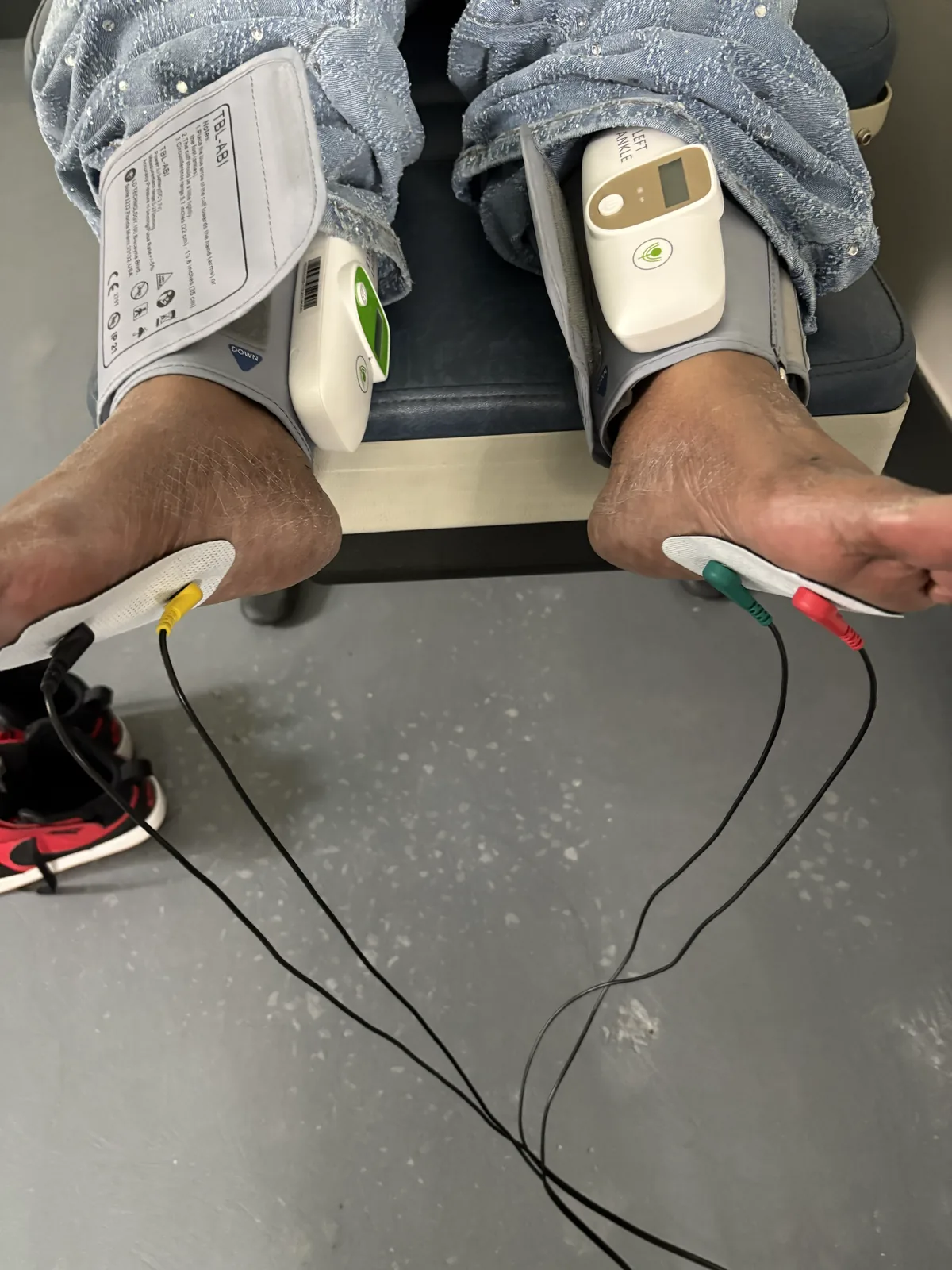
What happens when you come in for diabetic neuropathy treatment?
- Take the free Nerve Damage Score (5 questions, ~2 minutes, large print). You will learn which terrain failure is most likely driving your symptoms.
- Physician evaluation and diagnostics to confirm the pattern and rule in or out other causes.
- A personalized, physician-guided plan built around your specific drivers.
- Follow-up to track progress, because nerve tissue repairs gradually.
Frequently Asked Questions
Can diabetic peripheral neuropathy be reversed?
It depends on how advanced the damage is. Nerves have some ability to recover when the causes are treated early. Those causes are poor blood flow, high blood sugar, and glycation. Many patients get real symptom relief. When nerve loss is more advanced, the goal shifts to halting it and protecting the function that remains. Regenerve checks which stage you are in before recommending a plan. Individual results vary. See what recovery is realistic and what is not.
Do I have to stop taking gabapentin or my other medications?
No. Never stop a prescribed medicine on your own. Medicines like gabapentin, pregabalin, and duloxetine can be important for controlling pain while the terrain is being treated. Any changes are made only together with your physician. See what the evidence supports for gabapentin and pregabalin.
What does treatment actually involve?
It begins with a physician evaluation and diagnostics to find which failures are driving your symptoms. From there, a plan made for you may combine steps to restore circulation, reduce glycation, and supply nerve-repair substrates. These include Benfotiamine, Alpha-Lipoic Acid, and Methylcobalamin at clinical doses, along with other treatments offered at Regenerve. Every plan is made for the person. See how the Regenerve Protocol works step by step.
Is the NS100 a permanent implant?
No. The NS100 is temporary. The electrode arrays are placed percutaneously in an office procedure under topical anesthesia, stay in place for a 20-day course, and are then removed at a follow-up visit — no hardware stays in your body afterward, and no battery or generator is implanted. It is one of several options among our advanced therapies, and whether it suits you is decided at physician evaluation.
How soon might I notice a difference?
This varies. Some people notice changes within weeks. But nerve tissue repairs slowly, so real change often takes months. Acting earlier generally means more nerve function to protect. See what predicts change over time.
Is diabetic neuropathy treatment covered by insurance?
Coverage varies by plan and by which parts of care are involved. We can review your situation during your evaluation. Call (314) 886-5739 or text (314) 886-5902. See what to ask about coverage before you start.
Where is Regenerve located?
4477 Woodson Rd, Suite 104, St. Louis, MO 63134 — minutes from St. Louis Lambert International Airport, with easy access from I-70, I-170, and I-270. See our clinic location and the areas we serve.
What is the most effective treatment for diabetic neuropathy?
The most effective plan does two jobs at once. Medicines such as gabapentin, pregabalin, and duloxetine turn down the pain signal. But they do not restore blood flow, slow glycation, or help rebuild myelin. At Regenerve, a physician evaluation finds which of the three terrain failures is active. Then the plan goes after it: circulation, the drivers of glycation, and the substrates nerves need to repair.
What kind of doctor should I see for diabetic neuropathy?
See a physician who looks past the pain signal to why the nerves are failing. Regenerve is a physician-directed clinic in St. Louis focused on the metabolic and blood-vessel causes of nerve pain. Care starts with a physician evaluation and diagnostics. These include circulation and small-fiber nerve testing in the feet. Existing prescriptions are changed only together with your physician.
Can high blood sugar cause neuropathy?
Yes. When blood sugar stays high over time, it damages the smallest nerves in the body. The longest nerves, the ones that reach your feet, show it first. Sugar sticks to nerve proteins and forms advanced glycation end-products, which stiffen and short-circuit the wiring. Diabetes also narrows the hair-thin vessels that feed each nerve, so the nerve is starved of oxygen.
The information on this page is educational and is not a substitute for evaluation, diagnosis, or treatment by a physician. Individual results vary. Do not start, stop, or change any medication without consulting your physician.
Diabetic neuropathy and inner-ear problems track with the same metabolic state, and they add to each other. VNG balance testing measures the part your feet cannot tell you about.
Sources
- Pop-Busui R, Boulton AJM, Feldman EL, et al. Diabetic Neuropathy: A Position Statement by the American Diabetes Association. Diabetes Care. 2017. PMID 27999003
- Feldman EL, Callaghan BC, Pop-Busui R, et al. Diabetic neuropathy. Nature Reviews Disease Primers. 2019. PMID 31197153
- Ziegler D, Ametov A, Barinov A, et al. Oral treatment with alpha-lipoic acid improves symptomatic diabetic polyneuropathy: the SYDNEY 2 trial. Diabetes Care. 2006. PMID 17065669