
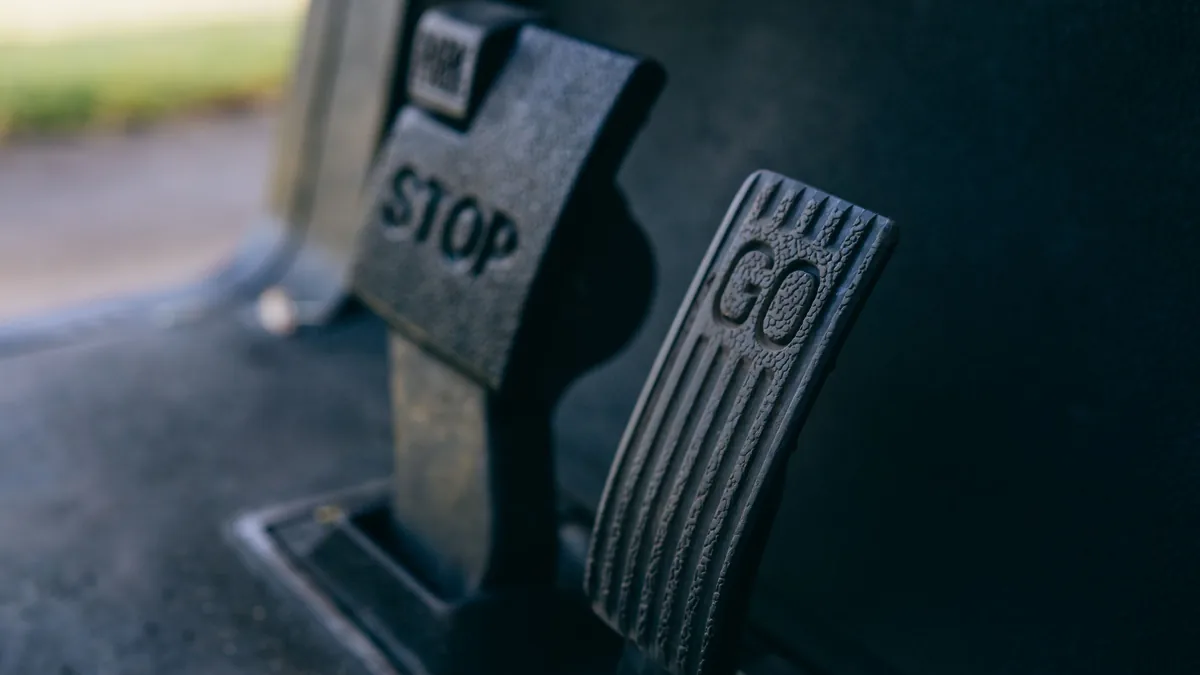
Numb feet from peripheral neuropathy change driving safety, because the pedal feedback loop depends on feeling you may no longer have. The National Institute of Neurological Disorders and Stroke lists two sensory nerve symptoms that matter here. One is not being able to feel vibration and touch, especially in the hands or feet. The other is loss of position sense.1 Both are exactly what you use to find a pedal and judge how hard you are pressing it.
Why do numb feet affect driving?
Driving is a correction loop. You press, you feel the push back, you adjust. When touch and position sense fade, the correction comes late or lands in the wrong place.
NINDS also notes that loss of position sense can leave a person unable to coordinate complex movements or keep their balance with their eyes shut.1 A footwell is a dark place where your eyes cannot help you.
Symptoms can arrive on any timescale
NINDS states that symptoms of peripheral neuropathy may develop over days, weeks or years. That depends on the type of nerve fibers affected and the type and severity of damage.1 That is why a driving call made two years ago is not a call about today.
Check again after any medicine change, any fall, any new numbness, and any near-miss you explained away. You can read how doctors describe the sensory pattern in peripheral neuropathy of the feet symptoms.
Is it dangerous to drive with neuropathy in your feet?
Does neuropathy slow your braking?
A 2017 case-control study in the Journal of Foot and Ankle Surgery measured brake response time on a computer driving simulator. It compared 25 active drivers with type 2 diabetes and lower-leg neuropathy against 25 active drivers with neither condition.2 The neuropathy group had a slower average brake response time. Abnormally delayed responses also happened more often.
Pressing the wrong pedal
A 2026 study in Transportation Research Interdisciplinary Perspectives used a driving simulation. It compared drivers with and without neuropathy affecting foot feeling and ankle position sense.3 Only the drivers with neuropathy made sudden, powerful, unsafe and unintended accelerations when braking was needed. These were cases of pedal confusion and misapplication.
The authors state that diabetic peripheral neuropathy raises the chance of pressing the wrong pedal. That puts those drivers at higher risk of a crash from unintended acceleration.3 They recommend three countermeasures: drive a manual gearbox instead of an automatic, fit an acceleration limiter, and light the footwell and pedals at night.
When should you stop driving with neuropathy?
These are the patterns to act on, not to shrug off:
- Numbness that is spreading or deepening over weeks instead of staying stable.
- Having to hunt for the pedal, or being unsure how far down you have pushed it.
- Any episode of unintended acceleration, pedal confusion, or a near-miss you cannot explain.
- New unsteadiness on uneven ground or in the dark.
- A new medication that affects alertness, balance or reaction time.
If driving already feels unreliable, pause it while you get checked. Do not test the question on a public road.
What an evaluation at Regenerve looks at
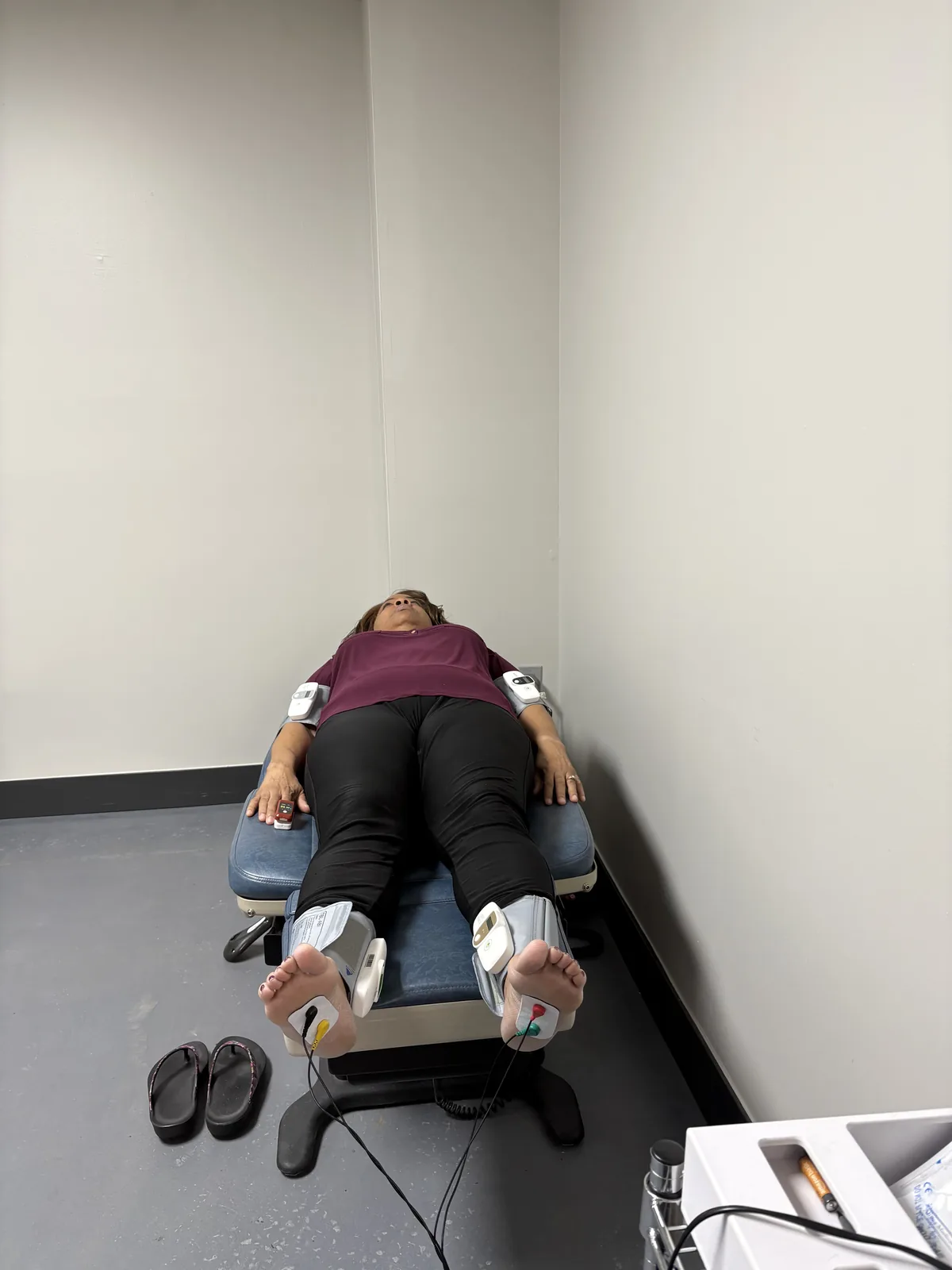
The useful question is not whether you have neuropathy. It is which cause is behind it and which specific functions have been lost. We do electrodiagnostic testing (EMG/NCS) on site. We sort between metabolic, nutritional, autoimmune, toxic and structural causes.
When balance is part of the picture, we use VNG as a test of inner-ear balance. VNG is a test, not a treatment. Our therapy options include class 4 photobiomodulation, class 3B cold laser and whole-body infrared.
Orthobiologic injections such as PRP and BMAC are offered in selected situations. Qutenza (capsaicin 8% patch) is FDA-approved in adults only for neuropathic pain from postherpetic neuralgia and from diabetic peripheral neuropathy of the feet. It is applied in clinic by a clinician and repeated no more often than every three months. We do not promise nerve regeneration, reversal or cure.
We see patients from the St. Louis region, Missouri and Illinois, at 4477 Woodson Rd #104, St. Louis, MO 63134. Details are on our St. Louis neuropathy treatment page.
Start with your Nerve Damage Score
If your feet have gone quiet, find out what is causing it before you decide anything about driving. The Nerve Damage Score is a free five-question screen.
If a family member is helping decide when driving should stop, our caregiver guide to peripheral neuropathy covers the talk and the safety checks.
Frequently asked questions
Can I keep driving if my feet are numb from neuropathy?
That depends on how much feeling and position sense you have lost. It is not something to judge from a good day. NINDS lists loss of vibration and touch feeling and loss of position sense among sensory nerve symptoms. Both affect how well you place and press a pedal. See burning feet and nerve pain.
What is pedal confusion, and is neuropathy really linked to it?
Pedal confusion means pressing the gas when you meant to brake. In a 2026 driving-simulation study, only drivers with diabetic peripheral neuropathy made sudden, powerful, unsafe and unintended accelerations when braking was needed. See the hidden drivers of peripheral neuropathy.
What should I ask about before a driving decision?
Ask about your sensory exam, your position sense, your medicines, and whether a formal driver rehab evaluation fits your case. Bring the specific driving moments that feel unreliable, not a general impression. See Regenerve services and testing.
Does treating the pain make driving safer?
Not by itself. Pain relief and accurate feeling are different things. A treatment that cuts burning does not restore the pressure and position feedback a pedal needs. Qutenza, for example, is approved for nerve pain, not for restoring feeling. See Qutenza (capsaicin 8% patch).
How do you drive a car safely with neuropathy?
Start with an honest check of your feeling and position sense, not a guess from a good day. The 2026 pedal-confusion study recommended three countermeasures: drive a manual gearbox instead of an automatic, fit an acceleration limiter, and light the footwell and pedals at night. Then check again after any medicine change, any fall, any new numbness and any near-miss.
What should you not do if you have neuropathy in your feet?
Do not judge your driving from a good day. Do not explain away a near-miss or a moment of pedal confusion. Do not assume that less pain means safer feet, because pain relief does not restore the pressure and position feedback a pedal needs. And if driving already feels unreliable, do not test the question on a public road. Pause it while you get checked.
Is it harder to drive at night with numb feet?
Yes. Loss of position sense can leave a person unable to coordinate complex movements or keep their balance with their eyes shut. A footwell at night is a place where your eyes cannot help. That is why the 2026 driving study recommended lighting the footwell and pedals at night. It is also why new unsteadiness in the dark is a sign to get checked.
Sources
- National Institute of Neurological Disorders and Stroke. “Peripheral Neuropathy.” Last reviewed March 13, 2026. https://www.ninds.nih.gov/health-information/disorders/peripheral-neuropathy
- Meyr AJ, Spiess KE. “Diabetic Driving Studies—Part 1: Brake Response Time in Diabetic Drivers With Lower Extremity Neuropathy.” Journal of Foot and Ankle Surgery. 2017;56(3):568–572. https://pubmed.ncbi.nlm.nih.gov/28476387/
- Perazzolo M, Esselaar M, Marple-Horvat DE. “Sudden, powerful, unsafe and unintended accelerations: Pedal confusion and misapplication in drivers with diabetic peripheral neuropathy.” Transportation Research Interdisciplinary Perspectives. 2026;38:102129. https://doi.org/10.1016/j.trip.2026.102129