

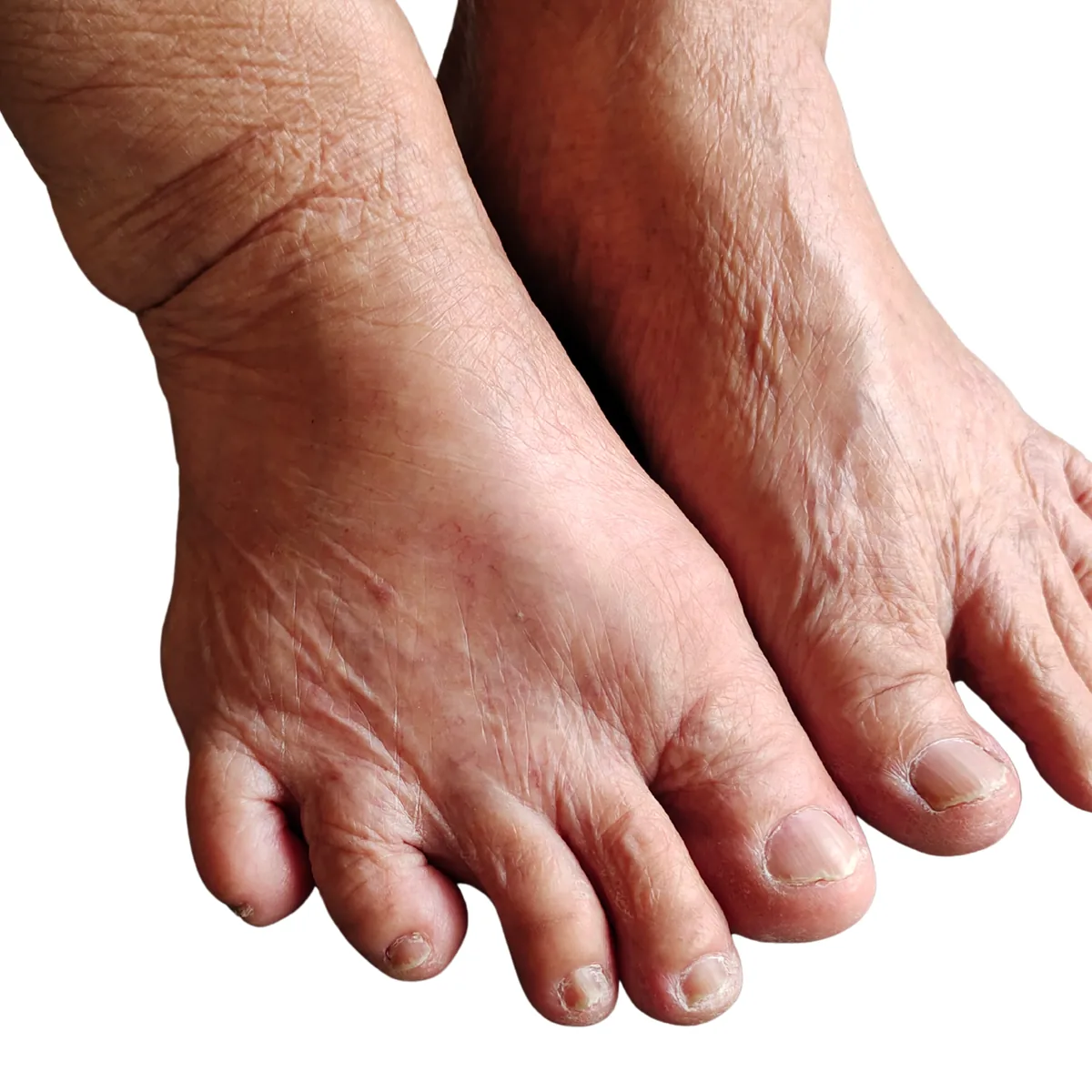
The warning signs of Charcot foot are heat or warmth in one foot, a change in color or redness, swelling, and foot pain. Cleveland Clinic advises seeing a healthcare provider as soon as you notice any change in your feet.1 Charcot foot is rare. It affects less than 1% of all people with diabetes.1 The danger is not how common it is. The danger is the delay. When neuropathy has dulled protective feeling, the foot can be taking damage while reporting very little pain.
Doctors are advised to suspect acute Charcot neuroarthropathy in a certain kind of patient. That patient is 40 years or older, with obesity and peripheral neuropathy. The foot is suddenly swollen after little or no remembered injury. The patient reports little to no pain. This is truest when x-rays and lab tests for infection are normal.2 That description is worth reading twice. It says the lack of pain is part of the picture, not a reason to wait.
Key takeaways
- Compare both feet. Warmth on one side is the sign people most often notice first.
- Do not wait for pain. Dulled feeling means the usual alarm may never go off.
- Redness and swelling are not always infection. They still need a checkup the same week.
- Delay has a cost. Delayed treatment leads to rigid deformities of the foot and ankle. That raises the risk of ulcers, infection and major leg amputation.2
- The underlying neuropathy still has a cause. Blood sugar is one factor among several.
What is Charcot foot?
Charcot foot is a condition where the bones and joints of the foot weaken and can change shape. It happens with peripheral neuropathy. Dulled feeling lets repeated injury and inflammation go on. The usual response, guarding a sore foot, never kicks in.
Why neuropathy makes the warning signs easy to miss
When feeling is dulled, pressure, rubbing or a small twist can injure the foot without you noticing at the time. You may see the swelling before anything hurts. That reversed order is exactly why this is a looking problem, not a feeling problem.
So the symptoms people usually link to neuropathy are not the ones to track here. Burning at night, numbness, and pins and needles describe the nerve. Warmth, swelling and color change describe the foot. Both matter, and they are checked in different ways. Our overview of peripheral neuropathy of the feet symptoms covers the nerve side.
What are the early symptoms of Charcot foot?
Cleveland Clinic lists these four early symptoms. You can check all four at home with no equipment.1
- Heat or warmth, especially one foot noticeably warmer than the other
- Discoloration or redness over the foot
- Swelling, including a shoe that suddenly fits differently
- Foot pain, which may be mild or missing when feeling is dulled
How to check, in a way you will actually repeat
- Compare both feet at the same time of day, under the same conditions. Use the back of your hand to feel temperature.
- Look at the soles with a mirror or a phone camera if you cannot lift the foot easily.
- Note whether a change came after extra walking, a new pair of shoes or a bump you barely noticed.
- Write down what you see and the date. A photo on the same day each week makes a slow change easy to see.

Is a red, swollen foot Charcot foot or an infection?
A warm, red, swollen foot can look like cellulitis, a skin infection. It is often treated as that first. But with neuropathy, small repeated injuries can cause a very similar picture with no infection at all. That is one reason the diagnosis gets missed early.
This is not a call to make at home. It is a reason to get checked, not to wait two weeks and see which answer fits.
What happens if Charcot foot goes untreated?
A classic later sign is rocker-bottom foot. It happens when the bones in the middle of the foot collapse and the arch drops.5 Once the foot changes shape, pressure lands in the wrong places. That bad pressure is what carries the risk forward into ulcers.
The neuropathy underneath still needs a driver
Charcot foot happens on top of peripheral neuropathy, and the neuropathy itself deserves the same close look. In many patients diabetes is the main cause. But low nutrients, autoimmune processes, toxic exposures, medicines and pinched nerves can all add to it.
Finding which one does the most damage is the difference between two plans. One cuts ongoing nerve injury. The other only manages symptoms. Our approach when diabetes is the main cause is on the diabetic peripheral neuropathy treatment page.
Where Regenerve’s therapies do and do not fit
At Regenerve, class 4 photobiomodulation, class 3B cold laser, whole-body infrared, and metabolic and nutrition care are part of a longer-term plan for the nerve’s environment. None of them is the answer to a suddenly warm, swollen foot. If Charcot warning signs show up, the right next step is a prompt medical exam, not a therapy visit.
Orthobiologic injections (PRP and BMAC) are offered in selected situations.
Where to get help in the St. Louis region
Regenerve serves patients across the St. Louis region, Missouri and Illinois, including Edwardsville, Glen Carbon, Collinsville, Troy and Maryville. The clinic is at 4477 Woodson Rd #104, St. Louis, MO 63134, minutes from St. Louis Lambert International Airport.
Call (314) 886-5739 or text (314) 886-5902, or email info@regenerve.com. Hours are Monday through Thursday 9 a.m. to 4 p.m. and Friday 9 a.m. to 1:30 p.m. If a foot is acutely warm, red and swollen and you cannot be seen quickly, that is a reason to seek same-day care rather than to wait for a routine appointment.
Your next step
If you want to understand the neuropathy behind the foot risk, take the free five-question Nerve Damage Score. It shows which group of causes most likely applies to you. Your answers guide what we check first.
Frequently asked questions
What are the first Charcot foot warning signs I should check for?
Heat or warmth in one foot, especially when it is clearly warmer than the other. Swelling and a change in color or redness come with it. Foot pain can also show up, but dulled feeling can mute it. Any of these needs a prompt in-person exam. Our guide to choosing a neuropathy specialist covers what to ask for.
I have burning feet at night but no wound. Is that a Charcot warning sign?
Burning at night is a nerve-pain symptom, not a Charcot sign. On its own it does not tell you whether the bones and joints are involved. Warmth on one side, swelling and color change are the findings that call for a prompt exam. See burning feet and nerve pain.
Does testing for neuropathy help with Charcot risk?
Indirectly. Confirming that protective feeling is dulled tells you how much you must rely on looking at your feet instead of feeling a problem. That is the whole point of a daily check. Our on-site electrodiagnostic testing is on the neuropathy services page.
If I have diabetes, is blood sugar the only thing that raises my risk?
No. Nutrition, autoimmune, toxic and structural causes can exist alongside diabetes. They add to the nerve injury that leaves a foot at risk. See the hidden drivers of peripheral neuropathy.
Does Charcot foot hurt?
Often very little, and that is the trap. Neuropathy dulls protective feeling, so the foot can be taking damage while reporting little or no pain.2 Many people notice the swelling before anything hurts. Treat warmth, swelling and color change in one foot as the signal, even when the pain seems too mild to matter.
Who is most at risk for Charcot foot?
It is rare. It affects less than 1% of all people with diabetes.1 Doctors are advised to suspect it in anyone 40 or older with obesity and peripheral neuropathy who has a suddenly swollen foot after little or no remembered injury, and who has little or no pain. This is truest when x-rays and infection tests come back normal.2 Dulled feeling from neuropathy is the common thread.
How do I check my feet for Charcot foot at home?
Compare both feet at the same time of day. Use the back of your hand to feel whether one foot is warmer. Look at the soles with a mirror or a phone camera. Note whether a change came after extra walking, new shoes or a bump you barely noticed. Write down what you see with the date. A photo on the same day each week makes a slow change easy to see.
When should I see a doctor for a warm, swollen foot?
As soon as you notice the change. Cleveland Clinic advises seeing a healthcare provider as soon as you notice any change in your feet.1 Redness and swelling need a checkup the same week, even when infection is not the cause. If the foot is suddenly warm, red and swollen and you cannot be seen quickly, get same-day care. Do not wait for a routine visit.
Sources
- Cleveland Clinic, “Charcot Foot,” Cleveland Clinic health library, last updated June 30, 2023, https://my.clevelandclinic.org/health/diseases/15836-charcot-foot
- Marmolejo VS, Arnold JF, Ponticello M, Andersen CA, “Charcot Foot: Clinical Clues, Diagnostic Strategies, and Treatment Principles,” American Family Physician, May 1, 2018, https://www.aafp.org/afp/2018/0501/p594
- Wukich DK, Schaper NC, Gooday C, et al., on behalf of the International Working Group on the Diabetic Foot, “Guidelines on the diagnosis and treatment of active Charcot neuro-osteoarthropathy in persons with diabetes mellitus,” IWGDF, 2023, https://iwgdfguidelines.org/wp-content/uploads/2023/07/IWGDF-2023-08-Charcot-Guideline.pdf
- Rogers LC, Frykberg RG, Armstrong DG, et al., “The Charcot Foot in Diabetes,” Diabetes Care, 2011;34(9):2123–2129, https://diabetesjournals.org/care/article/34/9/2123/38608/The-Charcot-Foot-in-Diabetes
- MedlinePlus, “Charcot foot,” MedlinePlus Medical Encyclopedia, U.S. National Library of Medicine, review date November 7, 2024, https://medlineplus.gov/ency/article/007748.htm
- American Academy of Orthopaedic Surgeons, “Diabetic (Charcot) Foot,” OrthoInfo, https://www.orthoinfo.org/diseases–conditions/diabetic-charcot-foot/
- Collins AC, “Charcot Neuropathic Osteoarthropathy,” StatPearls, Treasure Island (FL): StatPearls Publishing, last updated January 31, 2026, https://www.ncbi.nlm.nih.gov/books/NBK470164/