
Yes, thyroid function can affect peripheral nerves, and it can do so before anyone uses the word neuropathy. One study compared 60 adults aged 20 to 50 with newly diagnosed hypothyroidism against 60 healthy people of the same ages. Nerve conduction testing showed statistically significant changes across motor and sensory nerves. Signals took longer to start (latency), and speed and strength (velocity and amplitude) dropped [1]. That does not mean your thyroid explains every symptom you have. But it does mean thyroid function belongs on the list of causes you check.
Key takeaways
- Hypothyroidism has been associated with measurable nerve conduction changes in adults with newly diagnosed disease [1].
- Peripheral neuropathy is a category, not a diagnosis. The useful question is which cause is doing the damage: metabolic, nutritional, autoimmune, toxic or structural.
- Genetic evidence in people of European ancestry links hypothyroidism to higher odds of diabetic peripheral neuropathy. It did not show the same direction of effect for every type of neuropathy studied [2].
- Thyroid disease and metabolic disease often come together. So finding one cause is not a reason to stop looking.
- We do electrodiagnostic testing (EMG/NCS) on site at Regenerve. That way symptoms can be matched to measured nerve function, not to a label.
How does low thyroid affect your nerves?
Peripheral nerves are tissue that needs a lot of energy. They depend on a steady oxygen supply through very small blood vessels and on steady energy handling inside the cell. Thyroid hormone affects both.
When thyroid hormone is low, that background shifts. The change is often subtle at first. That is why nerve testing can be abnormal before a person describes a clear pattern of numbness or burning.
None of this makes hypothyroidism the automatic answer for foot symptoms. It makes thyroid status one of several things worth confirming before a workup is called complete. If you want the wider list, read about the hidden drivers of peripheral neuropathy.
What does nerve testing show in people with hypothyroidism?
The 2016 study in Annals of Medical and Health Sciences Research tested 60 adults aged 20 to 50 with recently diagnosed hypothyroidism against 60 healthy people of the same ages. In the motor nerves examined, the hypothyroid group showed significantly increased latencies and decreased conduction velocities [1].
The sensory nerves tested, median and sural, showed the same direction of change: longer latencies with lower velocities and amplitudes [1]. The authors concluded that nerve involvement can develop at an early stage of hypothyroidism.
Two limits are worth stating plainly. This was a single study in adults aged 20 to 50. And abnormal conduction numbers are not the same thing as disabling symptoms.
Does hypothyroidism raise the risk of diabetic neuropathy?
A 2024 Mendelian randomization study in Frontiers in Endocrinology looked at eight nerve conditions using genetic data from people of European ancestry. It reported that genetically predicted hypothyroidism was associated with increased odds of diabetic peripheral neuropathy, with an odds ratio of 1.22 [2].
The same analysis did not point the same way for every type. For polyneuropathies the estimate ran in the protective direction. That is a reminder that neuropathy subtypes do not behave as one disease [2].
Read this as a signal about risk, not as proof that treating a thyroid lab will resolve nerve pain. It supports checking thyroid status carefully when diabetes and nerve symptoms are both present, alongside the blood sugar work that drives diabetic nerve damage.
Neuropathy is a category, so the work is finding the driver
Treating “neuropathy” as though it were one disease is the most common way a workup stalls. The groups below are what we sort symptoms into before choosing tests.
Driver categories we evaluate
- Metabolic, including diabetes, prediabetes and thyroid disease.
- Nutritional, including B12 status and malabsorption after surgery.
- Autoimmune and inflammatory, when the pattern suggests the immune system is attacking nerve.
- Toxic, including medicine effects, alcohol and heavy metal exposure.
- Structural, including trapped nerves and spine-related causes.
More than one of these is often active at once. That is the practical reason we map before we treat.
How is neuropathy tested when you have thyroid disease?
Testing exists to separate three different problems. One is slowed conduction in the large nerve fibers. Another is injury to the small fibers. The third is a nerve environment that is short on oxygen or under metabolic strain. Each one points somewhere different.
Electrodiagnostic testing (EMG/NCS) on site
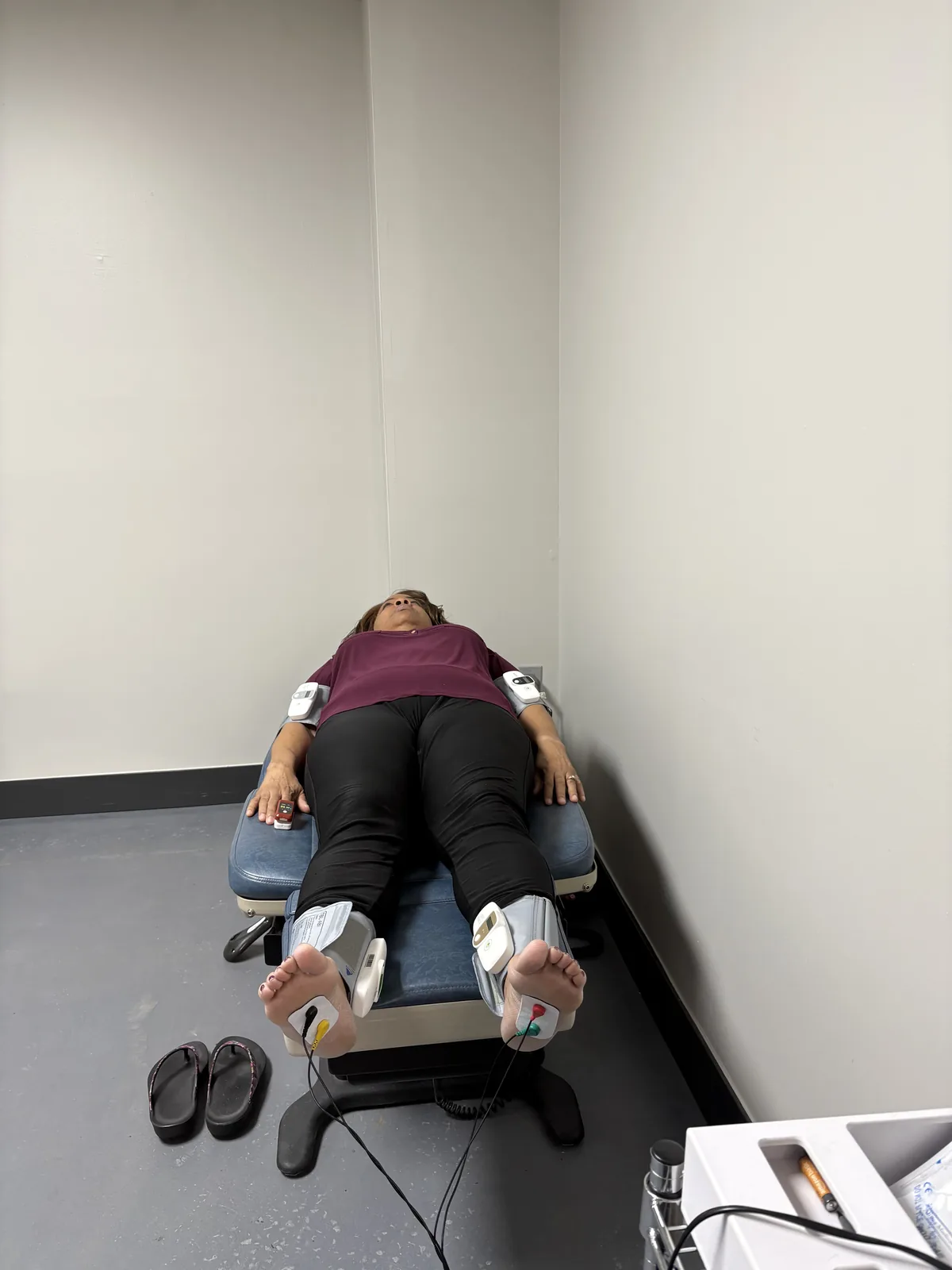
Electrodiagnostic testing measures how well the larger nerves conduct. It shows whether the pattern fits a neuropathy that hits the longest nerves first, a trapped nerve or something else. At Regenerve we do this on site instead of sending you elsewhere.
Small-fiber and vascular assessment
Burning, temperature changes and pain that seems out of proportion to the exam often involve the small fibers. Standard conduction studies do not capture those. We use in-office checks of small-fiber and blood-vessel function, so the plan is built on measurement.
What care looks like when the driver is metabolic or endocrine
Thyroid replacement is managed by the clinician who prescribes it. Our work sits alongside that. It aims at the environment around the nerve, not at masking the signal.
In-clinic modalities we offer
Regenerve offers class 4 photobiomodulation, class 3B cold laser and whole-body infrared as parts of a plan, applied in clinic under clinician direction. They support the tissue environment while the cause we found is treated. They are not stand-alone answers.
What we do not claim
We do not promise nerve regeneration or reversal. We do not publish success percentages for our protocols. What we can commit to is measuring before treating and telling you what the measurements show.
Frequently asked questions
Can hypothyroidism cause peripheral neuropathy?
Low thyroid function has been linked to measurable changes in nerve conduction. One study compared 60 adults aged 20 to 50 with newly diagnosed hypothyroidism against 60 healthy people of the same ages. Their motor and sensory nerves showed longer latencies and slower conduction velocities than the healthy group. That is a reason to test instead of assume, because more than one cause is often present. See peripheral neuropathy of the feet symptoms.
I have hypothyroidism and burning feet at night. What testing should I ask about?
Burning that is worse at night often points to the small nerve fibers, which standard nerve conduction testing does not measure well. A useful workup separates large-fiber conduction from small-fiber and autonomic function. It also checks for nutrition and toxic causes at the same time. See small fiber neuropathy symptoms and testing.
Does thyroid disease change how diabetic neuropathy is managed?
It can change what gets looked at. A 2024 Mendelian randomization study in people of European ancestry reported that genetically predicted hypothyroidism was associated with higher odds of diabetic peripheral neuropathy. So thyroid status is worth confirming when both conditions are in play. The metabolic work does not change. See diabetic peripheral neuropathy treatment in St. Louis.
If my thyroid labs are treated and my feet still burn, what then?
That is common. It usually means thyroid function was one cause, not the only one. The next step is to look for nutrition, toxic, autoimmune and structural causes instead of repeating the same lab. See functional B12 deficiency and neuropathy.
What does hypothyroid neuropathy feel like?
Often it feels like very little at first. The change can be subtle. Nerve testing can turn abnormal before a person notices a clear pattern of numbness or burning. When symptoms do show up, burning, temperature changes, and pain that seems out of proportion to the exam often point to the small nerve fibers. Standard conduction studies do not capture those. That is why testing matters more than the label.
Is hypothyroid neuropathy reversible?
No one should promise that. Regenerve does not promise nerve regeneration or reversal, and it does not publish success rates. Research shows nerve involvement can begin early in hypothyroidism. And abnormal conduction numbers are not the same as disabling symptoms. The useful work is to measure nerve function on site and leave thyroid replacement to the clinician who prescribes it. Then check the other causes that often come with it: metabolic, nutritional, autoimmune, toxic, and structural.
How is thyroid neuropathy treated?
Thyroid replacement is managed by the clinician who prescribes it. Care at Regenerve sits alongside that and targets the environment around the nerve. Class 4 photobiomodulation, class 3B cold laser, and whole-body infrared are applied in the clinic as parts of a plan, not as stand-alone answers. Before any of that, on-site EMG and nerve conduction testing, plus small-fiber and blood-vessel checks, show which cause to treat first.
Start with the Nerve Damage Score
The starting point at Regenerve is the free five-question Nerve Damage Score. It takes a few minutes. It tells us which cause to look at first, so your visit starts with a plan instead of a guess.
Take the free Nerve Damage Score assessment. Then bring the result to a physician-led visit at Regenerve, 4477 Woodson Rd #104, St. Louis, MO 63134, minutes from St. Louis Lambert International Airport. We see patients from the St. Louis region, Missouri and Illinois.
Sources
- Gupta N, Arora M, Sharma R, Arora KS. “Peripheral and Central Nervous System Involvement in Recently Diagnosed Cases of Hypothyroidism: An Electrophysiological Study.” Annals of Medical and Health Sciences Research, 2016;6(5). https://pmc.ncbi.nlm.nih.gov/articles/PMC5414436/ — referenced for the nerve conduction findings in 60 adults aged 20 to 50 with newly diagnosed hypothyroidism versus 60 age-matched healthy controls.
- Frontiers in Endocrinology. “Causal relationship between hypothyroidism and peripheral neuropathy: a Mendelian randomization study of European ancestry.” 2024. doi:10.3389/fendo.2024.1436823. https://pmc.ncbi.nlm.nih.gov/articles/PMC11631618/ — referenced for the odds ratio of 1.22 for diabetic peripheral neuropathy in people of European ancestry and for the differing direction of effect across neuropathy phenotypes.