
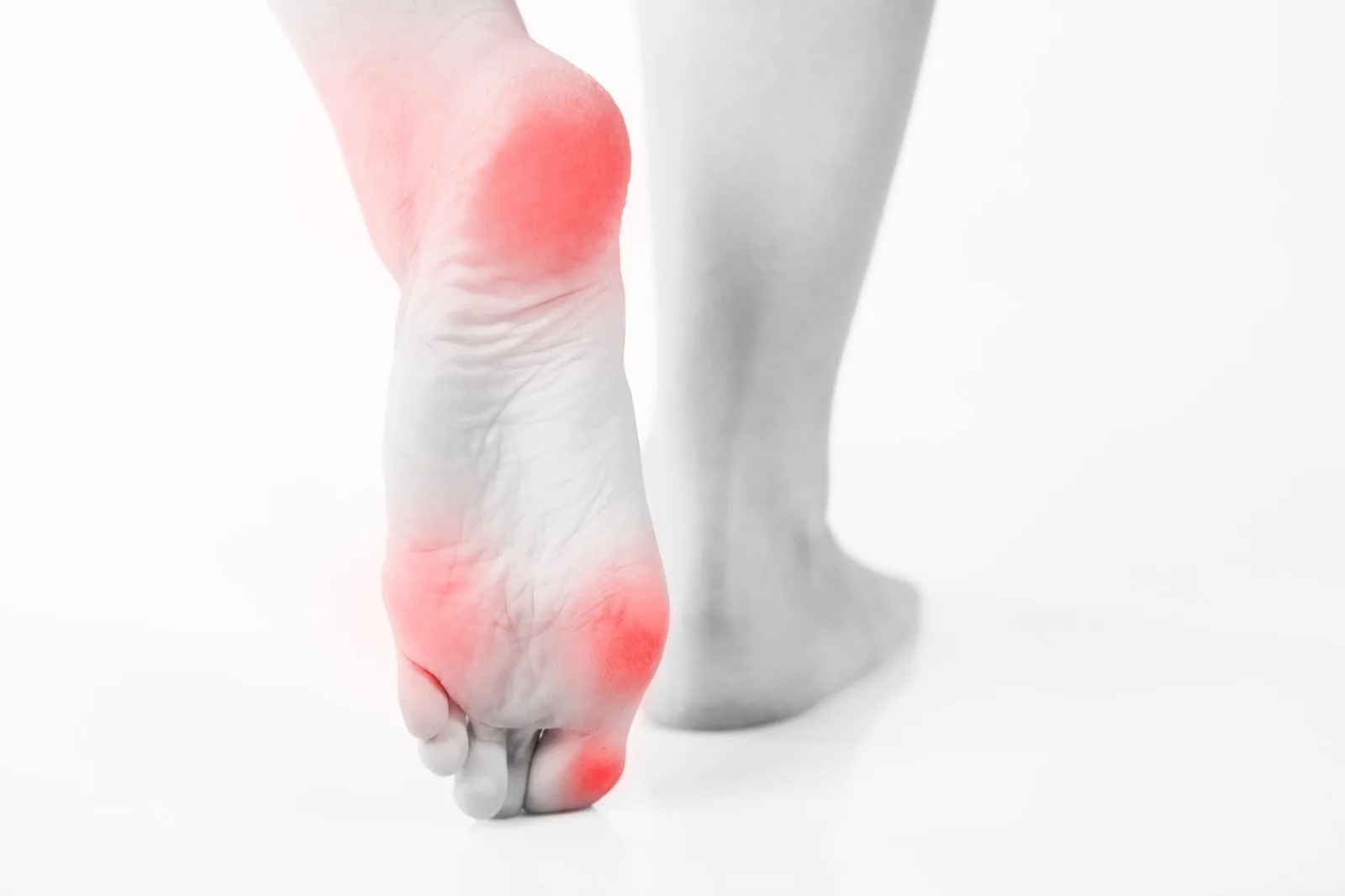
The quickest way to tell them apart is timing plus feeling. Plantar fasciitis is usually described as sharp pain under the heel. It is worst with the first few steps out of bed and eases as you warm up. Pressing on the inner heel sets off the pain [2]. Nerve pain in the foot is more often burning, tingling or numbness. It tends to involve the toes and forefoot, and it often gets worse at night instead of better with movement.
Key takeaways
- Location: plantar fasciitis centers on the inner and under side of the heel, where the fascia attaches [2]. Nerve symptoms usually start in the toes and work upward.
- Timing: morning pain on the first steps that improves with movement suggests the fascia [2]. Burning that is worse at rest and at night suggests nerve.
- Feeling: tingling, numbness and electric or hot-coal feelings describe nerves. The fascia does not cause them.
- Both can be present at once. So having one does not close the question.
- A 2013 survey looked at 75,000 US adults aged 18 and older. Of them, 0.85% (95% CI 0.77–0.92) reported diagnosed plantar fasciitis with pain in the past month [1].
- Numbness is a safety problem no matter the cause, because an injury you cannot feel goes untreated.
What does plantar fasciitis feel like?
Plantar fasciitis is a mechanical problem in the tissue that runs along the sole and attaches at the heel. The description clinicians hear most is sharp pain that is worst on the first few steps in the morning or after sitting. It then settles somewhat with activity [2].
On exam, pressing the inner underside of the heel, where the fascia attaches, usually sets off the pain [2]. It is one spot you can find, not a spreading feeling.
It is also common. A 2013 internet panel survey looked at 75,000 US adults aged 18 and older. Of them, 0.85% reported diagnosed plantar fasciitis with pain in the previous month. The reported figures were higher in women than men. They were higher in adults aged 45 to 64 than in younger adults. And they were higher at a BMI of 30 or above than below 25 [1].
What are the first signs of neuropathy in the foot?
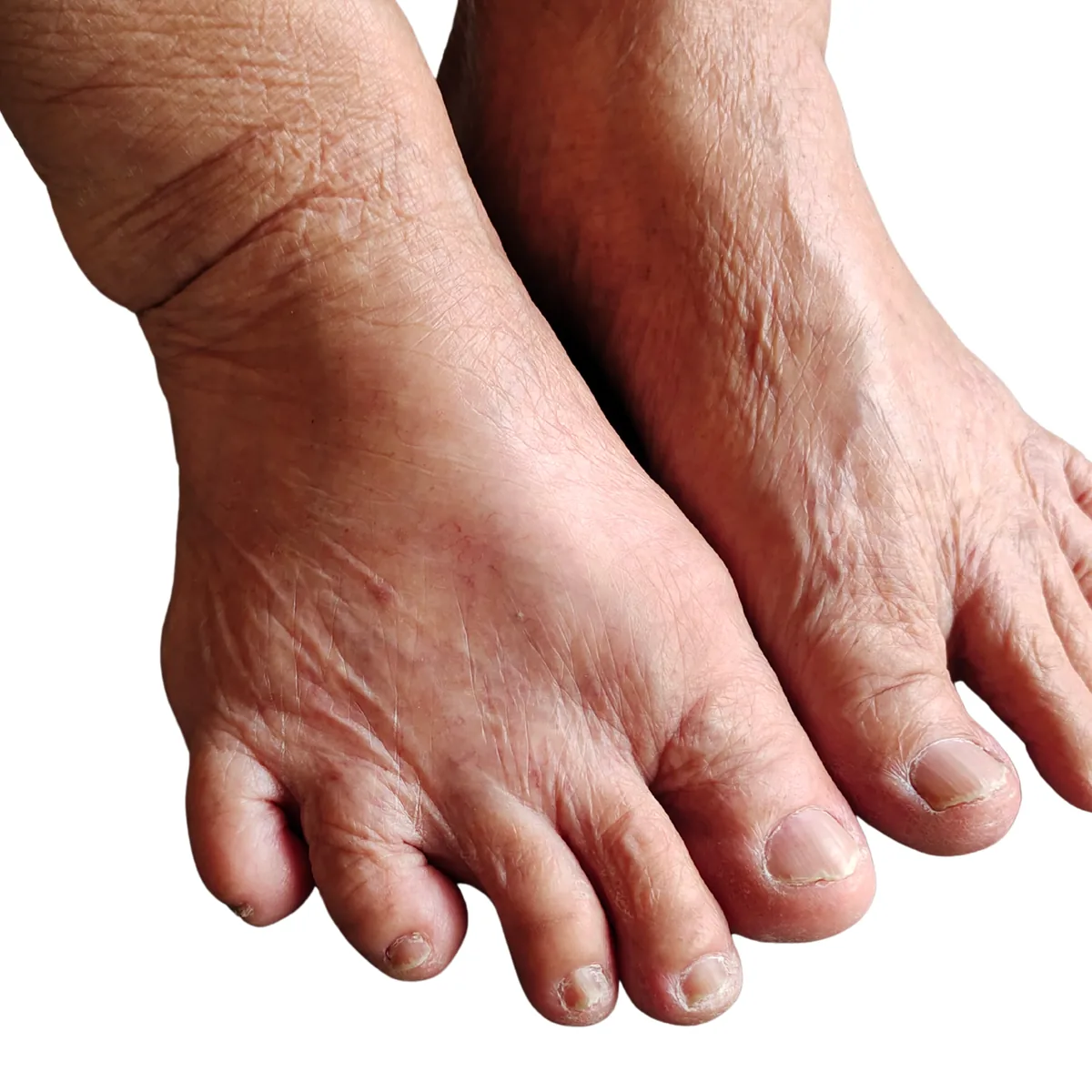
Nerve pain reads differently. People describe burning, pins and needles, numbness, or a sense that the foot is padded or not fully theirs. The feelings often do not sit over one spot you can find.
Where it shows up is the other clue. The longest nerve fibers fail first. So symptoms usually begin in the toes and spread upward over time, often in both feet, not one. That is what makes the pattern useful: mechanical pain does not travel that way.
Why is nerve pain in the feet worse at night?
Mechanical pain usually responds to load. It is worse when you use the foot and better when you rest it. Nerve symptoms often do the opposite and are most noticeable when you are still. That is why burning feet at night is such a common complaint.
How do I know if my foot pain is plantar fasciitis or neuropathy?
- Worst moment. Plantar fasciitis: first steps out of bed. Neuropathy: evening and night, at rest.
- Where. Plantar fasciitis: a focal spot at the inner heel. Neuropathy: toes and forefoot, spreading upward, usually both sides.
- Quality. Plantar fasciitis: sharp, mechanical, tied to load. Neuropathy: burning, electric, tingling, numb.
- Response to movement. Plantar fasciitis: eases as you warm up. Neuropathy: mostly unchanged, or worse when you stop.
- Other findings. Plantar fasciitis: none beyond the foot. Neuropathy: often balance changes, less feeling, and symptoms in the hands later.
Use this to describe your symptoms accurately, not to reach a verdict. Mixed pictures are common, and the two can happen together.
Will plantar fasciitis treatment help nerve pain?
Fascia care and nerve care do not overlap much. Months of stretching, orthotics and night splints aimed at a fascia problem will not treat a nerve problem. And the delay costs more than the time.
Neuropathy is a category, not a diagnosis. So finding it is the start of the work, not the end. The next question is which cause is to blame: metabolic, nutritional, autoimmune, toxic or structural.
Numbness changes the urgency
Dulled protective feeling means blisters, burns and pressure injuries can go unnoticed until the skin has broken down. Check both feet daily. Treat an open area or a hot, swollen foot as a reason to be seen, not to wait.
Sudden severe weakness, numbness that gets worse fast, or new loss of bladder or bowel control is an emergency. Go to emergency care, not to a clinic visit.
How the evaluation works at Regenerve
Plantar fasciitis is diagnosed clinically, mostly from the history and from where pressing sets off the pain [2]. Nerve damage needs measuring. We do electrodiagnostic testing (EMG/NCS) on site here.
Conduction studies map the larger fibers. Sometimes the story is burning and temperature change, not numbness and weakness. Then the small fibers are the likely target, and a different check is needed. That is why we also use in-office small-fiber and blood-vessel checks.
What treatment addresses, and what it does not promise
Regenerve offers class 4 photobiomodulation, class 3B cold laser, whole-body infrared, electrodiagnostic testing and metabolic and nutrition care. We apply them as parts of a plan built around the cause we find. Orthobiologic injections such as PRP and BMAC are offered in selected situations.
We do not promise nerve regeneration or reversal. We do not publish success percentages for our protocols.
Frequently asked questions
What is the single fastest way to tell them apart?
Ask what the first steps out of bed feel like. Sharp pain under the heel that is worst on the first few steps and eases as you move is the classic plantar fasciitis description. Burning, tingling or numbness that is worse at night and involves the toes points to nerve damage. See small fiber neuropathy symptoms and testing.
Can I have both at the same time?
Yes. It is common enough that assuming one rules out the other is how people end up treating the wrong problem for months. Mechanical heel pain and nerve symptoms can exist together, and each needs its own answer. See peripheral neuropathy treatments for the feet.
Which test settles it?
No single test covers both. Plantar fasciitis is diagnosed clinically, mostly from where pressing sets off the pain on exam. Nerve damage is checked with electrodiagnostic testing. When the story is burning, not weakness, a small-fiber check is added. See peripheral neuropathy of the feet symptoms.
My balance is off along with the foot pain. Is that related?
It might be a separate problem worth measuring, not part of the foot pain. Videonystagmography is a test of inner-ear balance, used to look into unsteadiness. It is not a treatment for anything. See VNG balance testing.
Where can I be evaluated for this in the St. Louis area?
Addresses, hours and directions are listed on our St. Louis Neuropathy Clinic — Location & Directions page.
Can plantar fasciitis cause numbness in the toes?
Tingling, numbness and electric or hot-coal feelings describe nerves, and the fascia does not cause them. Plantar fasciitis is sharp pain in one spot on the inner underside of the heel. If your toes are numb or tingling, nerve damage is the likely reason, and it can sit alongside heel pain. Numbness is also a safety issue, so check both feet every day.
What is commonly mistaken for plantar fasciitis?
Nerve pain in the foot is often mixed up with it, because both show up on the sole and both can hurt. The difference is the pattern. Fascia pain is sharp, sits at one spot on the inner heel and eases as you warm up. Nerve pain burns or tingles, starts in the toes, spreads upward in both feet and is often worse at rest.
What gets rid of neuropathy in the feet?
Treatment depends on the cause, so the first step is finding it: metabolic, nutritional, autoimmune, toxic or structural. Regenerve builds the plan around that cause using class 4 photobiomodulation, class 3B cold laser, whole-body infrared and metabolic and nutrition care, with PRP or BMAC injections in selected situations. We do not promise nerve regeneration or reversal. And stretching and orthotics aimed at the fascia will not treat it.
Start with the Nerve Damage Score
The starting point at Regenerve is the free five-question Nerve Damage Score. It takes a few minutes. It tells us which cause to look at first, so your visit starts with a plan instead of a guess.
Take the free Nerve Damage Score assessment. Then bring the result to a physician-led visit at Regenerve, 4477 Woodson Rd #104, St. Louis, MO 63134, minutes from St. Louis Lambert International Airport. We see patients from the St. Louis region, Missouri and Illinois.
Sources
- Nahin RL. “Prevalence and Pharmaceutical Treatment of Plantar Fasciitis in United States Adults.” The Journal of Pain, 2018;19(8). doi:10.1016/j.jpain.2018.03.003. https://pmc.ncbi.nlm.nih.gov/articles/PMC6066406/ — referenced for the 0.85% (95% CI 0.77–0.92) of 75,000 US adults aged 18 and older in the 2013 National Health and Wellness Survey who reported diagnosed plantar fasciitis with pain in the past month, and for the reported differences by sex, age band and BMI.
- Buchanan BK, Sina RE, Kushner D. “Plantar Fasciitis.” StatPearls. StatPearls Publishing; updated January 7, 2024. https://www.ncbi.nlm.nih.gov/books/NBK431073/ — referenced for the first-step morning pain pattern, for pain at the inferior and medial heel reproduced on palpation at the plantar fascial insertion, and for plantar fasciitis being a clinical diagnosis.