
VNG balance testing · St. Louis
VNG Balance Testing in St. Louis: When Neuropathy Is Not the Only Reason You Are Unsteady
Regenerve offers VNG balance testing in St. Louis for people with neuropathy who feel unsteady. It finds out whether the inner ear is adding to the problem. The test, videonystagmography, records your eye movements. That measures how well the balance organs of the inner ear are working. If you have neuropathy and feel unsteady, it is easy to assume your feet are the whole story. Often they are not. Testing is how you find out instead of guessing.
Why Test the Inner Ear When You Have Neuropathy?
Standing upright draws on three streams of information. One is what your feet and joints sense from the ground. One is what your eyes see. One is what the balance organs of the inner ear report about the position of your head. Peripheral neuropathy weakens the first stream. That makes the other two more important, not less.
There is a specific reason not to stop at the feet. One analysis used the National Health and Nutrition Examination Survey. It looked at United States adults aged 40 and over. Among people with diabetes, vestibular dysfunction (inner-ear balance trouble) independently raised the odds of falling more than twofold. The odds ratio was 2.3 (95% confidence interval 1.1 to 5.1). That association held after adjusting for peripheral neuropathy and retinopathy. The same analysis found more vestibular dysfunction the longer people had diabetes and the higher their hemoglobin A1c.
Put plainly: take a person with diabetic peripheral neuropathy who is falling. The inner ear can be an added, separate contributor. Treating only the feet leaves that contributor unaddressed.
What Does a VNG Test Measure?
The inner ear and the eyes are wired together. When the balance organs sense head movement, they drive small automatic eye movements to keep your gaze steady. Those eye movements can be recorded. That makes them a readable signal from a system you cannot otherwise see directly.
During testing, sensors record your eye movements. You follow visual targets, and your head and body are moved into different positions. The pattern of those responses shows whether the vestibular system is adding to your unsteadiness. It also shows whether the two sides differ.
VNG is a measurement, not a treatment. Its value is that it turns “I feel unsteady” into something specific enough to act on.
What Happens During a VNG Test?
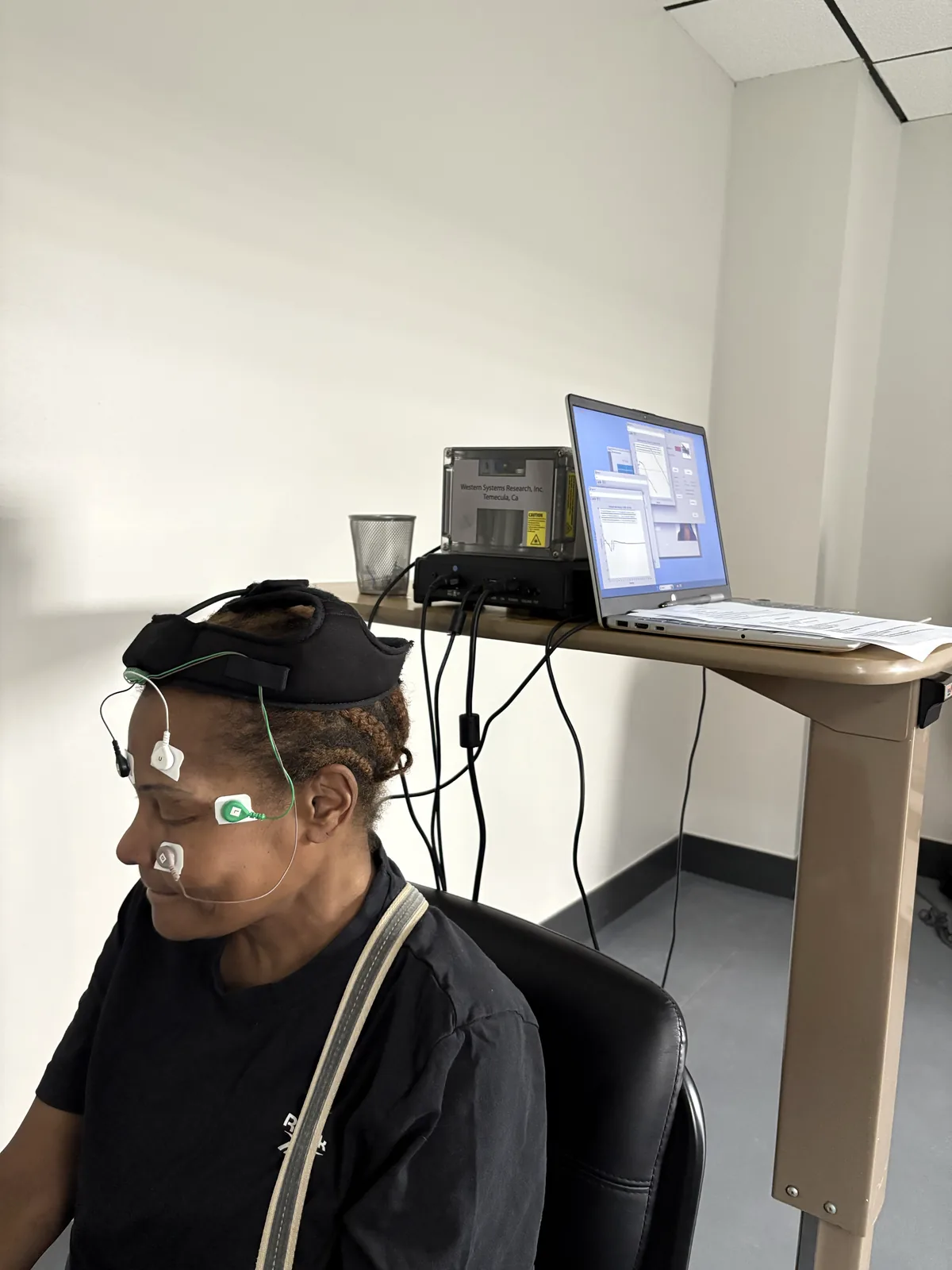
Testing is non-invasive. There are no needles and no injections. You sit for most of it. Sensors are placed near the eyes to record movement while you look at targets and while your position is changed.
Some position changes can bring on brief dizziness. That is part of what is being measured, not a sign something went wrong. The feeling usually settles quickly. Tell the person testing you if you have neck or back limits, so the positions can be adjusted. If position changes tend to leave you unsteady, it is wise to have someone drive you home.
What Do VNG Test Results Mean?
A result that points away from the inner ear is still useful. It narrows the problem toward sensory loss in the feet, vision, drug effects, or blood pressure changes on standing. That means balance work should be aimed there.
A result that points toward the vestibular system changes the plan. Inner-ear problems often respond to targeted rehab. That is a different program from general strengthening. Either way, the finding feeds into balance and gait work alongside the rest of your treatment. If you need care beyond our scope, we will say so and refer you.
Falls are the reason any of this matters. Balance in older adults usually has many causes. Inner ear, nerve, joint, vision, and heart and blood vessel factors overlap. So the goal is to find which contributors are actually present in you, not to treat the average patient.
The Metabolic Dose–Response: Why the Ear Fails Alongside the Nerve
This is the part that makes vestibular testing a neuropathy question, not an ear question.
Researchers examined vestibular function in the National Health and Nutrition Examination Survey. They did not simply find that people with diabetes had more inner-ear dysfunction than people without. They found that it tracked with the metabolic state. It was more common with longer disease, more common with higher hemoglobin A1c, and more common alongside the other diabetic complications. The authors described the pattern as suggestive of a dose–response relationship between the severity of the metabolic disease and damage to the vestibular system.
The same analysis went further. Vestibular dysfunction raised the odds of falling more than twofold in people with diabetes. The odds ratio was 2.3 (95 percent confidence interval 1.1 to 5.1). And that was after adjusting for peripheral neuropathy and retinopathy. Then vestibular dysfunction, peripheral neuropathy and retinopathy were all entered together. The link between diabetes itself and falling disappeared into those three complications.
That is the terrain argument, stated in survey data. The inner ear is not a separate organ that happens to fail at the same time as your feet. It is the same small-vessel, small-fiber, metabolically-driven process showing up in a different tissue. And it adds to your fall risk independently of what your feet are doing.
It is also why treating the terrain is not an add-on to balance care. It is the part of balance care with the most leverage.
Quantifying Fall Risk Takes More Than One Test
Standing upright is a system with backups: inner ear, position sense from the feet and legs, and vision, checked against each other all the time. Any one part can weaken a long way while the other two carry the load. That is why people with large deficits walk normally in a bright, familiar room and go down in a dark hallway.
So the number that matters is not whether a deficit exists. It is how much reserve is left. That takes measuring more than one system:
- VNG — the inner ear and its central connections. It shows whether a loss is peripheral and can be rehabbed, or central and something else.
- Kinetisense [Gait Analysis for Fall Analysis] — markerless motion capture of posture, weight shift, sit-to-stand and gait. It shows the end result after every system has made up for the others.
- Cognivue [Cognitive and Memory Testing] — attention and processing speed. These decide whether a stumble gets caught or ends in a fall.
- Small fiber and autonomic testing — feeling from the sole, and the blood pressure response to standing. A silent orthostatic drop (blood pressure falling when you stand) is its own way to fall.
- Ankle–brachial index and vascular flow — because numb, cold feet are not always a nerve problem, and the treatment is entirely different.
- EMG and nerve conduction studies — whether weakness comes from a peripheral nerve, a nerve root or muscle. Only electrodiagnostic testing tells them apart.
![Clinician holding a tablet running Kinetisense [Gait Analysis for Fall Analysis] markerless motion capture with joint tracking markers and center-of-mass crosshairs overlaid on a patient standing for postural and gait assessment at Padda Institute, St. Louis](https://regenerve.com/wp-content/uploads/2026/10/regenerve-kinetisense-fall-risk-capture.webp)
A systematic review of diagnostic balance tests reached the same conclusion from the research side. A brief test is reasonable for screening, but a battery is needed for a comprehensive assessment. One test finds one deficit. It tells you nothing about the margin behind it. A full assessment instead produces a set of numbers that can be tracked: a risk-of-fall percentage, a mobility index, cadence, sway and gait velocity. Each is also compared against normal values.
![Kinetisense [Gait Analysis for Fall Analysis] Risk of Fall Gait report showing a high risk-of-fall percentage and low mobility index, with a table of serial measurements of risk of fall percentage, cadence, sway and gait velocity across five assessment dates](https://regenerve.com/wp-content/uploads/2026/08/padda-proc-kinetisense-risk-of-fall-gait-report.webp)
![Kinetisense [Gait Analysis for Fall Analysis] report showing gait velocity and cadence against normative values across five dates, a front-view postural compensation diagram, and a center of mass sway plot recorded during active gait](https://regenerve.com/wp-content/uploads/2026/08/padda-proc-kinetisense-center-of-mass-gait.webp)
What Losing Your Footing Actually Costs
For a neuropathy patient, the loop feeds itself through metabolism. That makes it different from an ordinary fall risk. Unsteadiness cuts down walking. Less walking costs muscle, and muscle is where most glucose is cleared. Poorer glucose clearing worsens the small-vessel and small-fiber damage already underway. That damage weakens feeling and inner-ear function further, and the unsteadiness deepens. The fall does not start the cycle. It speeds up one that is already turning.
What gets lost along the way is not recorded anywhere. Driving. Stairs. Showering without help. Going out after dark. Staying in your own home. People give these up one at a time, quietly. They usually tell nobody until something breaks.
There is a wider cost too. Neuropathy is common and under-diagnosed. Its balance effects arrive so quietly that they are often recorded for the first time in an emergency room. Then come the fracture, the hospital stay, the loss of independent living, and the family member who leaves work. That is costly in every way that matters. Nearly all of it flows from a metabolic process that could have been measured years earlier. Balance testing is not an extra in neuropathy care. It is how you find out how much time is left to change the outcome.
Frequently Asked Questions
I already know I have neuropathy. Why test my ears?
Because the two can exist together. The survey data above found vestibular dysfunction raised fall odds even after peripheral neuropathy was accounted for. Knowing your neuropathy diagnosis does not tell you whether a second contributor is present.
Does VNG hurt?
No. It is non-invasive and involves no needles. Certain position changes may briefly make you feel dizzy, which is part of the measurement. Our clinic FAQ covers what to expect at a first visit more broadly.
Will VNG fix my balance?
No. VNG is a diagnostic test, not a treatment. It decides whether balance work should be aimed at the inner ear or somewhere else. That is the difference between a targeted program and a generic one. See the services overview for what follows testing.
Should I stop any medication before the test?
Do not stop anything on your own. Some drugs affect the results. Bring your current list, and we will advise you ahead of time. You can send questions ahead through the contact page.
How does this fit with the rest of my neuropathy care?
It sits with the diagnostic work, not the treatment plan. Alongside on-site nerve testing, it shows what is actually driving your symptoms before a program is built. Starting with the free Nerve Damage Score is a reasonable first step.
How will I feel after a VNG test?
Some of the position changes can bring on brief dizziness. That is part of what the test measures, not a sign that something went wrong. It usually settles quickly. If you know position changes tend to leave you unsteady, have someone drive you home. Tell the person testing you about any neck or back limits beforehand, so the positions can be adjusted.
What does a VNG test diagnose?
VNG shows whether the balance organs of the inner ear are adding to your unsteadiness, and whether the two sides differ. It also helps tell where a loss sits. It may sit in the inner ear itself, where rehab can help. Or it may sit in its central connections, which points somewhere else. It is a measurement, not a treatment: it turns “I feel unsteady” into something specific enough to act on.
What if my VNG test comes back normal?
A result that points away from the inner ear is still useful. It narrows your unsteadiness toward sensory loss in the feet, vision, drug effects, or blood pressure changes when you stand up, so balance work is aimed there instead. A result that points toward the inner ear changes the plan to targeted vestibular rehab. That is a different program from general strengthening.
Unsteady on Your Feet?
Start with your free Nerve Damage Score. Or schedule a consultation, and we will work out which parts of your balance system need attention.
Sources
- Teggi R, Familiari M, Battista RA, et al. “The social problem of presbystasis and the role of vestibular rehabilitation in elderly patients: a review.” Acta Otorhinolaryngologica Italica, 2023;43(4):227–234. Review describing balance impairment in older adults as multifactorial, including peripheral neuropathy and vestibular contributions. doi:10.14639/0392-100X-N1908
- Agrawal Y, Carey JP, Della Santina CC, Schubert MC, Minor LB. “Diabetes, vestibular dysfunction, and falls: analyses from the National Health and Nutrition Examination Survey.” Otology & Neurotology, 2010;31(9):1445–1450. Vestibular dysfunction independently raised fall odds in people with diabetes (OR 2.3, 95% CI 1.1–5.1) after adjusting for peripheral neuropathy and retinopathy, with a dose–response pattern against disease duration and hemoglobin A1c. doi:10.1097/MAO.0b013e3181f2f035
- Agrawal Y, Carey JP, Della Santina CC, Schubert MC, Minor LB. “Disorders of balance and vestibular function in US adults: data from the National Health and Nutrition Examination Survey, 2001–2004.” Archives of Internal Medicine, 2009;169(10):938–944. In 5,086 US adults aged 40 and older, 35.4% had measurable vestibular dysfunction; those who were symptomatic had a 12-fold increase in the odds of falling. doi:10.1001/archinternmed.2009.66
- Kozinc Ž, Löfler S, Hofer C, Carraro U, Šarabon N. “Diagnostic Balance Tests for Assessing Risk of Falls and Distinguishing Older Adult Fallers and Non-Fallers: A Systematic Review with Meta-Analysis.” Diagnostics (Basel), 2020. Concludes a brief test suits screening while a battery is needed for comprehensive fall-risk assessment. PMC7554797