

An EMG and nerve conduction study checks how well your muscles and the nerves that control them are working.1 EMG reads the electrical signals your muscles make at rest and in use. The nerve conduction study measures how fast and how well electrical signals move along your nerves, because a damaged nerve has a slower and weaker signal.1 At Regenerve the testing is done on site, so the exam and the results happen in one place.
What does an EMG test show?
MedlinePlus puts the idea simply: a healthy muscle should not give off any electrical signals when you are not moving it.1 If a muscle is damaged, it may show electrical activity at rest, or abnormal activity during use.
That is why EMG is a snapshot of how the muscle works, not a picture of how it looks. It tells you how the muscle is behaving right now. An image cannot give you that.
What does a nerve conduction study measure?
StatPearls says nerve conduction studies give data on three things: nerve conduction velocity, the amplitude of the compound motor action potential, and the sensory nerve action potential.2 Conduction velocity measures how fast signals travel in the large, coated (myelinated) axons of the nerve.
That last detail is the one patients most often need. The study mostly tests large, coated fibers. That is why it can read normal in a person whose symptoms come from small fibers.
Why are EMG and nerve conduction studies done together?
MedlinePlus notes that the tests can be done separately but are usually done at the same time.1 The combined pattern is what turns a set of abnormal numbers into a useful map of where the problem sits.
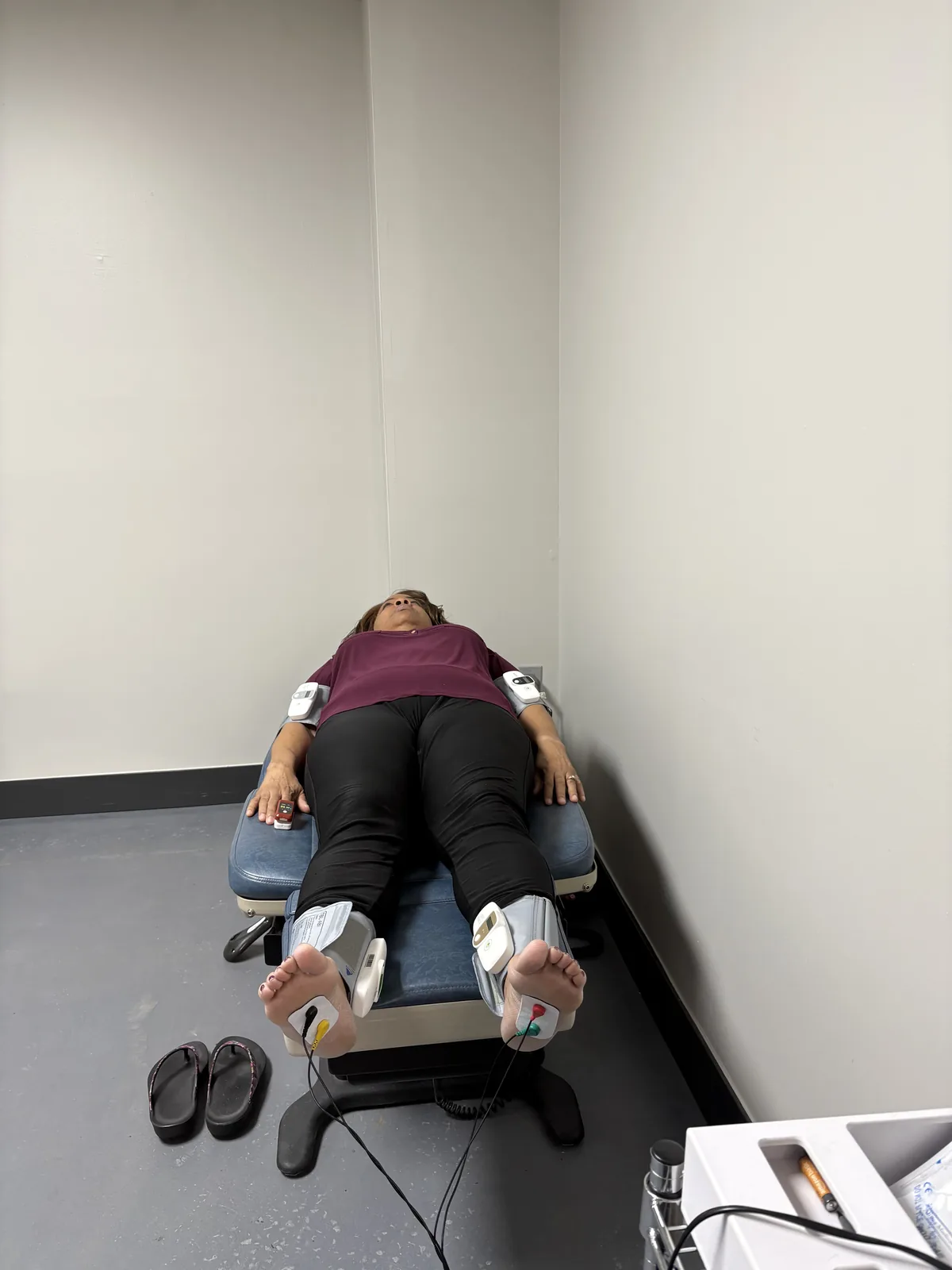
What can a nerve conduction test show, and what can it not?
StatPearls lists the clinical uses for nerve conduction studies and EMG. They help study how a disease works, judge how severe it is, find the level of injury and predict the outlook.2 These studies also help pinpoint the injury, tell sensory (feeling) from motor (strength) damage, and tell axonal from demyelinating patterns.2
What they do not do is name the cause. A slowed conduction speed does not say whether the cause is metabolic, nutritional, autoimmune, toxic or structural. And that is the question that decides treatment.
What does a normal EMG result mean?
A normal study means the specific nerves and muscles tested did not show a measurable problem. It does not mean the symptoms are imagined. And it does not end the workup.
Sometimes symptoms point to small fibers: burning, temperature change, changes in sweating. Then a normal large-fiber study is an expected finding, not a contradiction.
How we use the result at Regenerve
The test result is one input into finding which cause is injuring the nerve. From there we build a physician-directed plan around that cause, not around the word “neuropathy.”
Our services include on-site electrodiagnostic testing, class 4 photobiomodulation, class 3B cold laser, whole-body infrared, metabolic and nutrition care, and VNG balance testing. VNG is a test of inner-ear balance, not a treatment. Orthobiologic injections (PRP and BMAC) are offered in selected situations. The full list is on the Regenerve services page.
We do not promise nerve regeneration, reversal or cure, and we do not publish a success rate for our protocol.
We are at 4477 Woodson Rd #104, St. Louis, MO 63134, minutes from St. Louis Lambert International Airport, and we see patients from the St. Louis region, Missouri and Illinois. Directions and hours are on our St. Louis neuropathy treatment page.
Start with your Nerve Damage Score
If you are trying to decide whether nerve testing is your next step, the free five-question Nerve Damage Score is a fast way to focus the first visit.
Frequently asked questions
What does an EMG and nerve conduction study appointment involve?
Both tests are usually done in the same visit. EMG looks at the electrical signals your muscles make at rest and when used. The nerve conduction study measures how fast and how well signals move along your nerves. See small fiber neuropathy symptoms and testing.
My EMG was normal but my feet still burn. What does that mean?
It means the tested nerves and muscles did not show a measurable problem. It does not mean nothing is happening. Nerve conduction velocity measures signals in large, coated axons, so a small-fiber problem can hide under a normal study. See peripheral neuropathy of the feet symptoms.
What questions can the results actually answer?
StatPearls lists the clinical uses: studying how a disease works, judging how severe it is, finding the level of injury and predicting the outlook. They answer specific questions, not one single verdict. See the hidden drivers of peripheral neuropathy.
Does an abnormal result confirm diabetic neuropathy?
No. An abnormal study shows that nerve function is impaired. It does not find the cause, and more than one cause can be present at once. The cause workup goes on after the test result. See diabetic peripheral neuropathy treatment in St. Louis.
What happens if your EMG is abnormal?
An abnormal result shows that nerve or muscle function is impaired. The pattern can locate the problem, tell feeling from strength damage, and tell axonal from demyelinating damage. It does not name the cause. At Regenerve the result becomes one input into finding the cause, whether metabolic, nutritional, autoimmune, toxic or structural. Then the plan is built around that cause.
Where can I get an EMG and nerve conduction study in St. Louis?
Regenerve does EMG and nerve conduction studies on site at 4477 Woodson Rd #104, St. Louis, MO 63134, minutes from St. Louis Lambert International Airport. Because testing happens where you are examined, the results and the plan come together in one place. We see patients from the St. Louis region, Missouri and Illinois. Call (314) 886-5739 or text (314) 886-5902.
Sources
- MedlinePlus, U.S. National Library of Medicine. “Electromyography (EMG) and Nerve Conduction Studies.” Last updated April 10, 2024. https://medlineplus.gov/lab-tests/electromyography-emg-and-nerve-conduction-studies/
- Ramani PK, Lui F, Arya K. “Nerve Conduction Studies and Electromyography.” StatPearls [Internet]. Treasure Island (FL): StatPearls Publishing. Last updated February 10, 2025. https://www.ncbi.nlm.nih.gov/books/NBK611987/