
The exercises that work for peripheral neuropathy in the feet combine endurance and sensorimotor balance training. Add strength work two to three days a week and five minutes of foot and ankle mobility daily.
Exercise is the only treatment for peripheral neuropathy in the feet that has been shown, in people and not just animals, to change the nerve fibers themselves. Yet it is usually mentioned last, on the way out the door.
This article sets out what the trials actually tested and why it works. It gives a practical weekly program you can start with. And it covers the foot-protection rules that make exercising on numb feet safe.
Does exercise help peripheral neuropathy in the feet?
A 2022 systematic review with meta-analysis pooled 41 randomized controlled trials of exercise in patients with neuropathy. Of those, 27 were in diabetic peripheral neuropathy. The authors concluded that evidence-based advice can now be given for this group. They found the most helpful approach is a combination of endurance and sensorimotor training. Effects favored exercise across static balance, the Berg Balance Scale, the Timed Up and Go test, peroneal and sural nerve conduction velocity, and HbA1c.1
Look at what is in that list. The point is more than “patients felt better” here. Nerve conduction velocity and HbA1c both moved. Exercise is acting on the nerve and on the metabolic environment that damaged it.
Two smaller studies show the same thing at the level of the nerve fiber. In one, 17 people with diagnosed diabetic peripheral neuropathy did a 10-week supervised aerobic and strength program. It produced significant reductions in pain and in nerve symptoms. Skin biopsies also showed more intraepidermal nerve fiber branching.2 In the other, 32 patients with impaired glucose tolerance and neuropathy got a year of diet and exercise counseling made for each person. Their intraepidermal nerve fiber density rose by 1.4 fibers per millimeter at the biopsy site higher up the leg. That gain tracked with less nerve pain.3
These were small studies without large control groups, and they are not a promise of recovery. But they are direct evidence that nerve fibers respond to a change in the metabolic environment.
Why does exercise help neuropathy?
The nerves to your toes are the longest cells in the body, and they are fed by the smallest blood vessels. They fail first when fuel and oxygen delivery falters. Exercise attacks that problem from several sides at once. It improves insulin sensitivity and sugar handling. It lowers triglycerides and raises HDL. It improves tiny-vessel function and increases blood flow to the vasa nervorum, the vessels that feed the nerve itself.
That breadth is exactly what this condition needs. Tighter sugar control alone has a clear preventive effect in type 1 diabetes. But the effect is much weaker in type 2, where blood fats, blood pressure and insulin resistance carry a lot of weight.4 Among patients with idiopathic neuropathy, even those with fully normal blood sugar carried a heavy load of metabolic syndrome features, especially abnormal blood fats.5 Exercise is one of the few treatments that moves all of those at once. The mechanism is covered further in how sugar damages nerves.
How do you exercise safely with neuropathy in your feet?
- Get cleared. Talk to your physician first. This matters most if you have heart disease, eye disease from diabetes (retinopathy), kidney disease, an open wound, or an unexplained hot, swollen foot. A hot, swollen foot needs a checkup before any weight-bearing exercise.
- Inspect both feet before and after every session, including between the toes and the soles. Use a mirror if you cannot see them easily. When protective feeling is dulled, the foot stops reporting injury. That is why the visual check replaces the pain you would normally feel.6
- Wear properly fitted athletic shoes and seamless socks. Check inside the shoe with your hand before putting it on.
- Have support available. Do balance work next to a counter, a wall or a sturdy chair.
- Stop for any new blister, hot spot, unusual swelling, chest symptoms or a fall.
What is a good weekly exercise plan for neuropathy?
The evidence points to endurance plus sensorimotor training, with strength work supporting both. Build up to this over four to six weeks instead of starting at the top.
1. Endurance — 3 to 5 days per week
Start with 10 minutes and add 2 to 3 minutes per week. Work toward 30 minutes at a pace where you can talk but not sing. Walking is the default. Foot pain, ulcer risk or poor balance may make walking unwise. If so, a stationary bike, a recumbent bike, a rowing machine, an arm ergometer or water walking gives the same metabolic benefit while taking weight off the foot.
2. Sensorimotor and balance work — 3 to 5 days per week, 10 to 15 minutes
This is the part the meta-analysis found most crucial, and it is the one people skip. Always work within reach of a support.
- Feet-together stand — 30 seconds, progressing to eyes closed once it is easy with eyes open
- Semi-tandem then tandem stand — one foot partly, then fully in front of the other, 20 to 30 seconds each side
- Single-leg stand — start at 5 to 10 seconds per side, build toward 30
- Heel-to-toe walking — 10 steps along a countertop
- Weight shifts — forward, back and side to side, slowly, feeling the pressure move across the foot
- Head turns while standing — a harder test that trains the inner ear’s part in balance
- Foam or cushion standing — only once firm-ground work is reliably steady
Make it harder by taking away support, not by adding time. Go from eyes open to eyes closed, from two hands on the counter to one finger to none, and from firm ground to a soft surface.
3. Resistance — 2 to 3 days per week, non-consecutive
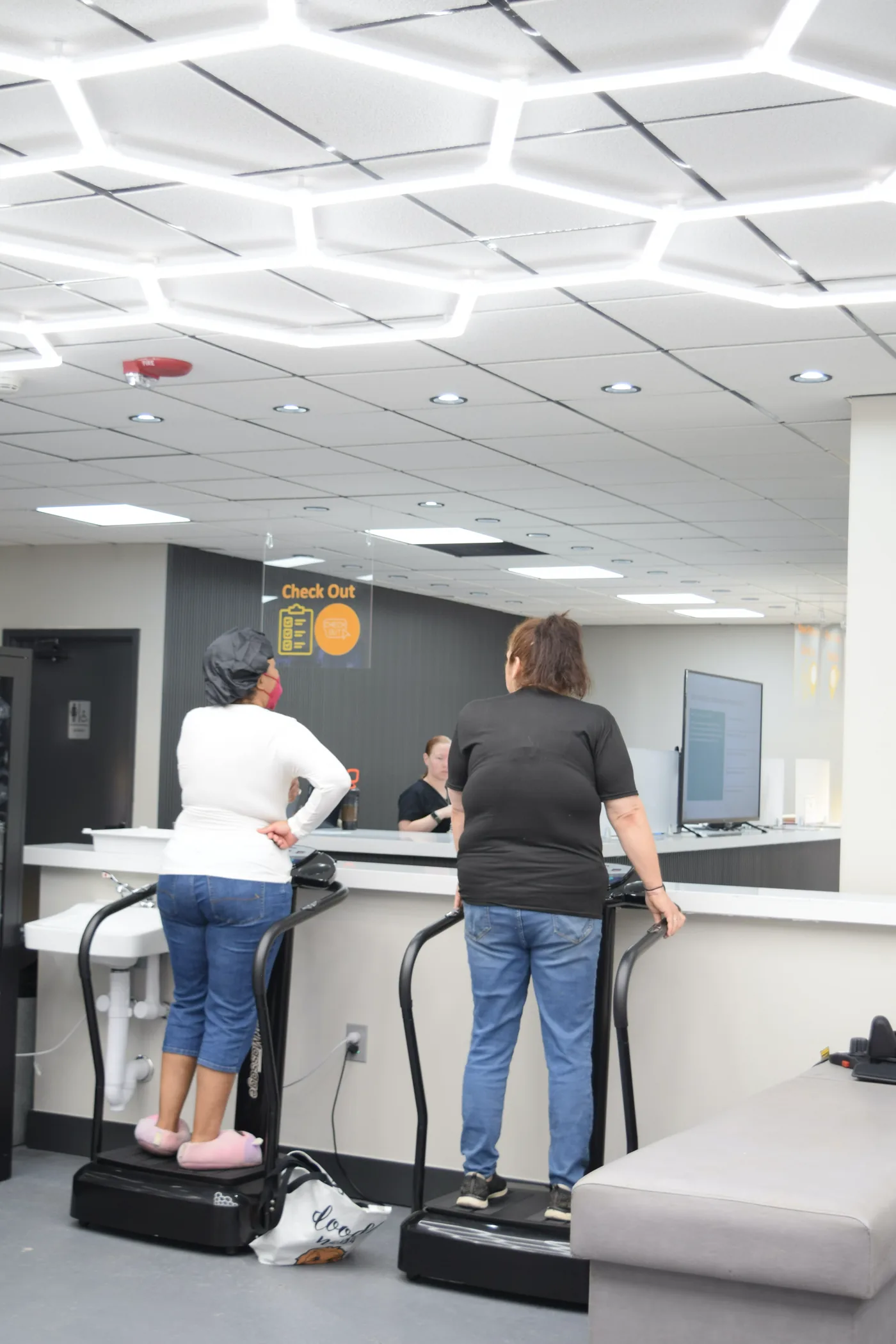
Do two to three sets of 10 to 15 reps of a few multi-joint moves. Good ones are sit-to-stand from a chair, heel raises, a seated or standing leg press or wall squat, hamstring curls, hip abduction, and rows or presses for the upper body. Elastic-band strength training has been studied in older adults with diabetic peripheral neuropathy for its effect on balance and fear of falling. It needs no equipment beyond a band.7
4. Foot and ankle mobility — daily, 5 minutes
- Ankle pumps, circles, and alphabet tracing with the toes
- Toe curls and spreads, and picking up a towel with the toes
- Calf and Achilles stretches — 30 seconds each side, twice
- Seated rolling of the sole over a ball, gently, and never on numb skin you have not inspected
5. Interrupt the sitting
Stand and move for two to three minutes every 30 minutes. This is not filler. Long stretches of sitting worsen sugar handling, whether or not you exercised earlier that day. And sugar handling is the thing you are trying to change.
What to expect, and when
Balance and steadiness usually improve first, often within four to six weeks. That is because they depend partly on training the feeling you still have and the muscles that use it. Pain and burning tend to shift over two to three months. Changes at the level of nerve fibers were measured at 10 weeks in one study and at 12 months in the other. This is a long-term treatment.
Some people notice a short-lived rise in feeling or discomfort in the first weeks. That usually settles. Sharp new pain, a hot or swollen foot, or any open area means stop and be seen.
Exercise is not the whole plan
Exercise is the highest-payoff thing you can do yourself. It does not replace finding out what is damaging the nerve. The cause may be a B12 deficiency, gluten-related injury, a medication, a toxic exposure or nerve compression. If so, that needs to be treated directly. The full list is in the 11 hidden drivers of peripheral neuropathy. How exercise fits alongside medical treatment is in peripheral neuropathy treatments for the feet. The supplements people usually ask about next are graded in alternative medicine for peripheral neuropathy.
Being evaluated in St. Louis
Regenerve is at 4477 Woodson Rd #104, St. Louis, MO 63134, minutes from St. Louis Lambert International Airport, and is led by Dr. Gurpreet Singh Padda, MD, MBA, MHP. The practice serves the St. Louis region, Missouri and Illinois. Balance and gait training, physical rehabilitation and nutritional counseling are part of what we offer, and electrodiagnostic testing is performed on site. The full list is on the services page.
Call (314) 886-5739 or text (314) 886-5902, or email info@regenerve.com. Office hours are Monday through Thursday 9:00 to 16:00 and Friday 9:00 to 13:30. Details are on the contact page and the locations page.
If you are not sure how far your neuropathy has progressed, the Nerve Damage Score can help. It is a five-question check that gives you a large-print report you can bring to any physician.
Frequently asked questions
What are the best exercises for peripheral neuropathy in the feet?
A combination of endurance training and sensorimotor or balance training, backed by strength work. A meta-analysis of 41 randomized trials found that combination most helpful in diabetic peripheral neuropathy. See peripheral neuropathy treatments for the feet.
Is walking safe if my feet are numb?
Usually yes, with well-fitted shoes and a look at both feet before and after every session, because a numb foot no longer reports injury. Any open wound or a hot, swollen foot needs a checkup before weight-bearing exercise. See peripheral neuropathy of the feet symptoms.
Can exercise regrow damaged nerves?
There is evidence that it can contribute. A 10-week supervised exercise program increased intraepidermal nerve fiber branching on skin biopsy. A year of diet and exercise counseling increased nerve fiber density. Recovery is partial and slow, and no one can promise a cure. See small fiber neuropathy symptoms and testing.
How long until exercise helps my neuropathy?
Balance and steadiness often improve within four to six weeks. Pain and burning usually shift over two to three months. In the published studies, changes measured at the nerve fiber were seen at 10 weeks and at 12 months. See the Regenerve Protocol.
What if I cannot walk far or my balance is poor?
Use a seated or supported option for the endurance part, such as a recumbent bike, an arm ergometer or water walking. Do balance work holding a counter. The metabolic benefit does not require walking. See the hidden drivers of peripheral neuropathy.
Should I exercise if it makes my feet hurt more?
A short-lived rise in feeling in the first weeks is common and usually settles. Sharp new pain, a new blister or hot spot, or a hot and swollen foot means stop and get checked. See which specialist you should see.
Does wiggling your toes help neuropathy?
Toe movement is useful, but it is not the main event. Toe curls and spreads, picking up a towel with your toes, and ankle pumps and circles make up a five-minute daily mobility routine. The trial evidence for less pain and better nerve measures comes from endurance plus balance training, backed by strength work. So toe exercises belong alongside that program, not in place of it.
Which exercises should you avoid with neuropathy in your feet?
It depends on your feet. Foot pain, ulcer risk or poor balance may make walking unwise. If so, switch to a stationary or recumbent bike, a rowing machine, an arm ergometer or water walking. Skip weight-bearing exercise until an open wound or a hot, swollen foot has been checked. Save foam or cushion balance work until you are reliably steady on firm ground.
Can I do neuropathy exercises at home?
Most of the program needs no gym. Balance work is done beside a kitchen counter, a wall or a sturdy chair. Strength work can be sit-to-stands from a chair, heel raises and wall squats. Elastic-band training has been studied in older adults with diabetic neuropathy using nothing but a band. Check both feet before and after every session.
Sources
- Streckmann F, et al. Exercise and Neuropathy: Systematic Review with Meta-Analysis. Sports Medicine. 2022. PMID 34964950
- Kluding PM, et al. The effect of exercise on neuropathic symptoms, nerve function, and cutaneous innervation in people with diabetic peripheral neuropathy. Journal of Diabetes and its Complications. 2012. PMID 22717465
- Smith AG, et al. Lifestyle intervention for pre-diabetic neuropathy. Diabetes Care. 2006. PMID 16732011
- Callaghan BC, Little AA, Feldman EL, Hughes RA. Enhanced glucose control for preventing and treating diabetic neuropathy. Cochrane Database of Systematic Reviews. 2012. PMID 22696371
- Smith AG, Rose K, Singleton JR. Idiopathic neuropathy patients are at high risk for metabolic syndrome. Journal of the Neurological Sciences. 2008. PMID 18606421
- Boulton AJM, et al. Comprehensive foot examination and risk assessment: a report of the task force of the foot care interest group of the American Diabetes Association. Diabetes Care. 2008. PMID 18663232
- Armat MR, et al. The Effect of Resistance Exercises Using an Elastic Band on Balance and Fear of Falling in Older Adults With Diabetic Peripheral Neuropathy. Archives of Physical Medicine and Rehabilitation. 2024. PMID 38218307