

Nerve symptoms can begin before anyone tells you that you have diabetes, and there are two separate reasons for that. The first is that a lot of diabetes has simply not been found yet. The CDC estimates that 27.6% of US adults aged 18 and older who have diabetes are undiagnosed. That is about 11.0 million people [1]. The second is that nerve injury is reported in people whose sugar handling is impaired but has not crossed the diabetes line [2].
Key takeaways
- An estimated 27.6% of US adults with diabetes do not know they have it. That is roughly 11.0 million people, based on 2023 data [1].
- An estimated 115.2 million US adults aged 18 and older have prediabetes [1].
- Peripheral neuropathy has been reported more often in people with impaired glucose tolerance than in people with normal glucose tolerance [2].
- About 20% of people with type 2 diabetes already have diabetic peripheral neuropathy when the diabetes is diagnosed [2].
- Neuropathy is a category, not a diagnosis. Sugar is one cause among several, and more than one is often active at once.
- Dulled protective feeling is a safety problem before it is a comfort problem. Daily foot checks start now, not after testing.
Why can neuropathy start before diabetes is diagnosed?
People fairly assume the order is diagnosis first, complications later. In practice, the metabolic changes come before the label, sometimes by years. The label arrives when someone happens to run the right test.
That is why “my sugar was normal” is weaker comfort than it sounds. It describes one measurement on one day. The CDC estimate of 11.0 million US adults with undiagnosed diabetes shows how often the measurement has simply not been made [1].
How common is neuropathy in prediabetes?
A 2017 review in the Journal of Diabetes Investigation looked at peripheral neuropathy in prediabetes and the metabolic syndrome. It reports that neuropathy has been found more often in people with impaired glucose tolerance than in people with normal glucose tolerance. It draws on population studies that looked at all three groups [2].
The same review notes that roughly 20% of people with type 2 diabetes already have diabetic peripheral neuropathy when the diabetes is diagnosed [2]. In those cases, nerve damage is not a late complication. It is there from the start.
What this does not prove is a line below which nerves are safe. What it shows is that sugar handling short of diabetes is worth taking seriously when someone has foot symptoms.
How does prediabetes damage nerves?
Nerves in the limbs are fed by very small blood vessels. They depend on steady oxygen delivery and steady metabolic conditions. Both can be disturbed while a person is still described as not diabetic.
Glycation
Over time, sugar reacts with proteins, and the products of that reaction build up in tissue. This is the chemistry behind how sugar damages nerves. It does not switch on at a diagnostic cutoff.
Perfusion and metabolic strain
Nerve tissue needs a lot of energy compared with the blood supply it gets. When delivery and demand stop matching, the longest fibers, the ones reaching the toes, show it first. That is why symptoms usually start at the feet.
What does prediabetic neuropathy feel like?
The pattern matters more than how strong it is. What people describe most often is burning at night, pins and needles, numbness that spreads slowly upward from the toes, or a sense that the foot is less responsive than it used to be.
Numbness is a safety issue first
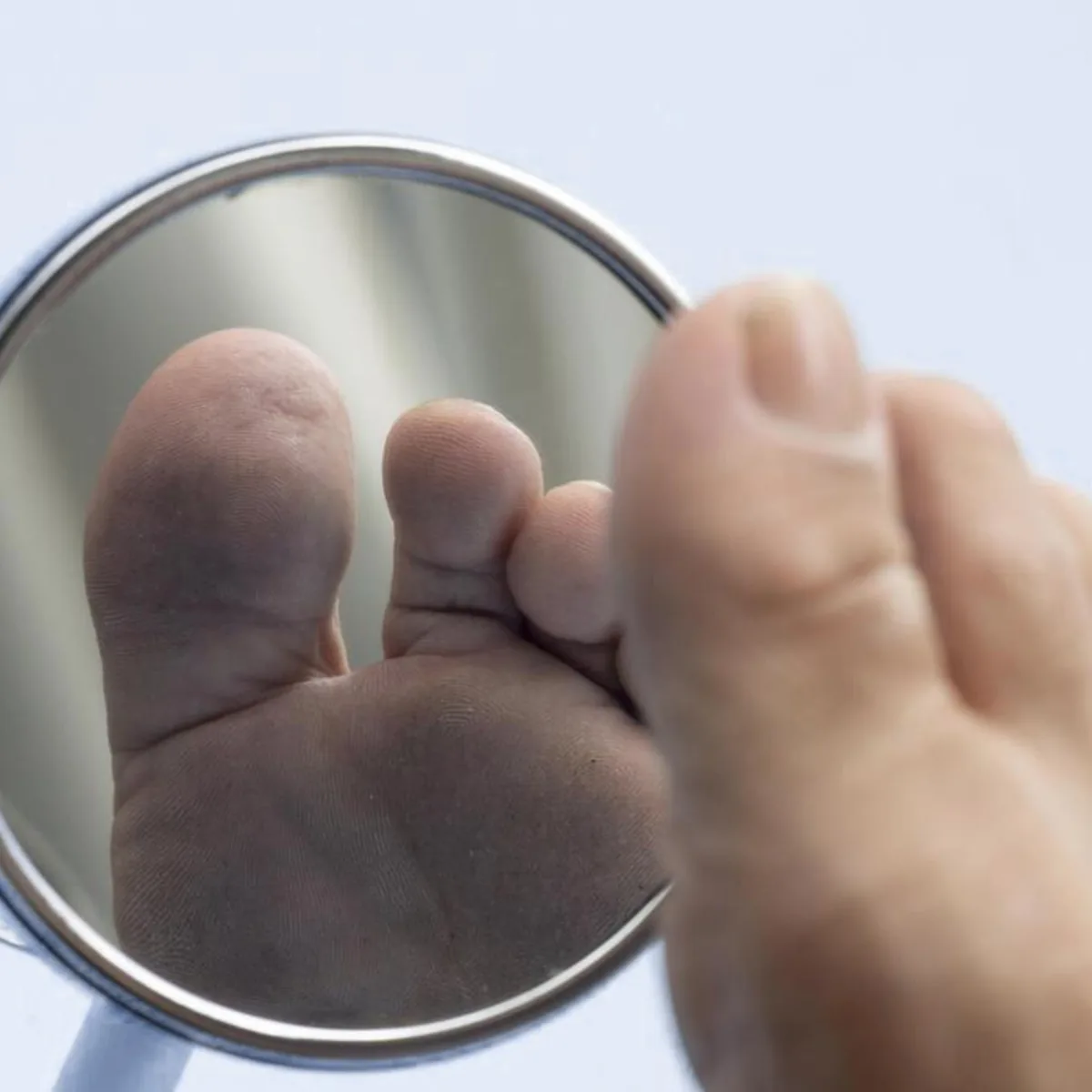
Loss of protective feeling means a blister, a seam, a pebble or a burn can go unnoticed until the skin has broken down. Check both feet daily, including between the toes and across the soles. Use a mirror or a second pair of eyes if you cannot see them easily.
Any open area, or a foot that is hot and swollen, needs a checkup, not watching and waiting.
Glucose is one driver, not the whole list
Even when sugar handling is clearly involved, it is rarely the only thing acting on the nerve. A workup that stops at the metabolic answer will miss the causes that are easiest to correct.
- Nutritional, including B12 status and poor absorption after stomach or bowel surgery.
- Autoimmune and inflammatory, including gluten-related and connective tissue processes.
- Toxic, including alcohol, heavy metal exposure and medicine effects such as chemotherapy.
- Structural, including trapped nerves and spine-related causes.
How is neuropathy tested at Regenerve?
The order is on purpose. Pin down the symptom pattern, then measure, then decide. We do electrodiagnostic testing (EMG/NCS) on site. It maps conduction in the larger nerve fibers.
Sometimes the story is burning and temperature change, not numbness and weakness. Then the small fibers are the likely target, and conduction studies are not the right tool. In those cases we use in-office small-fiber and blood-vessel checks, along with a metabolic and nutrition workup.
What care addresses, and what it does not promise
Regenerve offers class 4 photobiomodulation, class 3B cold laser, whole-body infrared and metabolic and nutrition care as parts of a plan built around the cause we find. Orthobiologic injections such as PRP and BMAC are offered in selected situations.
We do not promise nerve regeneration or reversal. We do not publish success percentages for our protocols.
Two related reads: early signs of diabetic peripheral neuropathy in the feet, and why belly fat that will not come off often points to high insulin.
Frequently asked questions
Can nerve damage start before diabetes is diagnosed?
It can. A review of peripheral neuropathy in prediabetes and the metabolic syndrome reports that neuropathy has been found more often in people with impaired glucose tolerance than in people with normal glucose tolerance. It also reports that roughly 20% of people with type 2 diabetes already have diabetic peripheral neuropathy when the diabetes is first found. See how blood sugar damages nerves.
My A1c is normal. Does that rule out a metabolic cause?
Not by itself. A single value in the normal range describes that moment, not the years behind it. And sugar is only one of several metabolic inputs a nerve depends on. The more useful question is what else is on the list. See the hidden drivers of peripheral neuropathy.
What else causes neuropathy when blood sugar looks fine?
Nutrition, autoimmune, toxic and structural causes all produce foot symptoms that look like the metabolic pattern. More than one is often present at the same time. B12 status is one of the first to check because it is common, testable and correctable. See functional B12 deficiency and neuropathy.
Should I be checked for celiac disease or gluten sensitivity?
It belongs in the workup when the pattern does not fit a metabolic neuropathy that hits the longest nerves first. It also belongs there when gut symptoms come with the nerve symptoms. Standard screening does not close the question in every case. See the gluten and neuropathy connection.
My feet are numb. What should I be doing at home right now?
Check both feet daily, including between the toes and the soles, because dulled protective feeling means an injury can go unnoticed until it is infected. Use a mirror or ask someone to look. Get any open area or hot, swollen foot checked, not watched. See small fiber neuropathy symptoms and testing.
How can you tell if neuropathy is from diabetes?
You cannot tell from the symptoms alone, because nutrition, autoimmune, toxic and structural causes produce foot symptoms that look like the metabolic pattern. More than one is often active at once. At Regenerve we start with the symptom pattern, then measure. That means EMG/NCS on site for the larger nerve fibers. It means in-office small-fiber and blood-vessel checks when burning is the main complaint. And it means a metabolic and nutrition workup.
What are the symptoms of prediabetes in the feet?
Nerve symptoms from impaired sugar handling usually start at the toes, because the longest nerve fibers are the first to show strain. People describe burning at night, pins and needles, numbness that creeps slowly upward, or a foot that feels less responsive than it used to. Dulled feeling also means a blister or small cut can go unnoticed, so check both feet every day.
Does neuropathy from prediabetes go away?
Nobody can honestly promise that, and Regenerve does not promise nerve regeneration or reversal. What we do is find the cause first, because sugar is rarely the only one. Then we build the plan around it. That plan can include metabolic and nutrition care, class 4 photobiomodulation, class 3B cold laser and whole-body infrared, with PRP or BMAC injections in selected situations. Daily foot checks start now.
Start with the Nerve Damage Score
The starting point at Regenerve is the free five-question Nerve Damage Score. It takes a few minutes. It tells us which cause to look at first, so your visit starts with a plan instead of a guess.
Take the free Nerve Damage Score assessment. Then bring the result to a physician-led visit at Regenerve, 4477 Woodson Rd #104, St. Louis, MO 63134, minutes from St. Louis Lambert International Airport. We see patients from the St. Louis region, Missouri and Illinois.
Sources
- Centers for Disease Control and Prevention. National Diabetes Statistics Report, updated January 21, 2026 (2023 data). https://www.cdc.gov/diabetes/php/data-research/index.html — referenced for the estimate that 27.6% of US adults aged 18 or older with diabetes are undiagnosed, representing 11.0 million people, and for the estimate of 115.2 million US adults aged 18 or older with prediabetes.
- Stino AM, Smith AG. “Peripheral neuropathy in prediabetes and the metabolic syndrome.” Journal of Diabetes Investigation, 2017. https://pmc.ncbi.nlm.nih.gov/articles/PMC5583955/ — referenced for the higher reported frequency of neuropathy in people with impaired glucose tolerance compared with people with normal glucose tolerance, and for the finding that approximately 20% of people with type 2 diabetes have diabetic peripheral neuropathy at the time of diagnosis.