
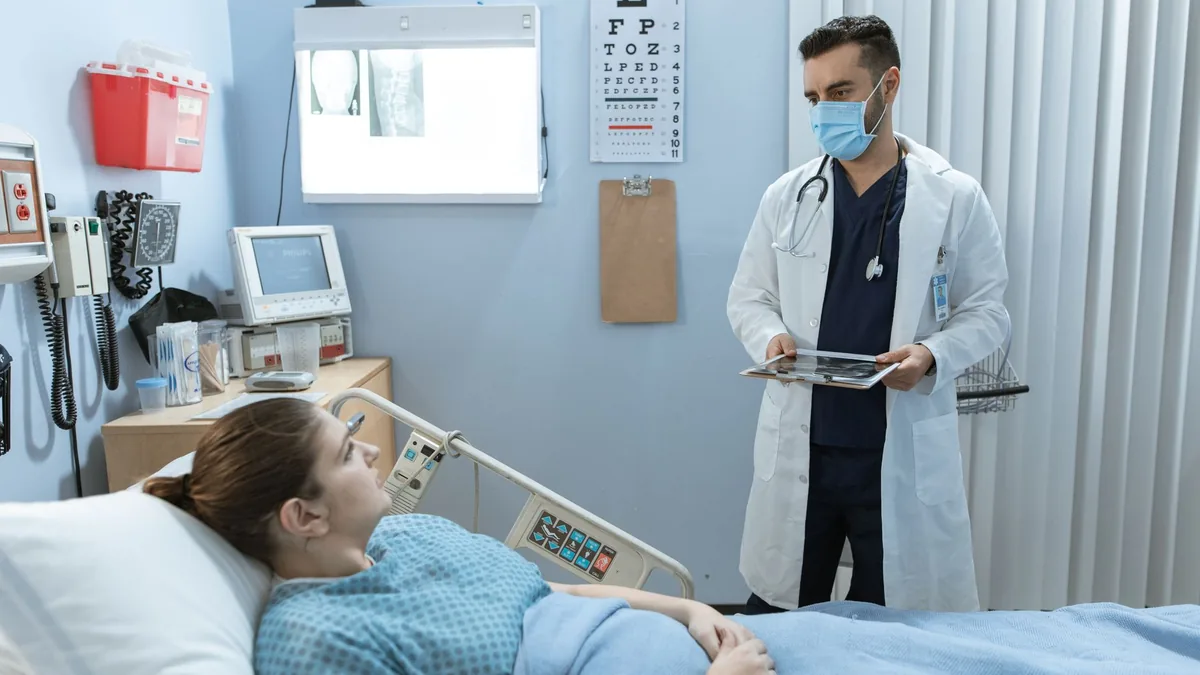
Ask the questions that force the visit to name a cause. The three that matter most are “What pattern do my symptoms follow?”, “What is this evaluation ruling in and ruling out?”, and “What would each test change about my plan?” Neuropathy is a category, not a diagnosis. So an evaluation that ends at the word “neuropathy” has not finished its job.
Peripheral neuropathy shows up in many ways. It can bring numbness, tingling, aching, burning, weakness of the limbs, hyperalgesia (extra pain), allodynia (pain from light touch) and pain, in varying degrees.1 That range is exactly why the symptom label alone cannot guide treatment. It is also why the questions below are built around finding the driver instead.
It is worth asking, because a careful workup finds an underlying cause in roughly 50 to 75 percent of patients with peripheral neuropathy.2 The rest of this checklist is what “careful” looks like from the patient’s side of the table.
What symptoms should I describe to my doctor?
Where symptoms started, how they spread, and whether both sides match are the first clues a clinician works from. Your job is to describe that pattern exactly. Do not boil it down to “my feet hurt.”
Questions that establish the pattern
- Where did this start, and in what order did it spread?
- Is it burning, numbness, weakness, or a combination?
- Are both sides affected equally, or is one side worse?
- What makes it worse and what makes it better across a normal day?
- Do I have balance changes, falls, or a change in how I walk?
A pattern that starts in both feet and creeps upward points one way. A sudden, one-sided, or fast-moving pattern points another. Say which of those describes you, and say it early in the visit.
Questions that make the evaluation commit
- What category are you most concerned about today?
- What finding would change your mind about that?
- What is this evaluation trying to rule in, and what is it trying to rule out?
- If this is small fiber involvement, how would you confirm it?
Want to learn more about nerve pain and the treatments we use? Get our neuropathy video series by email.
How is diabetic neuropathy diagnosed?
Having diabetes does not settle the question. It raises a second one: is diabetes the whole driver, or one of several stacked on top of each other?
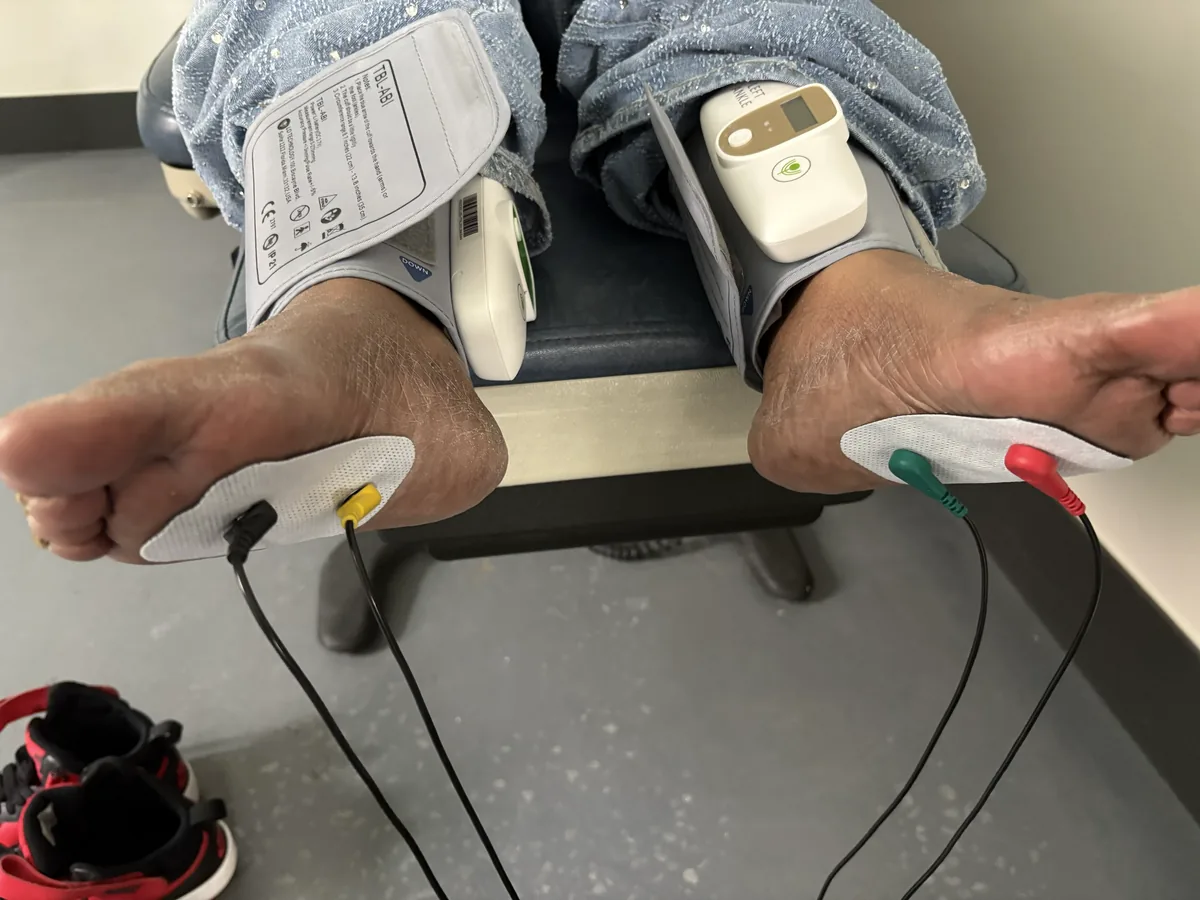
Peripheral neuropathy is mainly diagnosed in the exam room. It rests on your history and a neurological exam. Small fiber feeling is tested with temperature or pinprick. Large fiber feeling is tested with vibration. Ulcer risk is tested with 10 g monofilament pressure.1 Nerve conduction studies and intraepidermal nerve fiber density testing are called for when features are atypical. Examples are fast symptom onset, severe neuromotor impairment, or abnormal feeling that is worse on one side.1
Questions about testing purpose
- Does anything about my case count as atypical (unusual)?
- When would electrodiagnostic testing change what we do, rather than just confirm what we already suspect?
- If my nerve study is normal but my symptoms persist, what does that mean for the next step?
- How do my glucose history, A1c trend and kidney function change your concerns?
Regenerve performs electrodiagnostic testing (EMG/NCS) on site. That means the result is read against your history in the same building. It is not mailed back weeks later as a number without a plan.
What else causes neuropathy besides diabetes?
Nutritional, autoimmune, toxic and structural drivers can sit alongside a metabolic one, and they often do. If you have ever been told “nothing else explains it,” ask what exactly was checked. That is the useful follow-up.
Hidden-driver questions
- Besides diabetes, what other drivers are you looking at today?
- Could nutrient absorption be contributing, and how would you test that?
- Could a medicine, your drinking history, or something you were exposed to at work be involved?
- Did this begin after chemotherapy, surgery, or a shingles episode?
- If serum B12 is reported as normal, does that fully exclude a B12-related driver?
Our longer discussion of the drivers that get missed is in the hidden drivers of peripheral neuropathy. It is a fair list to bring with you to any evaluation, here or elsewhere.
What should I bring to a neuropathy appointment?
The best questions come out of your own timeline. A clinician can map the mechanism far faster when the details are on paper. Otherwise they get pieced together from memory in a fifteen-minute visit.
What to write down before you go
- The month and year symptoms began, and anything that happened around that time.
- Every prescription, store-bought medicine and supplement, with doses.
- Past surgeries, especially belly or weight-loss (bariatric) surgery.
- Alcohol history, stated honestly, because it changes the list of possible causes.
- Any prior nerve testing, lab work, or imaging, with the actual reports if you have them.
Ask what each treatment is aimed at
Once a driver is named, the questions shift from diagnosis to mechanism. The single most useful question about any proposed treatment is what it is meant to change. Is it the symptom, or the process producing the symptom?
Treatment questions worth asking
- What is the dominant driver in my case, and what does that imply for treatment?
- What is each proposed therapy targeting, and how will we know whether it worked?
- Which parts of this plan address the ongoing injury rather than the pain signal?
- How will the plan change if the driver map changes?
Regenerve offers class 4 photobiomodulation, class 3B cold laser and whole-body infrared. It also offers metabolic and nutritional care. Orthobiologic injections (PRP and BMAC) are offered too. Whatever is proposed, ask what it is aimed at before you agree to anything.
If shingles is in your history, ask about Qutenza specifically
Qutenza (capsaicin 8% patch) is FDA-approved in adults for neuropathic pain associated with postherpetic neuralgia and for neuropathic pain associated with diabetic peripheral neuropathy of the feet.3
Questions about the patch
- Does my diagnosis fall inside the approved indication?
- How long is the application, and how long is the visit?
- How often can it be repeated?
- What monitoring happens during and after the application?
It is applied in clinic by a clinician, never dispensed for home use, and repeated no more often than every three months.3
Questions that test the quality of the evaluation itself
The last set is about the clinic, not your nerves. A good evaluation should be able to answer these without pausing.
- How do you document which driver you believe is dominant, and what evidence supports it?
- What testing do you perform on site, and what gets sent out?
- When is the next touchpoint, and what should I bring to it?
- What would make you tell me this is not the right clinic for my problem?
Being evaluated in St. Louis
Regenerve is at 4477 Woodson Rd #104, St. Louis, MO 63134, minutes from St. Louis Lambert International Airport, and is led by Dr. Gurpreet Singh Padda, MD, MBA, MHP. The practice serves the St. Louis region, Missouri and Illinois.
Call (314) 886-5739 or text (314) 886-5902, or email info@regenerve.com. Office hours are Monday through Thursday 9 a.m. to 4 p.m. and Friday 9 a.m. to 1:30 p.m.
Want your answers organized before the visit? The Nerve Damage Score is a free five-question assessment. It produces a large-print report you can hand to any physician.
Frequently asked questions
What should I ask if my main symptom is numbness rather than pain?
Ask which fiber types the numbness pattern points to, and what test would confirm it. Then ask what loss of protective feeling means for foot care in the meantime. Numbness without pain still needs a driver named. See small fiber neuropathy symptoms and testing.
How do I prepare if my feet burn at night?
Write down when the burning starts, whether both sides match, and what changes it. Then ask which mechanism the clinician thinks is causing it. Bring that description, not a one-word summary. See burning feet and nerve pain.
Is a nerve conduction study always necessary?
No. Peripheral neuropathy is mainly a clinical diagnosis, made in the exam room. Nerve conduction studies are called for when features are atypical. Examples are fast onset, severe neuromotor impairment, or sensory findings that differ between sides. Ask what the result would change before you agree to it. See how to choose a neuropathy specialist.
What should I ask if I think a B12 problem was missed?
Ask how functional B12 status is checked when the blood level reads normal, and what would be measured alongside it. Then ask what treatment decision that testing would drive. See functional B12 deficiency and neuropathy.
What if gluten or celiac disease is a possibility for me?
Ask whether a gluten-related driver is on your list of possible causes. Ask what testing supports or rules it out. And ask what happens if celiac testing is negative but symptoms fit. See the gluten and neuropathy connection.
What tests confirm neuropathy?
Most peripheral neuropathy is diagnosed in the exam room, from your history and a neurological exam. Temperature or pinprick tests small fibers. Vibration tests large fibers. A 10 g monofilament checks ulcer risk. Nerve conduction studies and skin biopsy nerve fiber counts are added when features are atypical. Examples are fast onset, severe weakness or uneven feeling between sides. Regenerve performs EMG/NCS on site.
Can doctors find the cause of neuropathy?
Often, yes. A careful workup finds an underlying cause in roughly 50 to 75 percent of patients with peripheral neuropathy. That is why an evaluation that ends at the word “neuropathy” is not finished. Ask what the visit is ruling in and ruling out. Ask what finding would change the clinician’s mind.
What symptoms does peripheral neuropathy cause?
Numbness, tingling, aching, burning, weakness in the arms or legs, and pain. That includes extra sensitivity to pain (hyperalgesia) and pain from a touch that should not hurt (allodynia). The same symptoms come from many causes, so the list alone cannot guide treatment. The pattern matters more: where it started, how it spread, and whether both sides are affected equally.
Sources
- Bodman MA, Dreyer MA, Varacallo MA. Diabetic Peripheral Neuropathy. StatPearls. StatPearls Publishing. 2024. NCBI Bookshelf NBK442009
- Peripheral Neuropathy: Asking the Right Questions. Practical Neurology. March–April 2009. practicalneurology.com
- Averitas Pharma, Inc. QUTENZA (capsaicin) topical system — full prescribing information. Updated July 2026. DailyMed