

Uremic neuropathy is nerve injury that develops with advanced kidney disease. Its most important feature is how often it is there before it is obvious. A Tunisian cohort study looked at 31 children with stage G5 chronic kidney disease. Nerve conduction testing found uremic neuropathy in 45% of them. That included 13% who had silent neuropathy with no symptoms.3 Adults show the same gap. In 200 patients with predialysis CKD studied in India, prevalence was 45% based on symptoms and 90% on electrophysiological testing.1
That gap between what patients feel and what testing finds is the practical case for looking early. Do not wait for symptoms to become convincing.
Key takeaways
- Symptoms lag behind nerve dysfunction. Silent neuropathy is well known in advanced CKD.3
- Severity tracks with kidney function. In one adult cohort, prevalence rose from 55% in Stage 3 to 84.8% in Stage 5.2
- Uremia is a driver, not the only driver. Nutrition, medicine, autoimmune and structural causes can overlap.
- Testing separates fiber types. We do electrodiagnostic testing on site. It tells large-fiber patterns apart from what small fibers are doing.
- No regeneration or cure is promised. The goals are less ongoing injury, better function and safer walking.
What is uremic neuropathy?
Uremic neuropathy means nerve injury that happens alongside advanced kidney disease. Patients describe burning, numbness, electric-shock feelings or less feeling. It usually starts in the feet and usually on both sides.
Those descriptions alone do not show which nerve fibers are involved or what is causing the injury. In the Tunisian cohort of children, axonal neuropathy (damage to the nerve fiber itself) was the main pattern. No demyelinating cases (damage to the nerve’s coating) were found.3
Small fiber and large fiber involvement look different
Small fiber damage tends to cause burning, hot-coal feelings and pain at night. Large fiber damage tends toward numbness, less vibration sense and weaker protective feeling. That is what affects balance and safe walking.
This matters because it changes what we watch and what counts as a real change over time.
What else can cause neuropathy in kidney disease?
When kidney disease is advanced, it is easy to stop looking there. But a nerve can be under pressure from several sides at once. The causes that can actually be cut back are often not the kidney disease itself.
The overlaps that most often matter
- Diabetes. Many patients with CKD also have diabetes. Diabetic nerve injury can worsen or mimic uremic nerve injury.
- Nutritional deficiency. Diet limits, poor absorption and medicine effects all raise the risk in this group.
- Medications. The medicine list deserves as much attention as the kidney stage.
- Toxic and environmental exposures, including alcohol.
- Autoimmune processes and structural compression, which can add a second, separate weak point.
Finding which of these is adding to the damage is what turns a diagnosis into a plan. Our overview of the hidden drivers of peripheral neuropathy covers the ones most often left unchecked.
How is uremic neuropathy diagnosed?
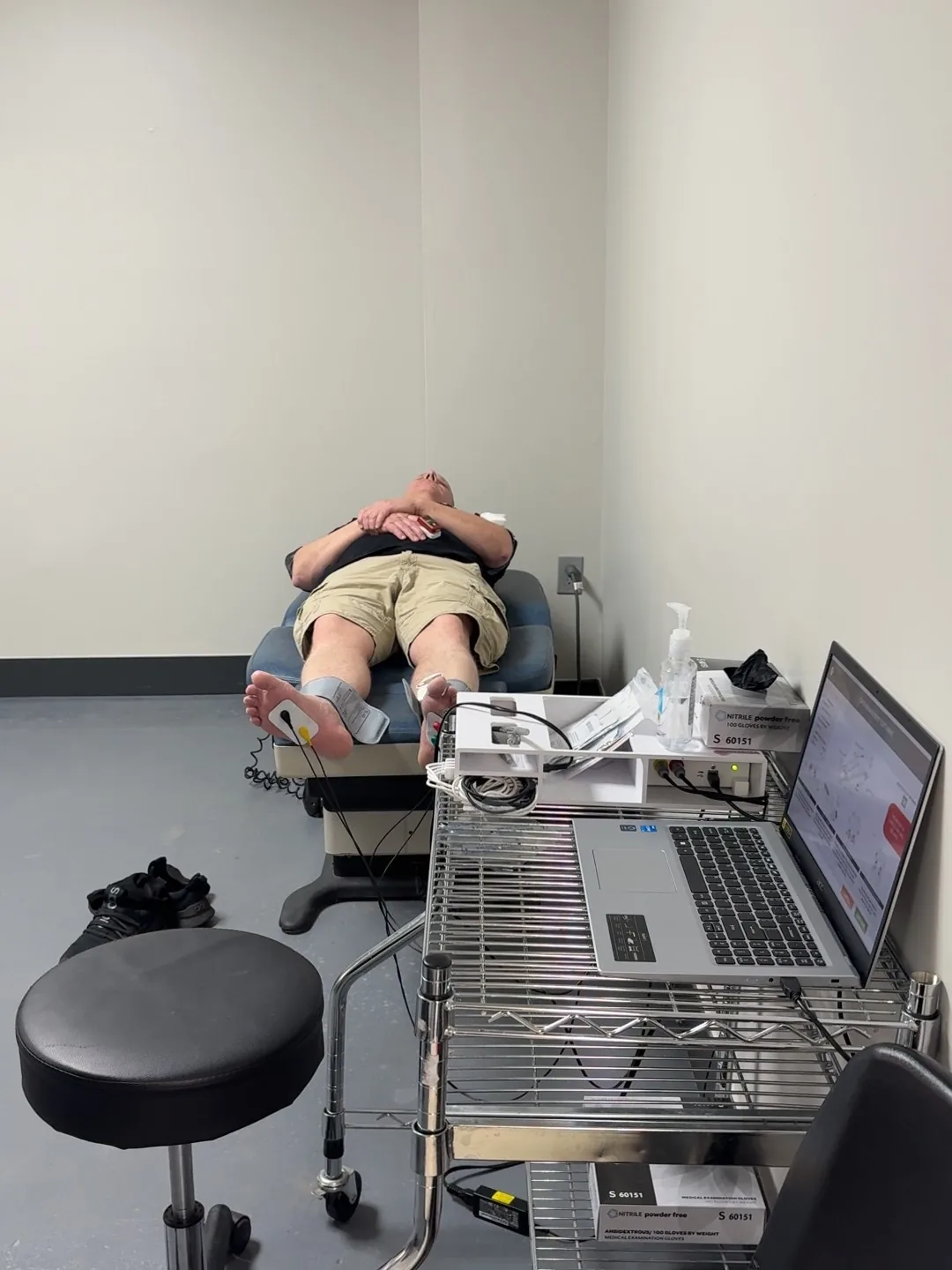
The workup answers two separate questions. Which nerves are affected? And what is affecting them? Testing answers the first. History, the exam and a metabolic review answer the second.
What it includes
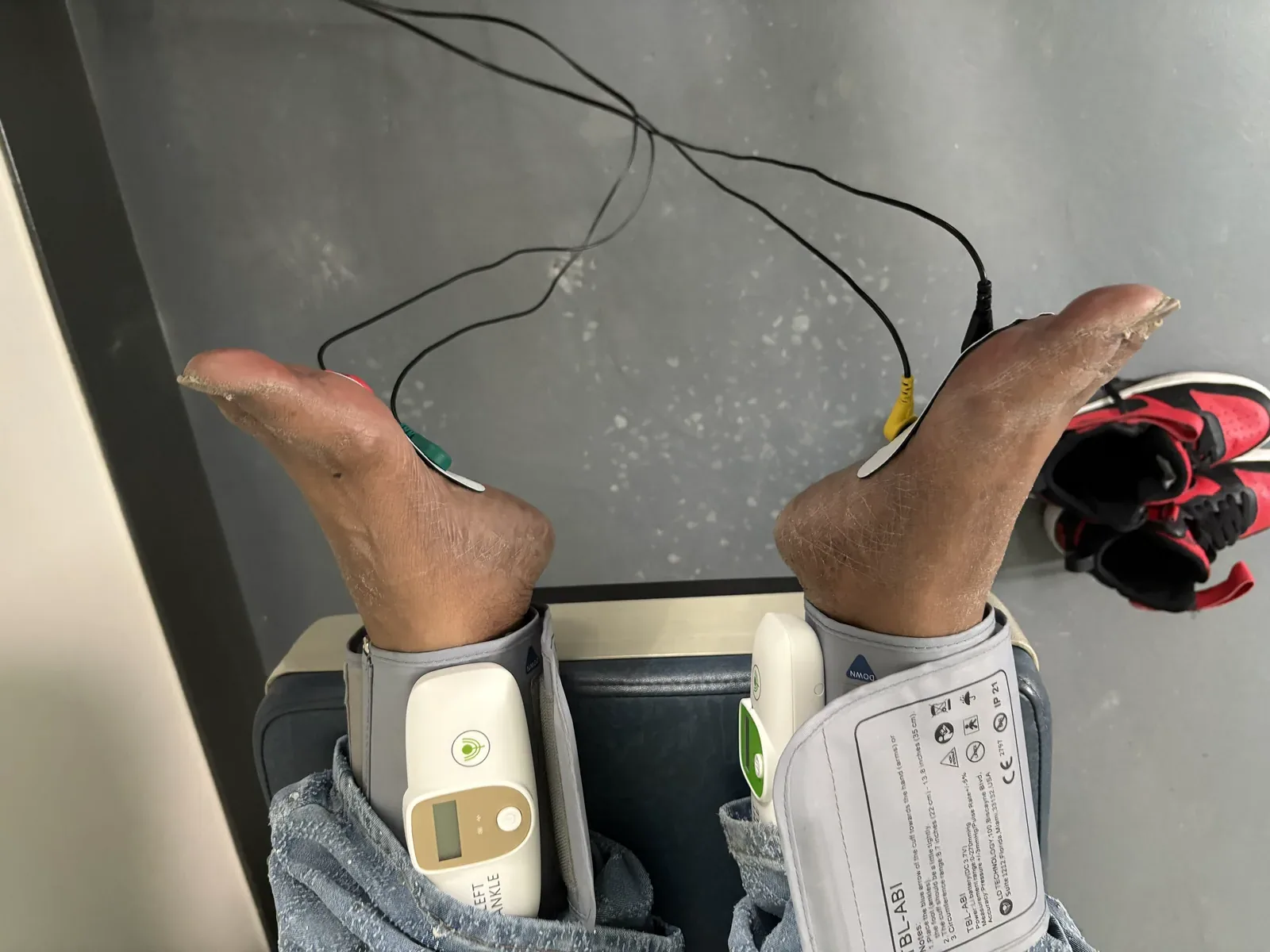
- Electrodiagnostic testing (EMG and nerve conduction studies), performed on site
- Metabolic and nutritional review, aimed at causes that can be fixed
- VNG balance testing when balance is affected. VNG is a test of inner-ear balance, not a treatment.
What testing does not settle
A nerve conduction study describes the injury. It does not name the cause. And a study that reads close to normal does not rule out small fiber damage. That is why we read the result alongside the rest of the workup, not on its own.
How is uremic neuropathy treated?
Surgery is not part of the treatment plan for uremic neuropathy. Care focuses on the workup, mapping the damage and non-surgical treatment. The aim is to cut ongoing nerve injury and support function.
The therapies used
- Class 4 photobiomodulation and class 3B cold laser, chosen when the symptom pattern and workup support them
- Whole-body infrared, used as part of the overall plan
- Metabolic and nutritional care, when we have found a cause that can be fixed
Kidney disease adds a limit we respect the whole way through. In this group, nutrition and metabolic changes are made together with the kidney team, not on their own.
Orthobiologic injections
Orthobiologic injections (PRP and BMAC) are offered in selected situations.
What we do not promise
We do not promise nerve regeneration, reversal or a cure. Nerve injury may have built up over years of advanced kidney disease. If so, the honest goals are less ongoing injury, better day-to-day function and safer walking.
Qutenza in this setting
Qutenza (capsaicin 8% patch) is indicated in adults for neuropathic pain associated with postherpetic neuralgia and for neuropathic pain associated with diabetic peripheral neuropathy of the feet.4
Where it is used, it is applied in clinic by a clinician, never dispensed for home use, and repeated no more often than every three months. More detail is on our page about the Qutenza capsaicin 8% patch.
Practical steps while you are being evaluated
- Check both feet daily if feeling is dulled. Use a mirror for the soles.
- Look for skin breakdown, calluses and pressure spots, and act on them early.
- Bring a current, complete medicine list to every visit.
- Report new weakness, new falls or a fast change right away. Do not wait for the next scheduled visit.
Regenerve in the St. Louis region
Regenerve treats peripheral neuropathy for patients across the St. Louis region, Missouri and Illinois, including Edwardsville, Glen Carbon, Collinsville, Troy and Maryville. The clinic is at 4477 Woodson Rd #104, St. Louis, MO 63134, minutes from St. Louis Lambert International Airport. Call (314) 886-5739 or text (314) 886-5902, or email info@regenerve.com.
Your next step
If you have kidney disease and nerve symptoms, take the free five-question Nerve Damage Score. It shows which group of causes most likely applies to you. Your answers guide what we check first.
Frequently asked questions
How often does neuropathy occur in chronic kidney disease?
It depends a lot on whether you count symptoms or nerve testing. One Indian hospital study looked at 200 adults with predialysis CKD. Prevalence was 45% based on symptoms and 90% on electrophysiological testing.1 Part of that gap is small-fiber injury that routine testing under-counts. See small fiber neuropathy symptoms and testing.
Does it get worse as kidney function declines?
That is the pattern reported. A cross-sectional study looked at 105 adults with CKD in Amritsar. Neuropathy prevalence rose from 55% in Stage 3 to 84.8% in Stage 5.2 Our workup, including on-site electrodiagnostic testing, is on the neuropathy services page.
Why do my feet burn at night if the problem is my kidneys?
Burning at night usually points to small-fiber damage. Small fibers can be affected while routine nerve conduction testing still looks close to normal. See burning feet and nerve pain.
Could something other than my kidney disease be causing this?
Often, yes. A nutrient shortage is one of the most common added causes in this group, and it can be fixed once it is found. See functional B12 deficiency and neuropathy.
What are the symptoms of uremic neuropathy?
People describe burning, numbness, electric-shock feelings or less feeling. It usually starts in the feet and usually on both sides. Burning and pain at night point to small nerve fibers. Numbness, less vibration sense and weaker protective feeling point to large fibers, and that is what affects balance. Many people show nerve changes on testing before they notice any symptoms at all.3
Can kidney disease cause tingling in the feet?
Yes. Nerve injury from advanced kidney disease usually starts in the feet, on both sides. It is also often there before it is felt. One study looked at 200 adults with predialysis CKD. By symptoms, 45% had neuropathy. But 90% showed it on nerve testing.1 Diabetes, low nutrients and medicines often overlap in this group. So tingling deserves a full search for every cause.
Is there a test for uremic neuropathy?
Yes. EMG and nerve conduction studies, done on site, show which nerves are affected. They often find neuropathy before symptoms do. In one cohort of children with stage G5 CKD, testing found neuropathy in 45%, including 13% with no symptoms.3 A near-normal study does not rule out small fiber injury and does not name the cause. So we read results alongside your history, exam and metabolic review.
Can uremic neuropathy be reversed?
We do not promise nerve regeneration, reversal or a cure. When nerve injury has built up over years of advanced kidney disease, the honest goals are less ongoing injury, better day-to-day function and safer walking. That is why the workup hunts for causes that can still be fixed, such as a nutrient shortage. It is also why any nutrition or metabolic change is planned with your kidney team.
Sources
- Jasti DB, Mallipeddi S, Apparao A, Vengamma B, Sivakumar V, Kolli S, “A Clinical and Electrophysiological Study of Peripheral Neuropathies in Predialysis Chronic Kidney Disease Patients and Relation of Severity of Peripheral Neuropathy with Degree of Renal Failure,” Journal of Neurosciences in Rural Practice, 2017;8(4):516-524, doi:10.4103/jnrp.jnrp_186_17, https://ruralneuropractice.com/a-clinical-and-electrophysiological-study-of-peripheral-neuropathies-in-predialysis-chronic-kidney-disease-patients-and-relation-of-severity-of-peripheral-neuropathy-with-degree-of-renal-failure/
- Singh P, et al., “Electrophysiological Characterization and Stage-Dependent Progression of Uremic Neuropathy in Chronic Kidney Disease,” Annals of Medicine and Medical Sciences, published May 21, 2026, Vol. 05 (2026), pages 707-711, https://ammspub.com/index.php/amms/article/view/579
- Yahyaoui A, Gammoudi N, Nouir S, Mabrouk S, Ghali H, Abroug S, Sakly G, “Prevalence of uremic neuropathy and the effect of dialysis in children with end-stage renal disease: A cohort study,” PLOS One, November 25, 2025, doi:10.1371/journal.pone.0337696, https://journals.plos.org/plosone/article?id=10.1371/journal.pone.0337696
- U.S. Food and Drug Administration, “QUTENZA (capsaicin) 8% topical system — prescribing information,” label effective July 7, 2026, via DailyMed, https://dailymed.nlm.nih.gov/dailymed/drugInfo.cfm?setid=3ffbbcb0-ad93-4f15-bb38-5da76a71c735