
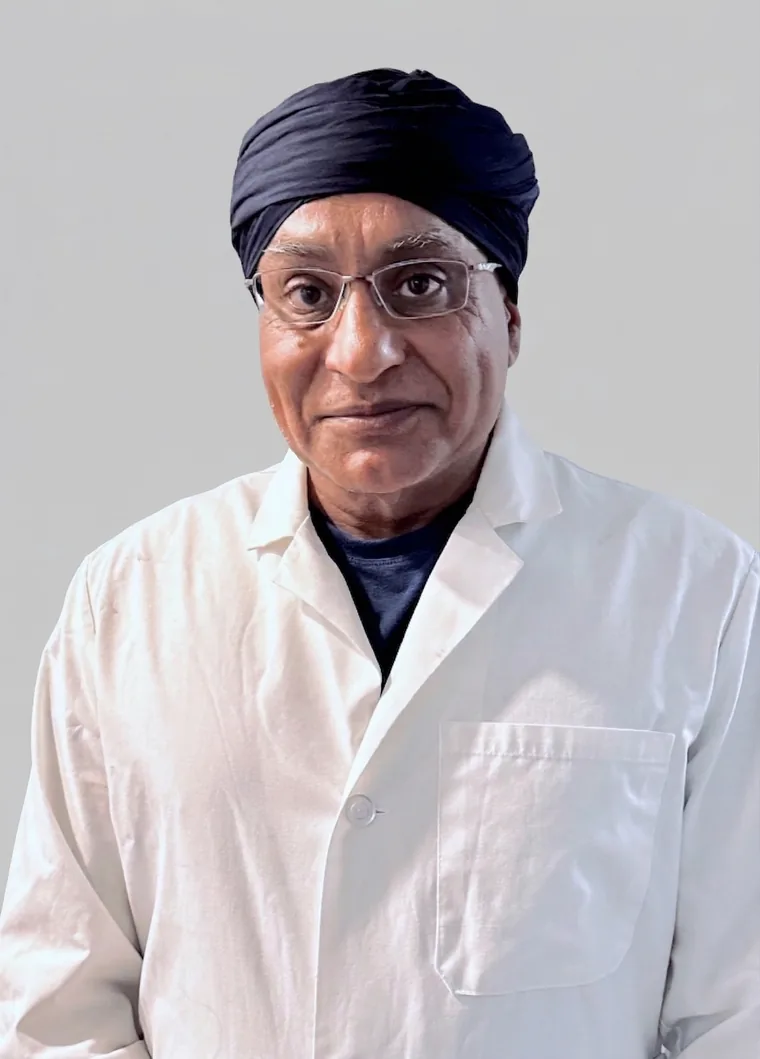
Neuropathy doctor · St. Louis
Dr. Gurpreet Singh Padda, MD, MBA, MHP, DABIPP, CPE
Dr. Gurpreet Singh Padda, MD, MBA, MHP, is the physician behind Regenerve’s root-cause approach to peripheral neuropathy. He treats the failing blood flow, metabolism and nerve biology that symptom drugs never touch.
What kind of doctor is best for neuropathy?
Peripheral neuropathy is rarely one disease. It is starving blood flow, unstable blood sugar, autoimmune attack and low nutrients, usually stacked on top of one another. A physician who treats only the pain signal will manage the symptom forever and never touch the cause.
What makes this mix rare is not the number of certifications. It is which ones sit together. Anesthesiology and pain medicine explain how a damaged nerve creates a signal and keeps it going. Obesity medicine and metabolic health explain why the nerve was damaged in the first place, because the largest single cause of peripheral neuropathy in this country is metabolic disease. Addiction medicine matters because so many people arrive after years on medicine that dulled the signal while the nerve kept getting worse.
Most neuropathy patients have seen physicians who hold one of these views. Few have seen one who holds all of them at once.
Is Dr. Padda board certified?
- Anesthesiology — Diplomate, American Board of Anesthesiology
- Pain Medicine — Diplomate, American Board of Pain Medicine
- Interventional Pain Management — Diplomate, American Board of Interventional Pain Management (DABIPP)
- Addiction Medicine — Diplomate, American Board of Addiction Medicine
- Obesity Medicine — Diplomate, American Board of Obesity Medicine
- Metabolic Health Practitioner — Diplomate, and the credential most directly relevant to diabetic and prediabetic neuropathy
- Fellow of Interventional Pain Physicians
- Certified Physician Executive — Diplomate, American College of Physician Executives
- Diplomate, National Board of Medical Examiners
Additional competency certification
- Regenerative Medicine in Interventional Pain Management (2024)
- Nutrition Network Advisor (2023)
- Controlled Substance Management competency certification (2010)
- Coding, Compliance and Practice Management competency certification (2009)
Licensed in Missouri (MD 100572), Illinois, Arizona, New Mexico, Georgia and Florida. Individual NPI 1427035955.
Education and training
- BA, Biology and MD — University of Missouri–Kansas City (1982–88)
- General Surgery residency — Cook County Hospital / University of Illinois–Chicago (1988–89)
- Anesthesia residency — Illinois Masonic Medical Center (1989–90)
- Anesthesia residency — Washington University–Barnes Hospital (1990–92), including Pediatric Anesthesia at St. Louis Children’s Hospital; Chief Resident 1991–92
- MBA, International Business Studies — Saint Louis University (1996–98)
- Certified Physician Executive — American College of Physician Executives (1998)
Academic appointments
Dr. Padda spent much of the 1990s in academic medicine at Saint Louis University and Cardinal Glennon. The work there was pediatric anesthesia and acute pain. In those patients, pain cannot be reliably self-reported. It has to be measured, not asked about. That habit of measuring is the same one applied to nerve function at Regenerve today.
- Assistant Professor of Anesthesiology, Saint Louis University (1992–99)
- Assistant Professor of Pediatrics, Saint Louis University (1993–99)
- Associate Director, Pediatric Anesthesiology and Director, Pediatric Acute Pain Management Service, Cardinal Glennon (1995–99)
- Deputy Director, Institutional Review Board, Saint Louis University (1998–99)
- Faculty, Psychiatry Residency Program, KCU Freeman Health System — pain and addiction (2024–present)
National presentations on metabolic disease and nerve pain
He gave two invited keynote talks to the American Society of Interventional Pain Physicians. They set out the idea behind the treatment approach here: chronic pain and metabolic disease are not separate problems that just happen to show up together.
- “Treating Metainflammation and Interventional Pain” — ASIPP, July 2020
- “Metabolic Inflammation and the Hedonic Treadmill” — ASIPP, New Orleans, July 2021
He has also presented at LowCarbUSA and Society of Metabolic Health Practitioners meetings between 2020 and 2025, on the metabolic causes of pain and nerve injury. For patients with diabetic neuropathy, this is the work that matters most. Its position is that nerve damage from metabolic disease is a metabolic problem first and a pain problem second. It is set out for patients on our science page.
Professional society leadership
- President, Missouri Society of Interventional Pain Physicians (2002–10, and 2023–present)
- Board Member and Examiner, American Board of Interventional Pain Physicians (2007–09)
- Board of Directors, American Society of Interventional Pain Physicians (2008–10)
Society memberships include the International Anesthesia Research Society, the American Society of Anesthesiologists, the Society for Pediatric Anesthesia, the American Society of Interventional Pain Physicians and the Association for Contextual Behavioral Science.
Publications and editorial work
Peer-reviewed work appears in Neuromodulation, Pain Medicine, Pain Physician, Critical Care Medicine, Anesthesia & Analgesia, Paediatric Anaesthesia, Ophthalmology, Dermatologic Surgery and the Southern Medical Journal. He serves as a review editor for PharmacoEconomics and is a coauthor of Next Level Your Life (2023).
Hospital affiliations
Anderson Hospital
Maryville, Illinois — full staff privileges.
SSM Health St. Clare Hospital
Fenton, Missouri — staff appointment.
Illinois licensure and Anderson Hospital privileges are why we treat patients from Maryville, Edwardsville, Glen Carbon, Collinsville and Troy here, instead of sending them back across the river.
How can I check Dr. Padda’s credentials?
Every claim on this page is checkable. We would rather you checked.
NPI Registry (NPPES) — NPI 1427035955 · Missouri Division of Professional Registration · the clinical reasoning behind the approach
Published research. His peer-reviewed record is registered under ORCID 0009-0001-0166-3186 and indexed at PubMed, OpenAlex and Semantic Scholar. His biographical record is Wikidata Q141049117.
Find Dr. Padda Online


Frequently asked questions
Does Dr. Padda personally see neuropathy patients?
Yes. The evaluation, the reading of nerve and blood-vessel tests, and the treatment plan are his. Regenerve is a one-physician practice by design. That is also why the schedule is limited.
Why does a pain physician hold obesity and addiction boards?
Because both conditions sit upstream of the nerve damage. Metabolic disease is the leading cause of peripheral neuropathy in the United States. Long-term opioid or gabapentinoid treatment is the most common thing a patient has already tried. Treating either one without understanding both tends to fail. See how neuropathy is evaluated here.
Is he affiliated with a hospital?
Yes — full staff privileges at Anderson Hospital in Maryville, Illinois, and a staff appointment at SSM Health St. Clare Hospital in Fenton, Missouri.
Where is the clinic?
4477 Woodson Road, Suite 104, St. Louis, MO 63134, next to Lambert Airport with on-site parking. Directions and hours are on the locations page.
Can Dr. Padda treat neuropathy patients from Illinois?
Yes. Dr. Padda is licensed in Illinois as well as Missouri, Arizona, New Mexico, Georgia and Florida. He holds full staff privileges at Anderson Hospital in Maryville, Illinois. That is why patients from Maryville, Edwardsville, Glen Carbon, Collinsville and Troy are treated at Regenerve instead of being sent back across the river. The clinic itself sits next to Lambert Airport in St. Louis.
Why doesn’t pain medication fix neuropathy?
Because pain medicine works on the signal, not on the reason the nerve is failing. Peripheral neuropathy is usually starving blood flow, unstable blood sugar, autoimmune attack or low nutrients, often stacked on top of one another. Many patients arrive after years on medicine that dulled the pain while the nerve kept getting worse. Treating only the pain signal manages the symptom forever and never touches the cause.
Where did Dr. Padda train?
Dr. Padda earned his biology degree and MD at the University of Missouri–Kansas City. He trained in anesthesia at Washington University–Barnes Hospital, where he was chief resident. Then he taught anesthesiology and pediatrics at Saint Louis University through the 1990s. He also holds an MBA from Saint Louis University. He is board certified in anesthesiology, pain, interventional pain, addiction and obesity medicine.
Board certifications and professional affiliations
Dr. Padda holds five board certifications. He keeps the professional affiliations below.
As Seen In
Our releases ran on AP News, The National Law Review, FOX 2 St. Louis and 570+ other news sites across the United States and Canada.
- 12press releases
- 4,600+news placements
- 580+news outlets
- 110+TV station sites
- AP News
- The National Law Review
- FOX 2 St. Louis
- WGN-TV Chicago
- PIX11 New York
- KRON 4 San Francisco
- Detroit Free Press
- The Detroit News
- The Indianapolis Star
- The Tennessean
- Milwaukee Journal Sentinel
- The Arizona Republic
- The Des Moines Register
- The Cincinnati Enquirer
Distributed by EIN Presswire for Nectar Media Group.
In the press
- Dr. Gurpreet Singh Padda, MD Puts the New Low-Carb Guideline to Work in Pain Care: Medicines Change Before Pain Does
EIN Presswire, October 7, 2026. A new low-carb guideline spells out which medicines, including insulin, diabetes pills and some drugs used for nerve pain, need a doctor’s adjustment in the first days of cutting carbohydrate. - Dr. Gurpreet Singh Padda, MD: Half of Diabetic Nerve Damage Causes No Symptoms, and It Still Causes Falls
EIN Presswire, September 24, 2026. For Falls Prevention Awareness Week: lost feeling in the feet raises the risk of a fall long before it hurts.
Start with the free Nerve Damage Score
Five large-print questions and a plain-language report by email — the first step toward a plan built on your biology rather than your symptom list.