

Neuropathy and heart disease are linked. In a 13-year national study of 7,116 US adults aged 40 and older, people with diabetes who had lost feeling in their feet had a 66 percent higher risk of dying of cardiovascular disease than people with diabetes whose feet tested normal [1]. The same sick fat and body-wide inflammation that injure small nerves also inflame arteries, and the feet are often where it shows first.
Your feet sit at the far end of the longest nerves you own. Those nerves are fed by the smallest blood vessels you own. When the chemistry of your blood turns hostile, the longest wire and the thinnest pipe fail first. That makes a burning or numb foot less a foot problem than an early report on the whole system, the heart included.
What did the national data show about numb feet and death?
The study used the National Health and Nutrition Examination Survey (NHANES), 1999 to 2004. Every participant had the same simple test: a thin nylon filament pressed against the sole of the foot. Overall, 13.5 percent could not feel it reliably. That was 27.0 percent of adults with diabetes and 11.6 percent of adults without it [1].
Over a median of 13 years, 2,128 participants died, 488 of cardiovascular causes. Deaths per 1,000 person-years ran 13.0 in people with neither diabetes nor neuropathy, 27.1 with diabetes alone, 34.3 with neuropathy alone, and 57.6 with both [1]. Neuropathy without diabetes carried a higher death rate than diabetes without neuropathy.
After adjusting for demographics and the standard cardiovascular risk factors:
- With diabetes, neuropathy meant a 49 percent higher risk of death from any cause (hazard ratio 1.49) and a 66 percent higher risk of cardiovascular death (1.66).
- Without diabetes, neuropathy meant a 31 percent higher risk of death from any cause (1.31). The cardiovascular figure, 1.27, did not reach statistical significance once the other risk factors were accounted for.
That second point deserves a plain reading. In people without diabetes, the heart-specific signal was smaller than the all-cause signal and could have been chance. The study also defined neuropathy by the filament alone and relied on self-reported heart disease [1]. The authors’ conclusion still stands on the all-cause numbers: decreased feeling in the foot may be an under-recognized risk factor for death, with or without diabetes.
Why would a nerve problem predict a heart problem?
Two reasons, and they stack.
The same soil feeds both. The Obesity Medicine Association’s 2026 clinical practice statement describes two ways excess fat drives cardiovascular disease. One is “fat mass disease,” the mechanical load of carrying it: more blood volume, a heart that has to work harder. The other is “sick fat disease,” or adiposopathy: fat tissue that has turned metabolically and immunologically abnormal and pushes out the drivers of type 2 diabetes, high blood pressure, abnormal lipids and clotting [2]. The idea of sick fat as a cardiovascular disease in its own right goes back more than a decade [3].
Sick fat does not keep its chemistry to itself. Nutrient overload switches on an immune response inside metabolic tissue, a slow, body-wide state researchers call metaflammation [4]. Its cytokines, chemokines and lipid signals are the same molecules that sensitize pain fibers and keep neuropathic pain going [5]. In the artery, they help build plaque. In the nerve, they help keep the small C-fibers firing. One fire, two places it burns.
Fat around the heart itself makes this personal. Epicardial fat sits directly on the heart muscle and the coronary arteries, with no barrier between them. When it turns harmful, it releases inflammatory and scarring signals straight into the tissue next to it, and it is tied to coronary disease, atrial fibrillation and heart failure [6].
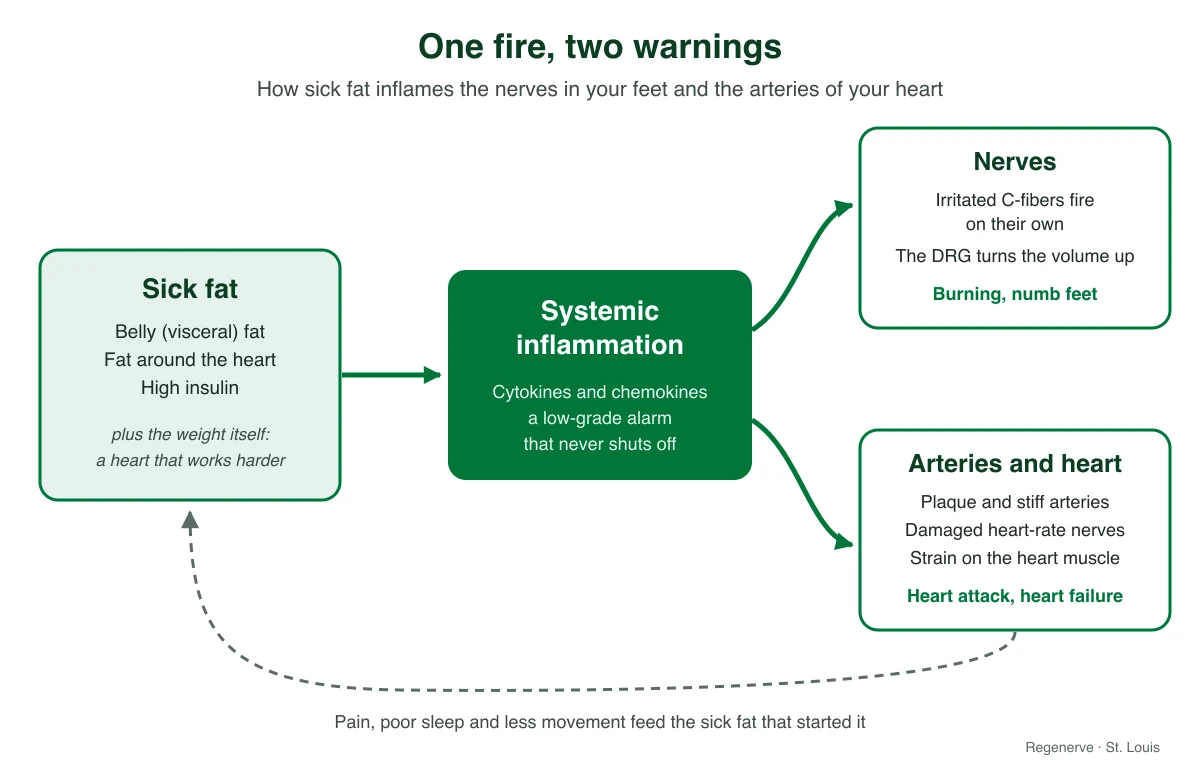
The nerves of the heart can be damaged too. Your heart rate and blood pressure are steered by autonomic nerves, the automatic wiring you never think about. The process that damages the nerves in your feet can damage these. That is cardiovascular autonomic neuropathy, and it is covered in autonomic neuropathy symptoms that get missed.
How much does damage to the heart’s nerves raise the risk?
A lot, and the more of it, the more risk. A meta-analysis of 15 studies in people with diabetes found that autonomic damage defined by two or more abnormal tests carried 3.45 times the risk of death. Defined by a single abnormal test, the relative risk was 1.20 [7].
The ACCORD trial looked at this in 8,135 adults with type 2 diabetes at high cardiovascular risk. Autonomic damage was read from heart-rate variability and a measure of the heart’s electrical recovery on a 10-second resting ECG. Over about three and a half years, people with that damage at the start were 1.55 to 2.14 times as likely to die, depending on the definition used, after full adjustment [8].
I have watched these nerves move in real time, on myself. I once wired myself to an EKG through a sauna heat experiment, pushed my own heart into bigeminy, an extra beat after every normal one, and reversed it with a cold plunge. I do not recommend that to anyone. The lesson stuck: the wiring that steers the heart answers to what you do to it, in both directions.
Does chronic pain itself raise heart risk?
The largest study to date says yes. Among 475,171 adults in the UK Biobank, followed for a median of 7 years, people with chronic widespread pain had a 48 percent higher risk of heart attack, stroke, heart failure or cardiovascular death than people without pain. Chronic pain in one area carried a 14 percent higher risk [9].
Those figures held after adjusting for established heart risk factors, physical activity, anxiety, depression, cancer, chronic inflammatory disease, pain and anti-inflammatory medicines, and income and education. Chronic pain accounted for about as much cardiovascular disease in that population as diabetes did: 8.6 percent against 7.3 percent [9].
A 2026 meta-analysis of 18 studies sharpened the picture. With the most complete adjustment, chronic widespread pain carried a 53 percent higher risk of atherosclerotic disease. The link to cardiovascular death was weaker and not statistically significant at full adjustment, and the studies varied widely [10]. So the strongest evidence is for arteries clogging, not yet for dying of it.
Biology is only part of why. Pain keeps people in a chair, wakes them at night and pulls them away from the people and places that kept them moving. Sitting, broken sleep and isolation are cardiovascular risks of their own, and a pain refugee usually carries all three. No adjustment in a study can fully separate them, and a treatment plan should not try to either.
What should someone with neuropathy check for their heart?
Start with the numbers that show the soil, not only the sugar. Bring this list to your physician, or ask us to run it:
- Fasting insulin, as an absolute number, and HOMA-IR. Insulin rises years before glucose does. In our clinic, a fasting insulin above 10 µIU/mL is high risk.
- LP-IR, the lipoprotein insulin-resistance score. It moves first, before the A1c rises.
- GGT. An under-used early marker of fatty liver. Our risk line is above 20 U/L, well under the lab’s “abnormal” flag.
- Oxidized LDL and the omega-3 index with the omega-6 to omega-3 ratio. Together they read the processed food that is driving the rest.
- High-sensitivity CRP. The inflammation reading: under 1 mg/L lower risk, 1 to 3 average, above 3 higher [11].
- B12 with methylmalonic acid or holotranscobalamin, and homocysteine. Serum B12 alone misses low-normal status, which injures nerves on its own.
- 25-hydroxy vitamin D.
Add three things that need no lab: your waist measurement, your blood pressure, and your resting heart rate. A resting pulse that stays fast, or dizziness every time you stand, is worth naming at the visit.
Our side of the workup, nerve conduction testing, skin biopsy when small fibers are the suspect, and balance testing, is described in EMG and nerve conduction testing. What we find about your heart risk goes to the physicians who manage it. Between visits, chronic care management keeps the numbers moving in the right direction.
What lowers both risks at once?
Treat the fat, not just the downstream numbers. That is the core of the 2026 statement, which calls for a “treat obesity first” approach aimed at both excess fat mass and sick fat [2]. The cardiovascular trials back it. In SELECT, 17,604 adults with overweight or obesity and established heart disease but no diabetes took semaglutide or placebo for a mean of almost 40 months. Heart attack, stroke or cardiovascular death occurred in 6.5 percent on semaglutide and 8.0 percent on placebo, a 20 percent relative reduction [12]. GLP-1 medicines may be part of your solution. Whether they fit is decided after the evaluation, with your labs in hand.
The rest is not optional, and it is not aftercare. Food built around protein, meat and fish, with real olive oil and no refined grains or industrial seed oils, lowers the insulin that keeps sick fat sick. Walking your feet can tolerate, even in short bouts, lowers it further, because working muscle pulls sugar out of the blood with less insulin. Sleep is when inflammation is supposed to settle. These are the treatment for the soil.
For the nerves themselves, our care goes after the three things that keep them hurting: inflammation around the nerve, irritated C-fibers, and an over-amplified dorsal root ganglion. That approach is laid out in regenerative neuropathy treatment. The deeper story of the inflammation is in systemic inflammation and nerve pain, and the weight story is in obesity and neuropathy. If belly fat will not move no matter what you do, start with the insulin explanation.
Numb feet are a warning you can act on years before a cardiologist would see anything. Most people get that warning and are handed a pill for the burning. Use it instead.
If you have chest pain, pressure, or sudden shortness of breath right now, call 911. This page is about long-term risk, not an emergency.
Questions patients ask about neuropathy and the heart
Does neuropathy mean I will have a heart attack?
No. It means your risk is higher than it looks on a standard checkup, and that the cause deserves a measured workup. Risk is a probability, and most of what drives it can be changed.
I have neuropathy but no diabetes. Does this apply to me?
Yes. In the national study, neuropathy without diabetes still carried a 31 percent higher risk of death from any cause. Many people with “unexplained” neuropathy turn out to have high insulin, prediabetes or a large waist, which is exactly why the labs above matter.
Can my heart be affected if my feet are numb but not painful?
Yes. The national study measured loss of feeling, not pain. Numbness signals failing nerve function, and that is the finding that tracked with mortality.
Sources
- Hicks CW, Wang D, Matsushita K, Windham BG, Selvin E. Peripheral Neuropathy and All-Cause and Cardiovascular Mortality in U.S. Adults : A Prospective Cohort Study. Ann Intern Med. 2021;174(2):167-174. doi:10.7326/M20-1340 (PMID 33284680)
- Bays HE, Varney C, Alexander L, Ng J, Tondt J, Weber C, et al. Obesity and Cardiovascular Disease: An Obesity Medicine Association (OMA) Clinical Practice Statement (CPS) 2026. Obes Pillars. 2026;20:100283. doi:10.1016/j.obpill.2026.100283 (PMID 42729919)
- Bays HE. Adiposopathy is “sick fat” a cardiovascular disease? J Am Coll Cardiol. 2011;57(25):2461-2473. doi:10.1016/j.jacc.2011.02.038 (PMID 21679848)
- Hotamisligil GS. Inflammation, metaflammation and immunometabolic disorders. Nature. 2017;542(7640):177-185. doi:10.1038/nature21363 (PMID 28179656)
- Ellis A, Bennett DLH. Neuroinflammation and the generation of neuropathic pain. Br J Anaesth. 2013;111(1):26-37. doi:10.1093/bja/aet128 (PMID 23794642)
- Iacobellis G. Epicardial adipose tissue in contemporary cardiology. Nat Rev Cardiol. 2022;19(9):593-606. doi:10.1038/s41569-022-00679-9 (PMID 35296869)
- Maser RE, Mitchell BD, Vinik AI, Freeman R. The association between cardiovascular autonomic neuropathy and mortality in individuals with diabetes: a meta-analysis. Diabetes Care. 2003;26(6):1895-1901. doi:10.2337/diacare.26.6.1895 (PMID 12766130)
- Pop-Busui R, Evans GW, Gerstein HC, Fonseca V, Fleg JL, Hoogwerf BJ, et al. Effects of cardiac autonomic dysfunction on mortality risk in the Action to Control Cardiovascular Risk in Diabetes (ACCORD) trial. Diabetes Care. 2010;33(7):1578-1584. doi:10.2337/dc10-0125 (PMID 20215456)
- Rönnegård AS, Nowak C, Äng B, Ärnlöv J. The association between short-term, chronic localized and chronic widespread pain and risk for cardiovascular disease in the UK Biobank. Eur J Prev Cardiol. 2022;29(15):1994-2002. doi:10.1093/eurjpc/zwac127 (PMID 35727954)
- Rönnegård AS, Schillemans T, Äng B, Boersma K, Ärnlöv J, Tseli E. Chronic widespread pain and the risk of cardiovascular disease-a systematic review and meta-analysis. Pain. 2026;167(6):1295-1307. doi:10.1097/j.pain.0000000000003965 (PMID 41972388)
- Pearson TA, Mensah GA, Alexander RW, Anderson JL, Cannon RO, Criqui M, et al. Markers of inflammation and cardiovascular disease: application to clinical and public health practice: A statement for healthcare professionals from the Centers for Disease Control and Prevention and the American Heart Association. Circulation. 2003;107(3):499-511. doi:10.1161/01.cir.0000052939.59093.45 (PMID 12551878)
- Lincoff AM, Brown-Frandsen K, Colhoun HM, Deanfield J, Emerson SS, Esbjerg S, et al. Semaglutide and Cardiovascular Outcomes in Obesity without Diabetes. N Engl J Med. 2023;389(24):2221-2232. doi:10.1056/NEJMoa2307563 (PMID 37952131)